Foxtail millet dahi: A gluten-free prebiotic
DOI:
https://doi.org/10.31783/elsr.2026.1213544Keywords:
dahi, enrichment, foxtail millet, sensory evaluationAbstract
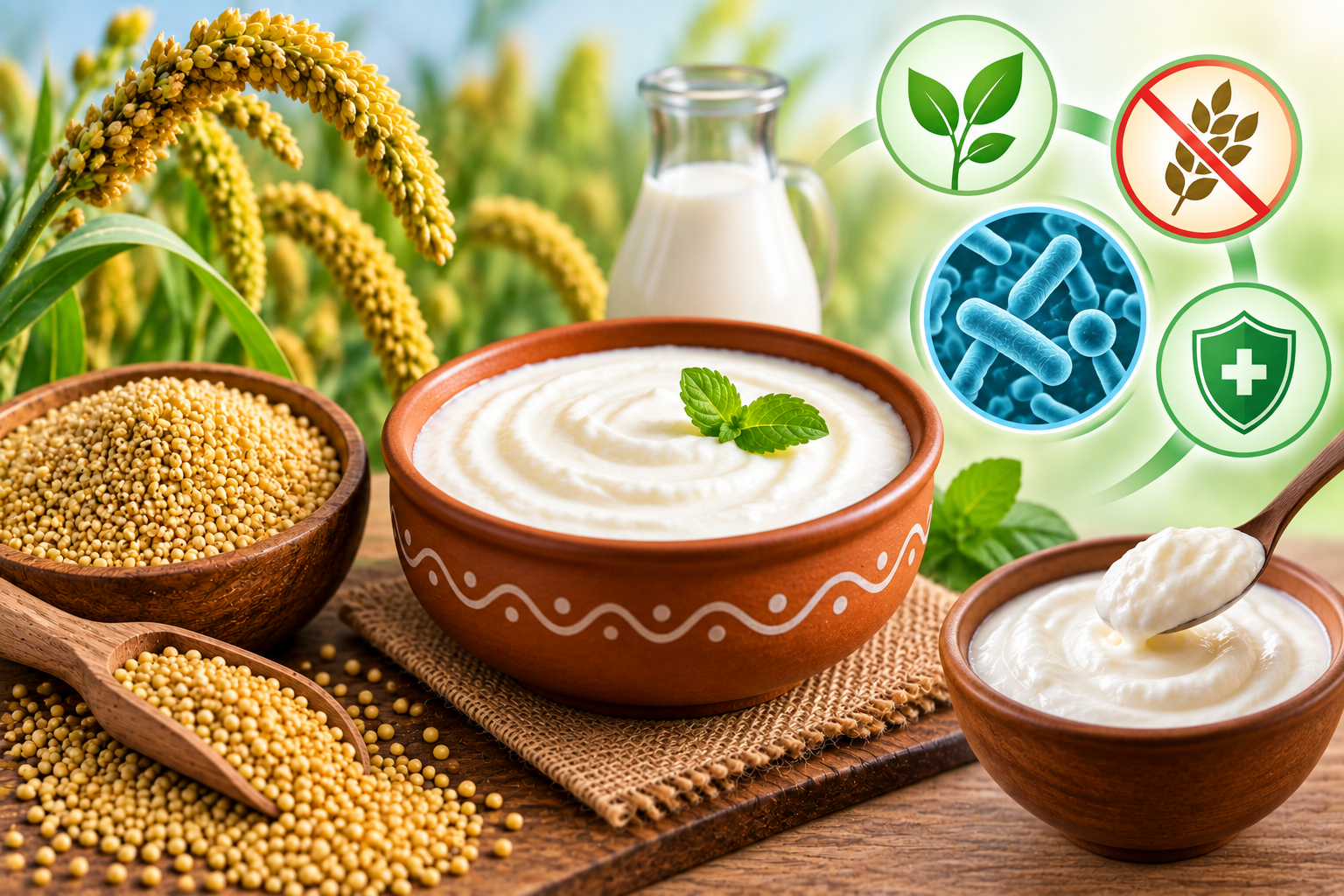
In this work, Dahi (Indian Curd) was produced by combining foxtail millet with whole milk. Physico-chemical and sensory properties in foxtail millet-enriched Dahi were found to have close similarities with those of marketed Dahi without enrichment. The sensory qualities in foxtail millet Dahi did not vary much with the marketed Dahi, except for the mouthfeel properties in some of the compositions. The measured pH and acidity values give the levels of fermentation, which were found to be similar to those of commercially available products. Additionally, the enriched Dahi also exhibited comparable water holding capacity, viscosity, firmness, and consistency in specific formulations. The microbial study indicated the presence of viable Bacillus sp. up to 7-8 days of aging. Throughout the storage period, no significant differences were observed in total titratable acidity and lactic acid bacteria count in the Dahi samples, and a highly acceptable sensory level was maintained.
References
[1] V. Fogliano and P. Vitaglione (2005). Functional foods: planning and development. Mol. Nutr. Food Res., 49: 256-262.
[2] D. F. Drinan, S. Robin and T. M. Cogan (1976). Citric acid metabolism in hetero- and homofermentative lactic acid bacteria. Appl. Environ. Microbiol., 31: 481-486.
[3] A. Liutkevicius, R. Narkevicius, V. Speicienė, G. Zaborskiene, D. Sekmokiene, A. Abaravicius and Z. Kucinskiene (2007). Study of milk and whey beverages with flaxseed oil. Food Chem. Technol., 41: 29-35.
[4] ICMR (2010). Nutrient requirements and recommended dietary allowances for Indians. A report of the expert group of the Indian Council of Medical Research. http://icmr.nic.in/final/RDA-2010.pdf. Accessed 20 Jan 2014.
[5] P. Behare, R. Singh and R. P. Singh (2009). Exopolysaccharide-producing mesophilic lactic cultures for preparation of fat-free Dahi-an Indian fermented milk. J Dairy Res., 76: 90-97.
[6] P. B. Devi, R. Vijayabharathi, S. Sathyabama, N. G. Malleshi and V. B. Priyadarisini (2014). Health benefits of finger millet (Eleusine coracana L.) polyphenols and dietary fiber: a review. J. Food Sci. Technol., 51: 1021-1040.
[7] J. Wang, H. Sun, S. Guo Y. Sun L.-Y. Kwok, H. Zhang and C. Peng (2021). Comparison of the effects of single probiotic strains Lactobacillus casei Zhang and Bifidobacterium animalis ssp. Lactis Probio-M8 and their combination on volatile and nonvolatile metabolomic profiles of yogurt. J. Dairy Sci., 104: 7509-7521.
[8] F. Remeuf, S. Mohammed, I. Sodini and J.P. Tissier (2003). Preliminary observations on the effects of milk fortification and heating on microstructure and physical properties of stirred yogurt. Int. Dairy J., 13: 773-782.
[9] S. Behera, F. A. El Sheikha, R. Hammami and A. Kumar (2020). Traditionally fermented pickles: how the microbial diversity associated with their nutritional and health benefits? J. Funct. Foods. 70: 103971. doi: 10.1016/j.jff.2020.103971.
[10] M. Beer, E. Arrigoni, D. Uhlmann, D. Wechsler and R. Amado (1991). Stability of polydextrose solutions to heat treatment and storage under acid conditions. Lebensmittel-Wissenschaft Technol., 24: 245-251.
[11] K. K. Tiihonen, H. Roytio, H. Putaala and A. C. Ouwehand (2011). Polydextrose functional fibre—improving digestive health, satiety and beyond. Nutrafoods. 10: 23-28.
[12] C. Beal, J. Skokanova, E. Latrille, N. Martin and G. Corrieu (1999). Combined effects of culture conditions and storage time on acidification and viscosity of stirred yoghurt. J Dairy Sci., 82: 673-681.
[13] F. Muskan, M. Redhu, S. Redhu and M. Rahimi (2025). Millets in the Global Market: a critical review of challenges and opportunities Food Prod. Process. Nutr., 7: 1-14. doi: 10.1186/s43014-025-00316-1.
[14] Q. Zhang, B. Yang, M. M. Brashears, Z. Yu, M. Zhao, N. Liu and Y. Li (2014). Influence of casein hydrolysates on exopolysaccharide synthesis by Streptococcus thermophilus and Lactobacillus delbrueckii ssp. bulgaricus. J. Sci. Food Agric., 94: 1366–1372.
[15] I. Amadou (2019). Millet based fermented beverages processing. In: A. M. Grumezescu, A. M. Holban (Eds). Fermented beverages. Woodhead Publishing. pp.433-472. doi: 10.1016/B978-0-12-815271-3.00011-7.
[16] T. M. Cogan, T. P. Beresford, J. Steele, J. Broadbent, N. P. Shah and Z. Ustunol (2007). Advances in starter cultures and cultured foods. J. Dairy Sci., 90: 4005-4021.
[17] J. B. Noffsinger, M. Emery, D. J. Hoch and J. Dokladalova (1990). Liquid chromatographic determination of polydextrose in food matrixes. J. Assoc. Off. Anal. Chem., 73: 51-53.
[18] P. Walstra, T. J. Geurts, A. Noomen, A. Jellema and M. A. J. S. Van Boekel (1999). Dairy technology: principles of milk properties and processes. New York: Marcel Dekker Inc; doi: 10.1201/9780824746414.
[19] J. B. Prajapati and V. Sreeja (2014). Dahi, related products—industry point of view. https://www.fnbnews.com/FB-Specials/Dahi-related-products--Industry-point-of-view-update.
[20] AOAC (2005). Official methods of analysis. The association of official analytical chemists. 8. Maryland: North Fredrick Avenue Gaithersburg. pp481.
[21] R. Pushkala and N. Srividya (2011). Influence of aloe gel enrichment on the physicochemical, textural and sensory characteristics of dahi. J. Food Sci. Eng., 1: 141-153.
[22] J. A. Lucey and H. Singh (1998). Formation and physical properties of acid milk gels: a review. Food Rev. Int., 30: 529-542.
[23] B. M. Watts, G. L. Ylimaki, L. E. Jeffery and L. G. Elias (1989). Basic sensory methods for food evaluation. Ontario: International Development Research Centre.
[24] H. S. Makelainen, H. A. Makivuokko, S. J. Salminen, N. E. Rautonen and A. C. Ouwehand (2007). The effects of polydextrose and xylitol on microbial community and activity in a 4-stage colon simulator. J Food Sci., 72: M153-M159.
[25] J. D. Estrada, C. Boeneke, P. Bechtel and S. Sathivel (2011). Developing a strawberry yoghurt fortified with marine fish oil. J. Dairy Sci., 94: 5760-5769.
[26] M. I. Foda, M. Abd El-Aziz and A. A. Awad (2007). Chemical, rheological and sensory evaluation of yoghurt supplemented with turmeric. Int. J. Dairy Sci., 2: 252-259.
[27] M. N. Hossain, M. Fakruddin and M. N. Islam (2012). Development of fruit dahi (yoghurt) fortified with strawberry, orange and grape juice. Am. J. Food Technol., 7: 562-570.
[28] A. Goyal, V. Sharma, M. K. Sihag, A. Singh, S. Arora, L. Sabikhi (2016). Fortification of dahi (Indian Yoghurt) with omega-3 fatty acids using microencapsulated flaxseed oil microcapsules. J Food Sci Technol., 53: 2422-2433.
[29] M. S. Hanif, T. Zahoor, Z. Iqbal, Ihsan-ul-Haq and A. M. Arif (2012). Effect of storage on rheological and sensory characteristics of cow and buffalo milk yogurt. Pak. J. Food Sci., 22: 61-70.
Downloads
Published
Issue
Section
License
Copyright (c) 2026 Author (s)

This work is licensed under a Creative Commons Attribution-NonCommercial-NoDerivatives 4.0 International License.
Copyright © The Author(s). This is an open access article distributed under the terms of the Creative Commons Attribution-NonCommercial-NoDerivatives 4.0 International License (CC BY-NC-ND 4.0), which permits unrestricted non-commercial use, distribution, and reproduction in any medium, provided the original author(s) and source are properly credited, and the work is not modified or adapted.