Yield and trace metal levels in colocasia (Colocasia esculenta L.)-potato (Solanum tuberosum L.) cropping sequence as influence by fly ash and fertilizer application
DOI:
https://doi.org/10.7324/ELSR.2017.3215Keywords:
Colocasia-potato cropping sequence, fly ash, lateritic soil, trace metalAbstract
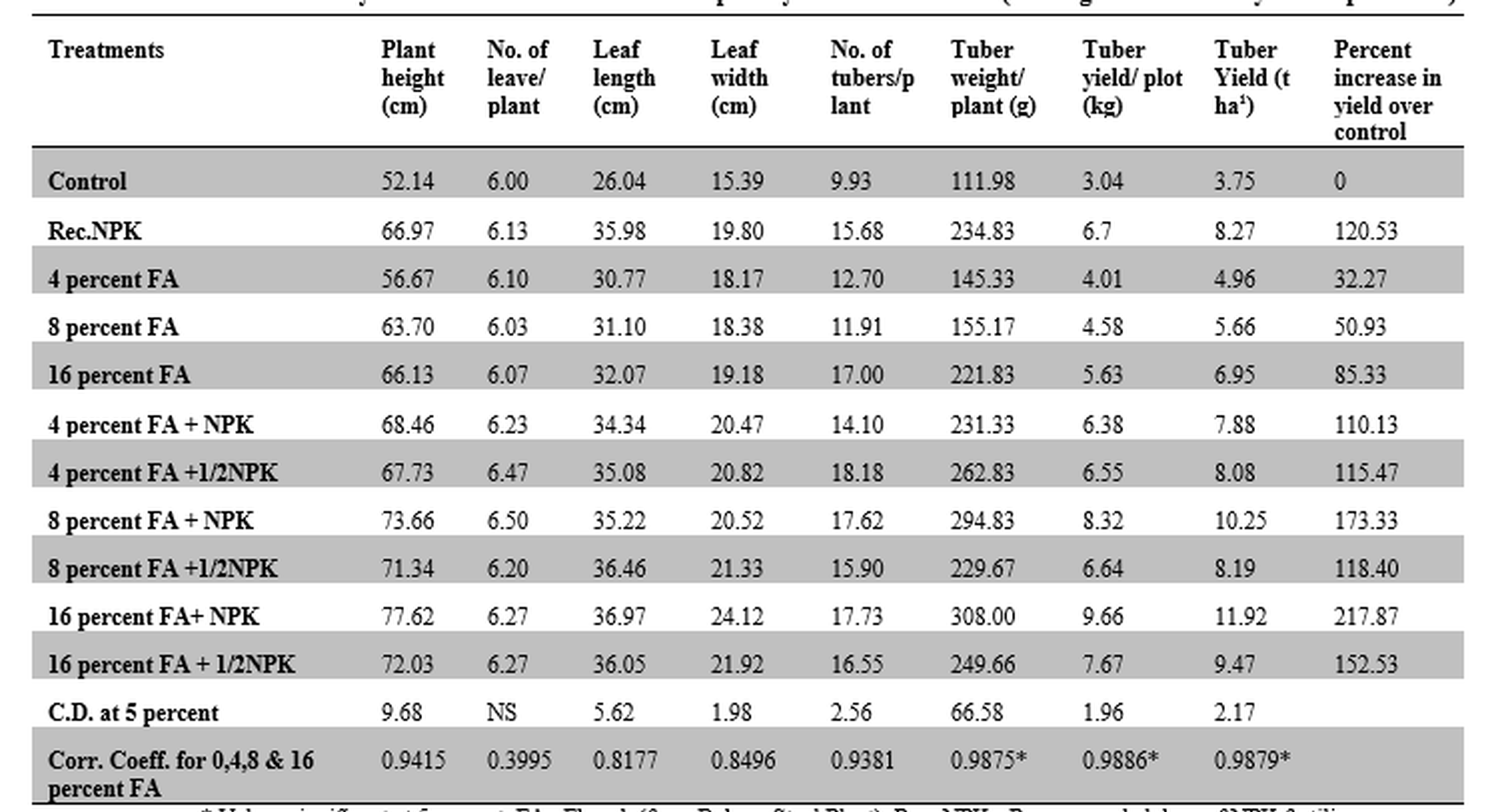
Experiments were conducted to see the effect of fly ash on growth, yield and quality of two tuber crops cropping sequence Colocasia and potato in red and lateritic soil of Chotanagpur Plateau. Result revealed a positive and significant effect of 4, 8 and 16 percent fly ash (w/w) incorporation in acidic soil (pH 5.9) on crop yield and on all growth attributes of both the tested vegetable crops. Tuber yield of Colocasia was recorded as 4.96, 5.66 and 6.95 t ha-1, respectively due to application of 4, 8 and 16% fly ash alone. Yield of Colocasia drastically increased over control and found higher (11.92 t ha-1) at 16% FA+NPK followed by 10.25 t ha-1 yield of Colocasia with 8% FA+NPK. Potato yield (22.39 t ha-1) was higher in 16% FA+NPK treatment followed by yield 20.63 t ha-1 at 8% FA+NPK applied treatment when grown on residual fly ash application. In control plot Pb, Co and Ni content were found 13.9, 15.2 and 5.0 mg kg-1, while at 16% fly ash application level, Pb, Co and Ni content were found 28.7, 35.6 and 15.7 mg kg-1, respectively in edible part of Colocasia (cormel). Fe (310 mg kg-1), Mn (28 mg kg-1), Zn (46.7 mg kg-1), Cu (35.8 mg kg-1), Pb (22.0 mg kg-1), Ni (20.9 mg kg-1) and Co (27.0 mg kg-1) content were higher in potato tuber, when grown on 16% residual fly ash in Colocasia-potato cropping sequence.
References
[1] N. Jamwal (2003). Is it all grey?. Down Earth 6: 38-41.
[2] R. N. Garg, H. Pathak, D. K. Das and R. K. Tomar (2005). Use of fly ash and biogas slurry for improving wheat yield and physical properties of soil. Environ. Monit. Assess., 107: 1-9.
[3] S. Dhadse, P. Kumari, and L. J. Bhagia (2008). Fly ash characterization, utilization and government initiatives in India – a review. J. Sci. Ind. Res., 67: 11-18.
[4] A. Kumar, A. K. Sarkar, R. P. Singh and V. N. Sharma (1998). Characterization of fly ash from Steel plant of Eastern India. J. Ind. Soc. Soil Sci., 46: 459-461.
[5] C. S. Piper (1966). Soil and Plant Analysis. Indian Edn. Hans Publisher, Bombay. http://krishikosh.egranth.ac.in/bitstream/1/2046590/1/9.pdf
[6] A. A. Elseewi, I. R. Straughan and A. L. Page (1980). Sequential cropping of fly ash - amended soil, effect on soil chemical properties and yield and elemental composition of plants. Sci. Total Environ., 15: 247-254.
[7] A. Kumar, A. K. Sarkar, R. P. Singh, and V. N. Sharma (1999). Effect of fly ash and fertilizer levels on yield and trace metal uptake by soybean and wheat crops. J. Ind. Soc. Soil Sci., 47: 744-748.
[8] A. Kumar, A. K. Sarkar, R. P. Singh, and V. N. Sharma (1998). Yield and trace metal levels in rice (Oryza sativa) as influenced by fly ash, fertilizer and FYM application. Ind. J. Agric. Sci., 68: 590-592.
Downloads
Published
Issue
Section
License
Copyright (c) 2017 Author (s)

This work is licensed under a Creative Commons Attribution-NonCommercial-NoDerivatives 4.0 International License.
Copyright © The Author(s). This is an open access article distributed under the terms of the Creative Commons Attribution-NonCommercial-NoDerivatives 4.0 International License (CC BY-NC-ND 4.0), which permits unrestricted non-commercial use, distribution, and reproduction in any medium, provided the original author(s) and source are properly credited, and the work is not modified or adapted.