
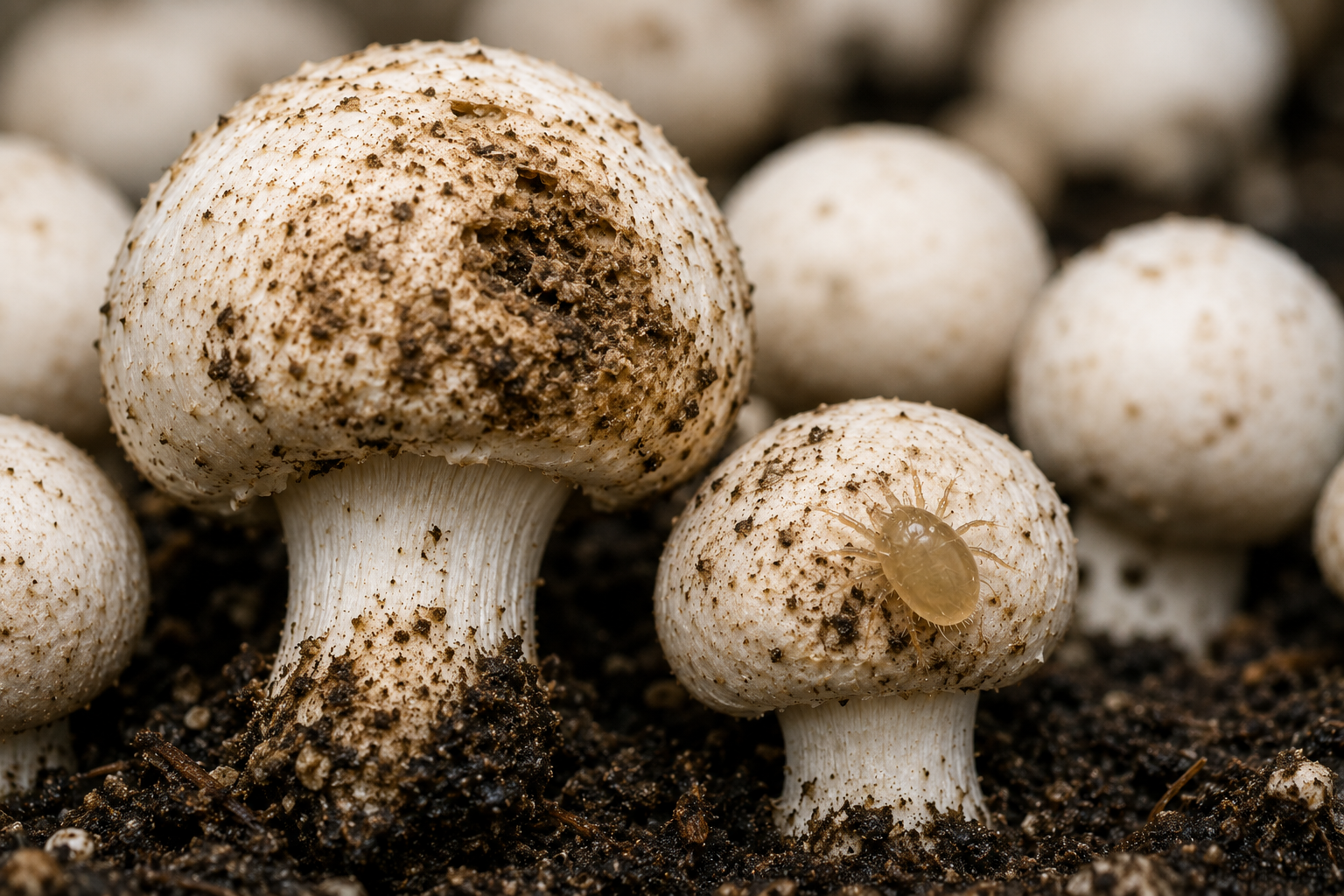
Damage potential of Tyrophagus putrescentiae Schrank (Acari: Acaridae) in mushrooms
DOI:
https://doi.org/10.7324/ELSR.2017.32615Keywords:
abiotic factors, diseases, mushrooms, mites, Tyrophagus putrescentiaeAbstract
Tyrophagus putrescentiae Schrank (Acari: Acaridae), is one of the most serious pests of high protein food including mushrooms. It is known to feed and disperse various pathogenic fungi in stored grain and products. It causes economic losses in stored products in addition to allergic disorder in workers handling stored products. Understanding T. putrescentiae multiplication on Agaricus bisporus compost, fruiting bodies, its role in transmission of disease is of paramount importance for the standardization of control measures. Documentation of the population abundance and selection of best compost for white button mushroom farming would open up new scope for farmers. Considering the above facts, efforts have been made to assemble the available literature in this article.
References
[1] R. Schuster (1956). Der Anteil der Oribatiden an den Zersetzungsvorg€angen im Boden. Z. Morphol. Okol. Tiere., 45: 1-33.
[2] N. Kaneko (1988). Feeding habits and cheliceral size of Oribatid mites in cool temperate forest soils in Japan. Rev. Ecol. Biol. Sol., 25: 353-363.
[3] M. Luxton (1972). Studies on the Oribatid mites of a Danish beech wood soil. I. Nutr. Biol. Pedobiologia, 12: 434-463.
[4] J. Smrz, H. Soukalova, V. Catska and J. Hubert (2016). Feeding pattern of Tyrophagus putrescentiae indicate that mycophagy is not a single category of nutritional biology. J. Insect Sci., 16: 1-8.
[5] G. Clancy (1981). Record of Caloglyphus sp. from cultivated mushrooms. Mushroom Sci., 11: 233-244.
[6] M. Singh (2011). Mushroom Production: An Agribusiness Activity. In: Mushroom-Cultivation, marketing and consumption (eds. Singh, M., Bhuvnesh, V., Kamal, S. and Wakchaure, G.C.), Directorate of Mushroom Research, ICAR, Solan (H.P.), 1-10.
[7] C. D. Thapa and P. K. Seth (1982). Mushroom mites and their control. Indian J. Mush., 8: 40-43.
[8] A. C. Davis (1938). Mushroom pests and their control. Cir. U.S. Department of Agriculture, Washington, D.C. P., 457pp.
[9] H. O. Chyichen (1999). Agricultural mite problems in Taiwan requiring additional studies. In held at Taiwan Agricultural Research Institute, Taiwan, March 24-25, 1999 (eds Chou Liang Yih and Lo Kang Chen). Chinese J. Entomology, 12: 121-135.
[10] F. P. Geels (1997). Rondetafel- bijeenkomst over Trichoderma. Champignoncultuur., 41: 13pp.
[11] P. L. Robertson (1959). A revision of the genus Tyrophagus, with a discussion on its Taxonomic position in the Acarina. Aust. J. Zool., 7: 146-182.
[12] R. L. Smiley (1987). Mites (Acari). In: Gorham, J.R. (Ed.), Insects and Mites in Food: An Illustrated Key. Agricultural Handbook No. 655, Volume 1, pp 3-44 U.S. Department of Agriculture, Washington, DC.
[13] Z. Kucerová and V. Stejskal (2009). Morphological diagnosis of the eggs of stored products mites. Exp. Appl. Acarol., 49: 173-183.
[14] K. Kheradmand, K. Kamali, Y. Fathipour and E. M. Goltapeh (2007). Development, life table and thermal requirement of Tyrophagus putrescentiae (Astigmata: Acaridae) on mushrooms. J. Stored Products Res., 43: 276-281.
[15] I. Sánchez-Ramos, F. Álvarez-Alfageme and P. Castañera (2007). Effects of relative humidity on development, fecundity and survival of three storage mites. Exp. Appl. Acarol., 41: 87-100.
[16] H. Pakyari and M. Maghsoudlo (2011). Development and life table of Tyrophgus putrescentiae (Astigmata: Acaridae) on Mushroom and Phytonematode. Academic journal of Entomology, 4: 59-63.
[17] P. Szafranek, M. Lewandowski and M. Kozak (2013). Prey preference and life tables of the predatory mite Parasitus bituberosus (Acari: Parasitidae) when offered various prey combinations. Exp. App. Acarol., 61: 53-67.
[18] B. Gurney and N. W. Hussey (1967). Pygmephonus species (Acariana: Pyemotidae) associated with cultivated mushrooms. Acatologia, 5: 121-155.
[19] A. D. Clift and R. B. Toffolon (1981a). Insects and mites associated with mushroom cultivation on three commercial farms near Sydney, NSW, Australia. Mush. Sci., 11: 537-549.
[20] A. D. Clift and R. B. Toffolon (1981b). Biology, fungal host preference and economic significance of two pymephorid mites (Acanina: Pygmephoridae) in cultivated mushroom. N.S.W., Australia, Mush. Sci., 11: 245-253.
[21] J. R. Gao, P. Zou and E. P. Ma (1986). Two new records of mushroom phymephorid mites from China (acari: Pygmephoridae) Acta Agric. Shanghai, 2: 27-32.
[22] C. P. Haines (1991). Insects and arachnids of tropical stored products: their biology and identification. Natural Resources Institute, Chatham Maritime, Kent, UK. 246 pp.
[23] W. X. Zou, X. F. Wang and H. Shi (1993). Ecological observation on Philomycus lilineatus and a preliminary study on its damage control. Chinese J. Zoology, 28: 5-8.
[24] M. G. Wu (1995). Controlling mites on mushrooms. Bulletin of Agricultural Sciences and Technology, Agricultural Bureau of Yicheng Country, Hubei 441400, China, 8 pp.
[25] A. Enkegaard, M. A. Sardar and H. F. Brodsgard (1997). The predatory mite Hypoaspis miles: biological and demographic characteristics on two prey species, the mushroom sciarid fly, Lyroriella solani, and the mould mite, Tyrophagus putrescentiae. Entomol. Exp. Appl., 82: 135-146.
[26] A. Gupta and S. K. Gupta (2004). Some new records of mites infesting stored grains in Kolkata and its neighborhood. Rec. Zool. Surv. India, 102: 77-82.
[27] R. Gulati, D. Singh and P. Bhatnagar (2009). Acarine fauna Associated with Agaricus bisporus compost. Mushroom Res., 18: 79-82.
[28] K. Okabe (1993). Population growth and depends behaviour of Histogaster sp. (Acari Acaridae) on several economically important fungi. Appl. Entomol. Zool., 28: 11-18.
[29] K. K. Chin and H.C. Yin (1996). An investigation of insect pest on the mushroom (Lentinus edode, Pleruotus osteatus) in south region of Korea. Korean Journal of Applied Entomology, 35: 45-51.
[30] S. Jess and J. F. Bingham (2004). Biological control of sciarid and phorid pests of mushroom with predatory mites from the genus Hypoaspis (Acari: Hypoaspidae) and the entomopathogenic nematode Steinernema feltiae. Bull. Entomol. Res., 94: 159-167.
[31] S. Cobanoglu and S. Bayram (1998). Mites (Acari) and flies (Insecta: Diptera) from natural edible mushrooms (Morchella: Ascomycetes) in Ankara, Turkey. Bulletin and Annales de la Societe Royale Belge d’Entomologie, 134: 187-198.
[32] N. Bahl, S. Ghai and D. Prasad (1981). Pest problems of button mushroom (Agaricus bisporus) (Alishatcs): 209. Third International Symposium on Plant Pathology, New Delhi, 14-18pp.
[33] R. S. Gill, G. S. Sandhu and M. S. Dhooria (1988). Studies on the pest and predatory status of mite Parasitus consanguineus Oudemans & Voigts (Parasitidae: Mesostigmata: Acari) occurring in Punjab. Indian J. Mushrooms, 14: 32-36.
[34] Anonymus (1974). Outbreaks and new records. Plant Protection Bulletin. FAO., 22: 48-51.
[35] N. W. Hussey, W. H. Read and J. J. Hesling (1969). The Pests of Protected Cultivation. The Biology and Control of Glasshouse and Mushroom Pests. Edward Arnold (Publisher) Ltd., London, 404 pp.
[36] P. Osborne and G. A. Hamilton (1966). Control of Tarsonemid Mites in Mushroom Sheds. Plant Pathol., 15: 140-141.
[37] P. Das (1986). Bionomics and control of mushroom mites. Ph.D. Thesis, BCKV, Kalyani, West Bengal.
[38] K. Okabe (1999). Vectoring of Hypocrea nigicans (Hypocreales: Hypocreaceae) by three fungivorus mite species (Acari: Acaridae). Exp. Appl. Acarol., 23: 653-658.
[39] D. W. Price (1976). Passage of veriticillum allo-gram populars through the alimentary canal of the mites. Phytopathology, 66: 46-50.
[40] O. Ali, R. Dunne and P. Brennan (1997). Biological Control of the sciarid fly, Lycoriella solani by the predatory mite, Hypoais miles (Acari: Laelapidal) in mushroom crops. Syst. Appl. Acarol., 2: 71-80.
[41] C. D. Thapa and P. K. Seth (1977). Occurrence of green mould (Trichoderma viridae) in mushroom beds causing Trichoderma spot on blotch of mushroom (Agaricus bisporus (lange) Sing.) Indian J. Mushrooms, 3: 26-30.
[42] J. S. Mignucci, C. Hernandez-Baco, L. Rivera-vargas, C. Betancourt and M. Alameda (2000). Diseases and Pests Research on Oyster musrhooms (Pleunotus spp.) in Puerto Rico. Int. J. Mushroom Sci., 3: 21-26.
[43] R. C. Castilho, G. J. de Moraesb, E. S. Silva, R. A. P. Freire and F. C. Da Eira (2009). The predatory mite Stratiolaelaps scimitus as a control agent of the fungus gnat Bradysia matogrossensis in commercial production of the mushroom Agaricus bisporus. Int. J. Pest Manage., 55: 181-185.
[44]D. Kropczyńska-Linkiewicz (1984). Roztocze (Acarida). In: Dmoch J, editor. Fauna Pieczarkarni w Polsce. Warszawa: Wydawnictwo SGGW; p. 32-53.
[45] E. S. Binns (1973). Predatory mites neglected allies?. Mushroom J., 12: 540-544.
[46] A. H. K. Al-Amidi and M. J. Downes (1990). Parasitus bituberosus (Acari: Parasitidae), a possible agent for biological control of Heteropeza pygmaea (Diptera: Cecidomyiidae) in mushroom compost. Exp. Appl. Acarol., 8: 13-15.
[47] P. Bussaman, A. Chandrapatya, R. W. Sermswan and P. S. Grewal (2004). Morphology, biology and behavior of the genus Pygmephorus (Acari: Heterostigmata), a new parasite of economic edible mushroom. In Proceedings of the 22th International Congress of Entomology, 15-21 August, Brisbane, Australia.
[48] A. Pardo, A. J. De Juan and J. Pardo (2004). Assessment of different casing materials for use as peat alternatives in mushroom cultivation. Evaluation of quantitative and qualitative production parameters. Span. J. Agric. Res., 2: 267-272.
[49] R. Snetsinger (1972). Biology and recognition of arthropod pests of the commercial mushroom. College of Agriculture Pennsyhania state University, p. 17.
[50] P. S. Barker (1967). The effects of high humidity and different temperatures on the biology of Tyrophagus putrescentiae (Schrank) (Acari: Tyroglyphidae). Can. J. Zool., 45: 91-96.
[51] F. Ottoboni, S. Mazzuccato, I. E. Rigamonti and. G. C. Lozzia (1993). Mites infesting flour and malt. Tec. Molitoria, 44: 673-676.
[52] I. Sanchez-Ramos and P. Castañera (2001). Development and survival of Tyrophagus putrescentiae (Acari: Acaridae) at constant temperatures. Environ. Entomol., 30: 1082-1089.
[53] M. Sarwar, X. Xuenong and W. Kongming (2010). Effects of different flour on the biology of the prey Tyrophagus putrescentiae (Schrank) (Acarina: Acaridae) and the predator Neoseiulus pseudolongispinosus (Xin, Liang and Ke) (Acari: Phytoseiidae). Int. J. Acarol., 36: 363-369.
[54] N. Ahmed, G. H. Rady, H. Abdelnabby, M. Weihua, S. Liu and M. Wang (2012). Damage effect of two storage mites (Acari: Acaridida) and their biology on the Shiitake mushroom (Lentinula edodes) at three constant temperatures. Int. J. Acarol., 38: 230-235.
[55] M. K. Nayak (2006). Psocid and mite pests of stored commodi¬ties: small but formidable enemies, In: Pro¬ceedings of the 9th International Working Conference on Stored Product Protection, (eds. Lorini, I., Bacaltchuk, B., Beckel, D., Deckers, E., Sundfeld, J.P., dos Santos, J.D., Biagi, J.C., Celaro, L.R.D.A., Faroni, L., Bortolini, O.F., Sartori, M. R., Elias, M.C. Guedes, R.N.C., da Fonseca, R.G. and Scussel, V.M.). Brazilian Post-harvest Association - ABRAPOS, Campinas, Brazil, 1061-1073 pp.
[56] M. Eaton and S. A. Kells (2009). Use of vapor pressure deficit to predict humidity and temperature effects on the mortality of mold mites, Tyrophagus putrescentiae. Exp. Appl. Acarol., 47: 201-213.
[57] A. D. Clift and M. A. Terras (1992). A simulation model to estimate effects of farm management and pest population on inoculation. 33: 421-426. Biological and Chemical Research Institute PMB, 10 Rydelmere, NSW 2116, Australia.
[58] S. A. Eraky (1995). Some biological aspects of Tyrophagus putrescentiae. In: The Acari Oficyna Dabor, (eds. Kropcyzynska, D., Boczek, J. and Tomczyk, A.), Warszawa., 127-133pp.
[59] M. C. J. Wicht (1970). Three new species of pyemotid mites associated with commercial mushroom. Acarologia, 12: 262-268.
[60] A. D. Clift (1978). The identify economic importance and control of insect pests of mushrooms in New SouthWales, Australia Mushroom Science., 10: 367-383.
[61] C. L. Van der Hoven, and A. Eicker (1989). The biology and control of a tyroglyphid mite, Caloghyde berlesei (Michael) on cultivated Agaricus bisporus in South Africa. http://www.isms.biz/braunschweig/volume-12-part-2-article-88/
[62] R. Broekhuizen (1938) Host Feeding damage and control of the mushroom pest, Brennandania Lambi (Acari: Pygmephoroidea) in China. Exp. Appl. Acarol., 17: 233-240.
[63] R. L. Berendsen, J. J. Baars, S. I. Kalkhove, L. G. Lugones, H. A. Wosten and P. A. Bakker (2010). Lecanicillium fungicola: causal agent of dry bubble disease in white-button mushroom. Mol. Plant Pathol., 11: 585-595.
[64] E. Dmowska, J. Dmoch, and K. Ilieva (1997). Early interaction of the bacterivorous nematode Rhabditis cucumeris and the edible fungus Agaricus bisporus in relation to time and quantity of nematode inoculation. Int. J. Mushroom Sci., 2: 15-23.
[65] B. Czajkowska (2002). Development of acarid mites on Fusarium oxysporum. Bull. Polish Acad. Sci., Biological Sciences, 50: 37-48.
[66] G. S. Gazeta, A. N. Norberg, A. E. Aboud-Dutra, and N. M. Serra-Freire (2000). Tyrophagus putrescentiae (Schrank, 1781) as a vector of pathogenic bacteria: laboratory observation. Entomologia y Vectores, 7: 49-55.
[67] D. L. Rinker (2002). Handling and using “spent” mushroom substrate around the world. In: Sánchez JE, Huerta G, Montiel E (eds) Mushroom biology and mushroom products. Impresos Júpiter, Cuernavaca, pp 43-60.
[68] A. Spillmann (2002). What’s killing the mushrooms of Pennsylvania? (A mushroom mistery). Agricultural Research, pp. 14-15.
[69] L. Kredics, L. García Jimenez, S. Naeimi, D. Czifra, P. Urbán, L. Manczinger, C. Vágvölgyi, and L. Hatvani (2010). A challenge to mushroom growers: the green mould disease of cultivated champignons. In: Current Research, Technology and Education Topics in Applied Microbiology and Microbial Biotechnology. FORMATEX, Badajoz, pp. 295-305. ISBN 978-84-614-6194-3.
[70] J. B. Akinyele, S. Fakoya and C. F. Adetuyi (2012). Anti-growth factors associated with Pleurotus ostreatus in a submerged liquid fermentation. Malays. J. Microbiol., 8: 135-140.
[71] L. P. Donini, E. Bernardi and J. S. Nascimento (2006). In vitro development of Agaricus brasiliensis in media supplemented with different brans. Pesqui. Agropecu. Brasil., 41: 995-999.
[72] F. J. Leiva-Lázaro, J. C. Saenz-Díez, E. Martínez, E. Jiménez, and J. Blanco (2015). Environmental impact of Agaricus bisporus mycelium production. Agric. Syst., 138: 38-45.
[73] M. H. Umar, and L. J. L. D. Van Griensven (1997). Morphological studies on the life span, developmental stages, senescence and death of fruit bodies of Agaricus bisporus. Mycol. Res., 101: 1409-1422.
[74] M. Foulongne-Oriol, P. Navarro, C. Spataro, N. Ferrer and J. M. Savoie (2014). Deciphering the ability of Agaricus bisporus var. burnettii to produce mushrooms at high temperature (25◦C). Fungal Genet. Biol., 73: 1-11.
[75] J. H. Linde, S. Combrinck, T. J. C. Regnier and S. Virijevic (2010). Chemical composition and antifungal activity of the essential oils of Lippia rehmannii from South Africa. S. Afr. J. Bot., 76: 37-42.
[76] R. T. Gahukar (2014). Mushroom pest and disease management using plant-derived products in the Tropics: A Review. Int. J. Vegetable Sci., 20: 78-88.
[77] J. T. Fletcher, B. Jaffe, S. Muthumeenakshi, A. E. Brown and D. M. Wright (1995). Variations in isolates of Mycogone perniciosa and in disease symptoms in Agaricus bisporus. Plant Pathology, 44: 130-140.
[78] S. R. Sharma and S. Kumar (2000). Studies on wet bubble disease of white button mushrooms (Agaricus bisporus) caused by Mycogone perniciosa. Science and cultivation of edible fungi. Proceedings of the 15th International Congress on the Science and Cultivation of Edible Fungi, Maastricht, Netherlands, 15-19 May, pp. 569-575.
[79] M. R. Franzolin, W. Gambale, R. G. Cuero and B. Correa (1999). Interaction between toxigenic Aspergillus flavus Link and mites (Tyrophagus putrescentiae Schrank)) on maize grains: effects on fungal growth and aflatoxin production. J. Stored Prod. Res., 35: 215-224.
[80] J. Hubert, J. Kopecky, M. A. Perotti, M. Nesvorna, H. R. Braig and M. Sagova-Mareckova et al. (2012). Detection and identification of species-specific bacteria associated with synanthropic mites. Microb. Ecol., 63: 919-928.
[81] A. H. K. Al-Amidi and R. Dunne and M. J. Downes (1991). Parasitus bituberosus (Acari Parasitidae)" An agent for control of Lycoriella solani (Diptera: Sciaridae) in mushroom crops. Exp. Appl. Acarol., 11: 159-166.
Downloads
Published
Issue
Section
License
Copyright (c) 2017 Author (s)

This work is licensed under a Creative Commons Attribution-NonCommercial-NoDerivatives 4.0 International License.
Copyright © The Author(s). This is an open access article distributed under the terms of the Creative Commons Attribution-NonCommercial-NoDerivatives 4.0 International License (CC BY-NC-ND 4.0), which permits unrestricted non-commercial use, distribution, and reproduction in any medium, provided the original author(s) and source are properly credited, and the work is not modified or adapted.