Incidence of Tetranychus urticae Koch on brinjal under field and screen house conditions
DOI:
https://doi.org/10.7324/ELSR.2017.321622Keywords:
brinjal, field, incidence, mite population, screen house, Tetranychus urticaeAbstract
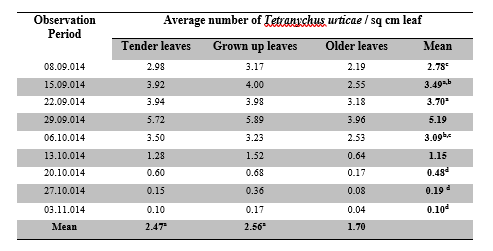
The incidence of Tetranychus urticae Koch, a two-spotted spider mite, was studied in brinjal ecosystem (Solanum melongena L.). Brinjal seeds (var. BR112) were raised in the Research Farm area, Department of Vegetable Science, CCS Haryana Agricultural University, Hisar during June 2014 and seedlings were transplanted during mid-July, 2014 in the field. In screen house, the crop was raised during mid-June, 2014. In field and screen house, two-spotted spider mite was recorded to study the population fluctuation on brinjal during the first week of September and continued until the first week of November 2014 at Hisar region. Different stages of T. urticae viz., eggs, larvae, nymphs and adults from ten randomly selected plants were recorded weekly on both ventral and dorsal surface of tender, grown up and older leaves of brinjal. The results revealed that the mite population showed a gradual increase until attainment of the peak in the last week of September 2014. The results clearly showed that 5.19 and 5.85 mites/sq cm leaf T. urticae population peak in the last week of September 2014 on brinjal plant under field and screen house conditions, respectively. Afterwards, a gradual decline in mite population was recorded until November. Mites showed a preference for grown-up leaves of brinjal as compared to tender and older leaves under field and screen house condition.
References
[1] T. Van Leeuwen, J. Vontas , A. Tsagkarakou, W. Dermauwa and L. Tirry (2010). Acaricide resistance mechanisms in the two-spotted spider mite Tetranychus urticae and other important Acari: A review. Insect Biochem. Mol. Biol., 40: 563-572
[2] D. G. James and T. S. Price (2002). Fecundity in two-spotted spider mite (Acari: Tetranychidae) increased by direct and systemic exposure to imidacloprid. J. Econ. Entomol., 95: 729-732.
[3] M. Haque, T. Islam, N. Naher and M. M. Haque (2011). Seasonal abundance of spider mite Tetranychus urticae Koch on vegetable and ornamental plants in Rajshahi. Univ. J. Zool. Rajshahi Univ., 30: 37-40.
[4] S. Farouk and M. A. Osman (2012). Alleviation of oxidative stress induced by spider mite invasion through application of elicitors in bean plants. Egyptian J. Biol., 14: 1-13.
[5] A. Migeon and F. Dorkeld (2007). Spider Mites Web: a comprehensive database for the Tetranychidae. http://www.montpellier.inra.fr/ CBGP/spmweb.
[6] Y. L. Park and J. H. Lee (2002). Leaf cell and tissue damage of cucumber caused by twospotted spider mite (Acari: Tetranychidae). J. Econ. Entomol., 95: 952-957.
[7] A. Khanna (1991). Bionomics of some important mite pests of vegetable crops at Hisar. M. Sc. Thesis, CCS HAU, Hisar.
[8] M.S. Dhooria (2003). Mite pests and their management in Punjab. In: Mites, their identification and management (eds. Yadav, P.R., Chauhan, R., Putatunda, B.N. and Chhillar, B.S.). CCS HAU, Hisar, India, pp 41- 48.
[9] M. F. Hoque, M. Khalequzzaman and W. Islam (2010). Population dynamics of Tetranychus urticae Koch and Phytoseilus persimilis Athias-henriot on three host plants. Pakistan J. Entomology, 32: 6-11.
[10] R. Gulati (2004). Incidence of Tetranychus cinnabarinus infestation on different varieties of Abelmoschus esculentus. Ann. Pl. Protec Sci., 12: 45-47.
[11] M. Geroh, R. Gulati, S. S. Sharma, H. D. Kaushik and D. R. Aneja (2010). Effect of abiotic stresses on population buildup of Tetranychus urticae Koch and its predator, Stethorus punctillum Weise on okra. Ann. Pl. Protec Sci., 18: 108-113.
[12] Kanika, R. Gulati and M. Geroh (2013). Influence of abiotic stresses on population dynamics of two spotted spider mite (Tetranychus urticae Koch) in Cucumber ecosystem. Ann. Pl. Protec Sci., 2: 242-246.
[13] T. Gotoh, K. Yamaguchi, F. Makiko and K. Mori (2004). Effect of temperature on life history traits of the predatory thrips, Scolothrips takahashii Priesner (Thysanoptera: Thripidae). Appl. Entomol. Zool., 39: 511-519.
[14] J. Razmjou, H. Tavakkoli and M. Nemati (2009). Life history traits of Tetranychus urticae Koch on three legumes (Acari: Tetranychidae). Mun. Ent. Zool., 4: 204-211.
[15] M. Khanamani, Y. Fathipour, H. Hajiqanbar and A. Sedaratian (2012). Reproductive performance and life expectancy of Tetranychus urticae (Acari: Tetranychidae) on seven eggplant cultivars. J. Crop Prot., 1: 57-66.
[16] M. Afzal and M. H. Bashir (2007). Influence of certain leaf characters of some summer vegetables with incidence of predatory mites of the family Cunaxidae. Pak. J. Bot., 39: 205-209.
[17] N. K. Dutta, S. N. Alam, M. K. Uddin, M. Mahmudunnabi and M. F. Khatun (2012). Population abundance of red spider mite in different vegetables along with its spatial distribution and chemical control in brinjal, Solanum melongena L. Bangladesh J. Agricul. Res., 37: 399-404.
[18] M. K. Tripathi, A. Kumar and D. K. Srivastava (2013). Seasonal incidence of mites, Tetranychus urticae Koch and T. ludeni Zacher on okra and brinjal crops. Ann. Pl. Protec Sci., 22: 52-55.
[19] Anonymous (1992). AICRP Agric. Acarol. Progr. Rep., UAS, GKVK, Bangalore. pp 85.
[20] Anonymous (1994). AICRP Agric. Acarol. Progr. Rep.,UAS, GKVK, Bangalore. pp 78.
[21] A. B. Rai, V. T. Vora and C. V. Patel (1995). Investigations on the integrated control of Tetranychus urticae (Acari: Tetranychidae) infesting brinjal in South Gujarat. In: Proceedings of fifth National Symposium on Acarology, Bangalore. pp 20-22.
[22] R. S. Patil (2005). Investigation on mite pests of solanaceous vegetable with special reference to brinjal. Ph.D. Thesis, University of Agricultural Sciences, Dharwad. http://krishikosh.egranth.ac.in/handle/1/69177
[23] K. P. Prasanna (2007). Seasonal incidence and management of tetranychid mites in brinjal. M.Sc. Thesis, University of Agricultural Sciences, Dharwad. http://krishikosh.egranth.ac.in/handle/1/77173
[24] M. Geroh (2007). Ecology and management of Tetranychus urticae Koch on okra, Abelmoschus esculentus L., M.Sc. Thesis, CCS HAU, Hisar.
[25] S. K. Gupta (1991). The mites of agricultural importance in India with remarks on their economic status. In: Dusbabek, F. & Bukva, V. (eds) Modern acarology. Academia, Prague, pp. 509-522.
Downloads
Published
Issue
Section
License
Copyright (c) 2017 Author (s)

This work is licensed under a Creative Commons Attribution-NonCommercial-NoDerivatives 4.0 International License.
Copyright © The Author(s). This is an open access article distributed under the terms of the Creative Commons Attribution-NonCommercial-NoDerivatives 4.0 International License (CC BY-NC-ND 4.0), which permits unrestricted non-commercial use, distribution, and reproduction in any medium, provided the original author(s) and source are properly credited, and the work is not modified or adapted.