Incidence of chilli mite, Polyphagotarsonemus latus (Banks) on chilli fruit parameters under field conditions
DOI:
https://doi.org/10.7324/ELSR.2017.322631Keywords:
chilli hybrids, fruit parameters, Polyphagotarsonemus latusAbstract
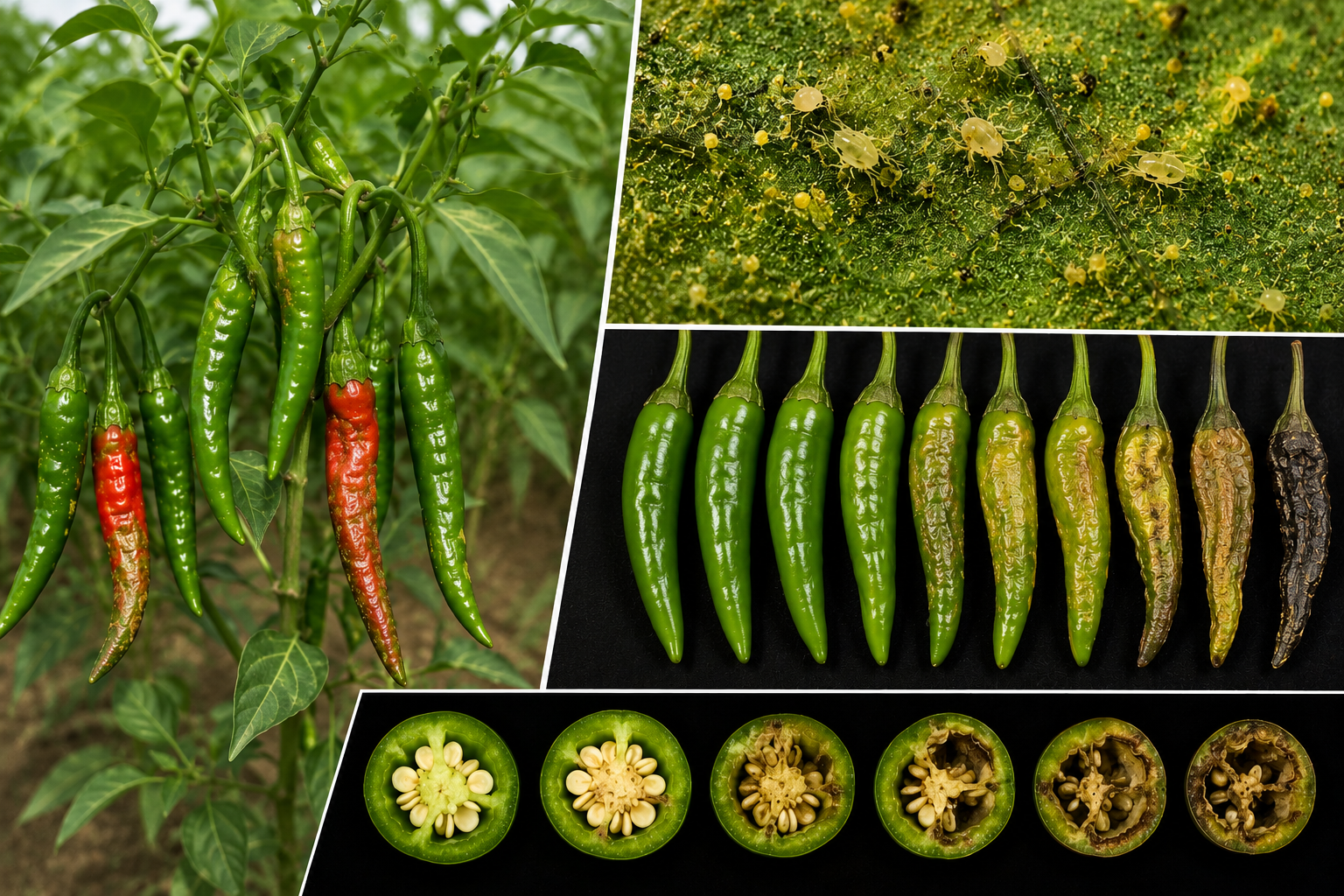
Fourteen chilli hybrids were raised to study the effect of phytophagous chilli mite, Polyphagotarsonemus latus (Banks) on fruit parameters of chilli at Research Farm Area, Department of Vegetable Sciences, CCS Haryana Agricultural University, Hisar (Haryana). Chilli mites are one of the major pests of vegetable, ornamental and fruit crops, causing considerable loss in yield. Correlation coefficient (r = -0.98) calculated between mite incidence and fruit length suggested an increase in mite population led to corresponding significant decrease in fruit length in fourteen chilli hybrids. Maximum average fruit length (6.50 cm) was recorded in hybrid 9/CHIhyb-10 with corresponding lowest mite count (2.53mites/leaf). In contrast, decreased fruit length was recorded in hybrids 10/CHIhyb-7 (2.50 cm) and 10/CHIhyb-6 (2.83 cm) with highest mite count of 6.28 and 5.70 mites/ leaf, respectively. Likewise, negative and highly significant correlation was recorded between mite incidence and fruit number (r = -0.98) and fruit yield/plant (r = -0.96).
References
[1] M. H. Tatagar, J. S. Awaknavar, R. S. Giraddi, H. D. Mohankumar, C. P. Mallapur and P. A. Kataraki (2011). Role of border crop for the management of chilli leaf curl caused due to thrips, Scirtothrips dorsalis (Hood) and mites, Polyphagotarsonemus latus (Banks). Karnataka Journal of. Agricultural. Sciences., 24: 294-299.
[2] V. Singhal (2003). Chillies. In Indian Agriculture, Indian Economic Data Research Centre, Mayapuri, New Delhi, pp. 565-570.
[3] M. de Coss-Romero and J. E. Peña (1998). Relationship of broad mite (Acari: Tarsonemidae) to host phenology and injury levels in Capsicum annuum. Florida Entomology, 81: 515-526.
[4] M. Roopa and C. T. A. Kumar (2014). Seasonal incidence of pests of capsicum in bangalore conditions of Karnataka, India. Global Journal of Biology, Agriculture and Health Sciences, 3: 203-207.
[5] R. S. Meena, O. P. Ameta and B. L. Meena (2013). Population dynamics of sucking pests and their correlation with weather parameters in chilli, Capsicum annum L. crop. The Bioscan, 8: 177-180.
[6] P. Vichitbandha and A. Chandrapatya (2011). Broad mite effects on chili shoot damage and yields. Pak. J. Zool., 43: 637-649.
[7] D. C. Borah (1987). Bioecology of Polyphngotarsonemus latus (Acari:Tarsonernidae) and Scirtorthrips dorsalis Hood (Thysanoptera: Thripidae) infesting chilli and their natural enemies. Ph.D.Thesis, University of Agricultural Sciences, Dharwad.
[8] A. Hosamani (2007). Management of chilli murda complex in irrigated ecosystem. Ph.D. (Agri.) Thesis, University of Agricultural Sciences, Dharwad.
[9] M. Manjunatha (1982). Bioecology and control of the spider mite, Tetranychus neocaledonicus Andre (Acari: Tetranychidae) on vegetables. M.Sc. (Agri) Thesis, University of Agricultural Sciences, Bangalore.
[10] G. V. P. Reddy, and P. Baskaran (1987). Biology and varietal preference of Tetranychus ludeni Zacher (Acari : Tetranychidae) on four varieties of eggplant Solanum Melongena L. Maysore J. Agric. Sci., 25: 331-321.
[11] R. van Maanen, E. Vila, M. W. Sabelis. and A. Janssen (2010). Biological control of broad mites (Polyphagotarsonemus latus) with the generalist predator Amblyseius swirskii. Exp. Appl. Acarol., 52: 29-34.
[12] D. N. R. Reddy and Puttaswamy (1984). Pest infesting chilli (Capsicum annuum L.) the nursery. Mysore J. Agric. Sci., 17: 122-125.
[13] A. S. M. Kamruzzaman, M. Z. Alam and M.R.U. Miah (2013). Effect of yellow mite, Polyphagotarsonemus latus (banks) density on hosts (Corchorus olitorius L.) phenology and assessment of yield loss under net house condition. Afr. J. Agric. Res., 8: 380-385.
Downloads
Published
Issue
Section
License
Copyright (c) 2017 Author (s)

This work is licensed under a Creative Commons Attribution-NonCommercial-NoDerivatives 4.0 International License.
Copyright © The Author(s). This is an open access article distributed under the terms of the Creative Commons Attribution-NonCommercial-NoDerivatives 4.0 International License (CC BY-NC-ND 4.0), which permits unrestricted non-commercial use, distribution, and reproduction in any medium, provided the original author(s) and source are properly credited, and the work is not modified or adapted.