Effect of different concentrations of sucrose on Alkaloids and Steroids production in vitro from Withania somnifera (L) Dunal (Ashwagandha)
DOI:
https://doi.org/10.7324/ELSR.2017.323236Keywords:
secondary metabolite compounds, sucroseAbstract
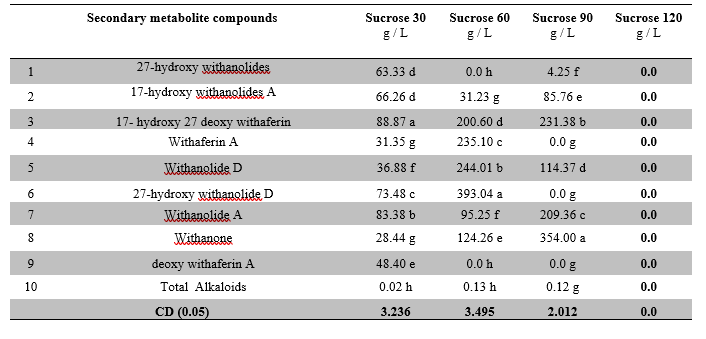
Present work has been conducted on Withania somnifera commonly known as Ashwagandha to study the influence of different sucrose concentrations on the production of high secondary metabolite compounds. With the addition of different sucrose concentrations 30, 60, 90 g / L to MS medium in in vitro conditions, production of secondary metabolite compounds increased. Ten compounds with different production rates were produced. Production rate of compound 17- hydroxy 27 deoxy withaferin, 27-hydroxy withanolide D and Withanone was maximum and significant under 30 g / L, 60 g / L, and 90 g / L sucrose treatment, respectively. However, MS medium containing 120 g / L sucrose led to burning of shoots and turned it in to brown.
References
[1] S. K. Kulkarni and A. Dhir (2008). Withania somnifera: An Indian ginseng. Prog Neuropsychopharmacol Biol Psychiatry., 32: 1093-1105.
[2] H. S. Puri (2002). Rasayana: Ayurvedic Herbs for Longevity and Rejuvenation (Traditional Herbal Medicines for Modern Times). 1sted. (London, England: CRC press). https://www.crcpress.com/Rasayana-Ayurvedic-Herbs-for-Longevity-and-Rejuvenation/Puri/p/book/9780415284899
[3] F. N. Hepper (1991). Old World Withania (Solanaceae): A taxonomic review and key to the species. In Solanaceae III: Taxonomy, Chemistry, Evolution.In Kew Bulletin.Hawkes, Lester, Nee, Estrada eds. (London, English: Royal Botanic Gardens Kew and Linnean Society), pp.785-788.
[4] I. Ilayperuma, W. D. Ratnasooriya and T. R. Weerasooriya (2002). Effect of Withania somnifera root extract on the sexual behaviour of male rats. Asian J Androl., 4: 295-298.
[5] D. J. Mabberley (2008). Mabberley's Plant-Book: a portable dictionary of plants, their classification and uses. (Cambridge, England: Cambridge University Press). http://www.cambridge.org/gb/academic/subjects/life-sciences/botanical-reference/mabberleys-plant-book-portable-dictionary-plants-their-classification-and-uses-4th-edition?format=HB#bLCAahr1x4kw7L67.97
[6] M. H. Mirjalili, E. Moyano, M. Bonfill, R. M. Cusido and J. Palazón (2009). Steroidal Lactones from Withania somnifera, an Ancient Plant for Novel Medicine. Molecules. 14: 2373-2393.
[7] Anonymous (1976). In The Wealth of India, (Raw Materials); CSIR: New Delhi, India.; 10, 580-585.
[8] K. Bone (1996).Clinical Applications of Ayurvedic and Chinese Herbs: Monographs for the Western Herbal Practitioner. (Warwick, Australia: Phytotherapy Press).
[9] L. C. Mishra, B. B. Singh and S. Dagenais (2000). Scientific Basis for the Therapeutic Use of Withania somnifera (Ashwagandha): A Review. Altern. Med. Rev., 5: 334-346.
[10] R. Asthana and M. K. Raina (1989). Pharmacology of Withania somnifera (L.) Dunal-a review. Indian Drugs, 26: 199-205.
[11] S. Singh and S. Kumar (1998). Withania somnifera: The Indian Ginseng Ashwagandha; Central Institute of Medicinal and Aromatic Plants: Lucknow, India. https://www.cabdirect.org/cabdirect/abstract/19980309657
[12] M. I. Choudhary, S .Yousuf and A. U. Rahman (2013). Withanolides: Chemistry and antitumor activity. In Natural Products; Ramawat, K.G., Merillon, J.M., Eds.; Springer-Verlag: Berlin, Germany; Heidelberg, Germany, 2013; pp. 3465-3495.
[13] M. Elsakka, E. Grigorescu, U. Stănescu, U. Stănescu and V. Dorneanu (1990). New data referring to chemistry of Withania somnifera species. Rev. Med. Chir. Soc. Med. Nat. Iasi., 94: 385-387.
[14] D. N. Majumdar (1955). Withania somnifera Dunal. Part II: alkaloidal constituents and their chemical characterization. Ind. J. Pharm., 17: 158-161.
[15] P. U. Devi, A. C. Sharada, F. E. Solomon, M. S. Kamath (1992). In vivo growth inhibitory effect of Withania somnifera (Ashwaganda) on a transplantable mouse tumor, Sarcoma 180. Indian J. Exp. Biol., 30: 169-172.
[16] P. U. Devi (1996). Withania somnifera Dunal (Ashwaganda): Potential plant source of a promising drug for cancer chemotherapy and radio sensitization. Indian J. Exp. Biol., 34: 927-932.
[17] U. Supe, F. Dhote and M. G. Roymon (2006). In Vitro plant regeneration of Withania somnifera. Plant Tissue Cult. Biotech., 16: 11-115.
[18] A. Niyaz and E. N. Siddiqui (2014). Seed Germination of Withania somnifera (L.) Dunal. European J. Medicinal Plants, 4: 920-926.
[19] T. Murashige and F. Skoog (1962). A Revised Medium for Rapid Growth and Bioassay with Tobacco Tissue Cultures. Physiol. Plant, 15: 473-497.
[20] E. Rodel and R. A. Fisher (1971). Statistical Methods for Research Workers, 14. Aufl., Oliver & Boyd, Edinburgh, London 1970. XIII, 362 S., 12 Abb., 74 Tab., 40 Biometrical J., 13: 429-430.
[21] M.W. Fowler (1983). Commercial application and economic aspects of mass plant cell culture, In: Mantel SH & Smith H (Eds.), Plant Biotechnology, Cambridge University Press, Cambridge, 75-108.
[22] M. Pavia and J. Janick (1983). In vivo and in vitro production of alkaloids in Theobroma cacao L., Acta Hortic., 131: 265-274. https://doi.org/10.17660/ActaHortic.1983.131.31
[23] R. Wijnsma, R. Verpoorte, P. A. A. Harkes, T. B. Van Vliet, H. J. Hoopen and A. B. Svendse (1986). The influence of initial sucrose and nitrate concentrations on the growth of Cinchona ledgeriana cell suspension cultures and the production of alkloids and anthraquinones. Plant Cell, Tissue and Organ Culture, 7: 21-29.
[24] J. M. Dupraz, P. Christen and I. Kapetandis (1994). Tropane alkaloids in transformed roots of Datura quercifolia. , Planta med., 60: 158-162.
[25] F. Vázquez-Flota, O. Moreno-Valenzuela, M. L. Miranda-Ham, J. Coello-Coello and V.M. Loyola-Vargas (1994). Catharanthine and ajmalicine synthesis in Catharanthus roseus hairy root cultures. In: Schripsema J., Verpoorte R. (eds) Primary and Secondary Metabolism of Plants and Cell Cultures III. Springer, Dordrecht.
[26] T. Matsumoto, K. Okunishi, K. Nishida, M. Noguchi and E. Tamaki (1971). Studies on the culture conditions of higher Plant cells in suspension cultyre. Part II. Effect of nutritional factors on the growth. Agric. Biol. chem., 35: 543-551.
[27] C. Gertlowski and M. Petersen (1993). Influence of the carbon source on growth and rosmarinic acid production in suspension cultures of Coleus blumei. Plant Cell Tiss. Org. Cult., 34: 183-190.
[28] L. D. Kapoor (2001). Handbook of Ayurvedic Medicinal Plants; CRC Press: London, UK, pp. 337-338.
[29] Atta-ur-Rahman, S. A. Jamal, M. I. Choudary and E. Asif (1991). Two withanolides from Withania somnifera. Phytochemistry, 30: 3824-3826.
[30] Atta-ur-rahman, S. Abbas, Dur-E-Shahwar, S. A. Jamal and M. I. Choudhary (1993). New withanolides from Withania spp. J. Nat. Prod., 56: 1000-1006.
[31] M. I. Choudary, S. Abbas, A. S. Jamal and Atta-ur-Rahman (1996). Withania somnifera- A source of exotic withanolides. Heterocycles, 42: 555-563.
[32] R. P. Rastogi and B. N. Mehrotra (1998). Compendium of Indian Medicinal Plants. 2nd Reprint, Central Drug Research Institute, Lucknow and National Institute of Science Communication, Council of Scientific and Industrial Research, New Delhi, 434-436.
[33] M. Bandyopadhyay, S. Jha and D. Tepfer (2007). Changes in morphological phenotypes and withanolide composition of Ri-transformed roots of Withania somnifera. Plant cell Rep., 26: 599-609.
[34] C. K. Atal,. O. P. Gupta, K. Ranghunathan and K. L. Dhar (1975). Pharmacognosy and Phytochemistryof withania somnifera. Central Council for Research in IndianMedicine and Homeopathy, New Delhi, India.
[35] Anonymous (2004). Monograph: Withania somnifera. Altern. Med. Rev., 9: 211-214.
[36] K. Y. Sahwar, M. Sabah and A. S. Muhammad (2000). Detection, Purification and Quantification of the Vanxtrin Compound in Callus Cells of Catharanthus Roseus, J. Biotechnology Res., 2: 53-52.
Downloads
Published
Issue
Section
License
Copyright (c) 2017 Author (s)

This work is licensed under a Creative Commons Attribution-NonCommercial-NoDerivatives 4.0 International License.
Copyright © The Author(s). This is an open access article distributed under the terms of the Creative Commons Attribution-NonCommercial-NoDerivatives 4.0 International License (CC BY-NC-ND 4.0), which permits unrestricted non-commercial use, distribution, and reproduction in any medium, provided the original author(s) and source are properly credited, and the work is not modified or adapted.