
Can sweat glands act as temporary or permanent replacement for the excretory function of kidney?
DOI:
https://doi.org/10.31783/Keywords:
excretion, nephron, sweat glandAbstract
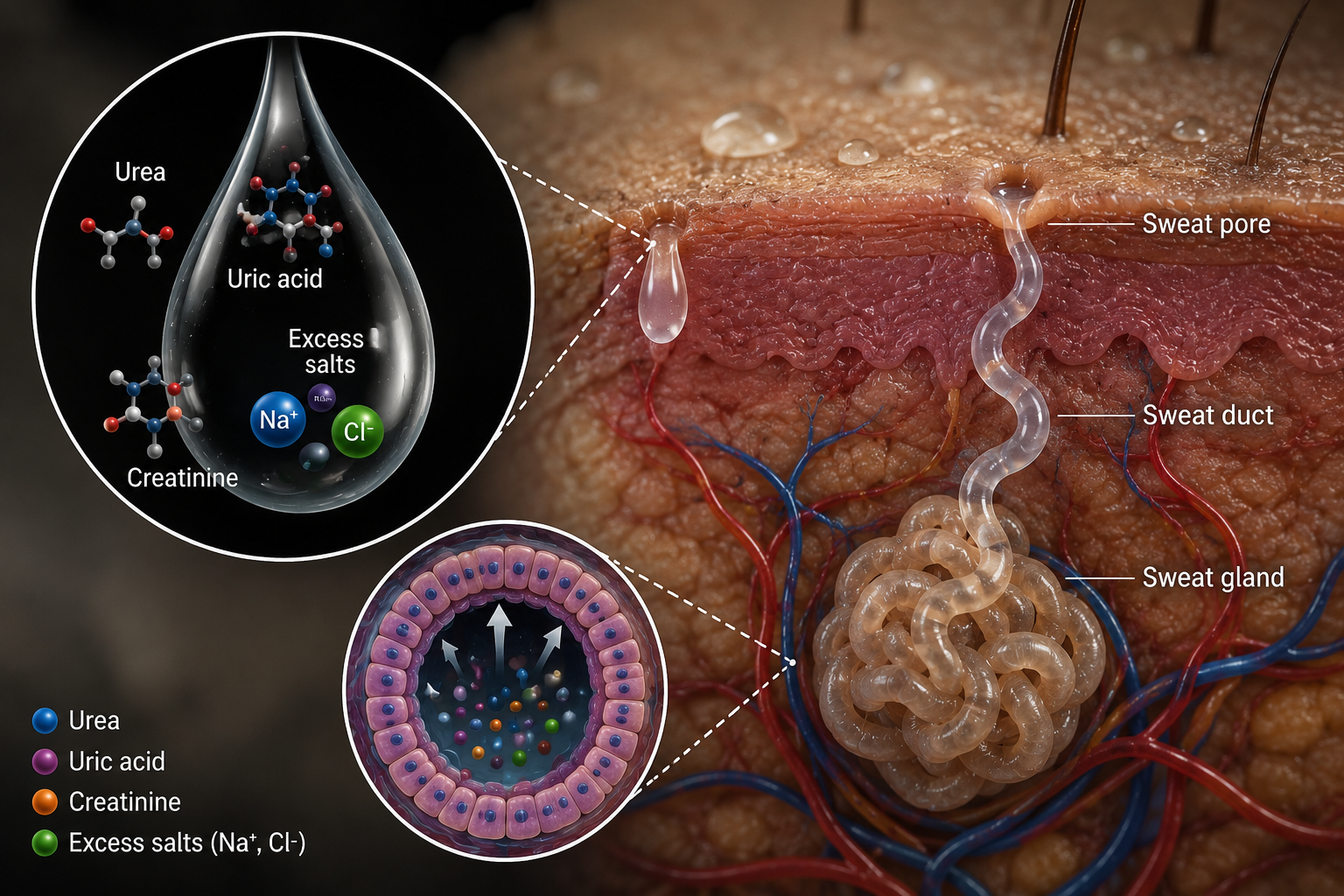
Uremic frost – the powdery whitish substance, comprising urea and uric acid salts, on the skin of some patients with end stage kidney disease could be an attempt by the sweat glands to take over the function of the failing kidneys. Currently end stage kidney disease is managed mainly by hemodialysis and eventually kidney transplantation. Kidneys are primarily the organs for excretion of metabolic wastes. A normal kidney contains 800,000 to 1.5 million nephrons. This excretory function, which is essential for life, consists of filtration and selective reabsorption / secretion to produce urine. The major nitrogenous waste in urine is urea. The sweat glands are basically organs of thermoregulation. However, they are also involved in excretion of metabolic wastes. The total number of sweat glands lies between 1.6 and 4.5 million. There are anatomical and physiological similarities between the nephron – the functional unit of the kidney and the sweat gland. This article proposes a functional similarity between the two. Anatomically, the sweat gland bears some resemblance to the nephron. A nephron has 2 basic components, the glomerulus and the tubules. Similarly, the sweat gland has a secretory unit consisting of a base rolled into a glomerulus, and a duct that carries the sweat away. Both the kidneys and the sweat glands excrete nitrogenous wastes, water and electrolytes. The hypothesis is that the skin, via the sweat glands, constitutes an alternative excretory organ to the kidneys, though probably minor, and thus could act as temporary or permanent replacement for the kidneys.
References
[1] M. Anthea, R. L. J. Hopkins, C. W. McLaughlin, S. Johnson, M. Q. Warner, D. LaHart, J. D. Wright (1993). Human Biology and Health (1993). Englewood Cliffs, New Jersey, USA: Prentice Hall. ISBN 0-13-981176-1. OCLC 32308337
[2] G. Pocock and C. D. Richards (2006). Human physiology: the basis of medicine. 3rd ed. Oxford Core Texts. Oxford: Oxford University Press. ISBN 9780198568780.
[3] A. C. Guyton and J. E. Hall (2006). Textbook of Medical Physiology. Ser. ISBN 0-7216-0240-1. Elsevier.
[4] W. F. Ganong (2003). Expression error: Missing operand for Review of Medical Physiology ISBN 0-07-140236-5.
[5] K. Kurosumi, S. Shibasaki and T. Ito (1984). Cytology of the Secretion in Mammalian Sweat Glands. Int. Rev. Cytol., 87: 253-329.
[6] S. S. G. S. Anatomy (2005). The anatomical basis of clinical practice. Churchill Livingstone, New York.
[7] H. H. Mosher (1933). Simultaneous Study of Constituents of Urine and Perspiration. J. Biol. Chem. 99: 781-790.
[8] G. E. Folk and A. Semken (1991). The evolution of sweat glands". Int. J. Biometeorol., 35: 180-186.
[9] T. Kameia, T. Tsudab, S. Kitagawab, K. Naitoha, K. Nakashimaa, T. Ohhashi (1998). Physical stimuli and emotional stress-induced sweat secretions in the human palm and forehead. Analytica Chimica Acta, 365: 319-326.
[10] L. B. Baker , K. A. Barnes , M. L. Anderson , D. H. Passe and J. R. Stofan (2016) . Normative data for regional sweat sodium concentration and whole-body sweating rate in athletes. J. Sports Sci., 34: 358-68.
[11] G. W. Mack and E. R. Nadel (1996). Body fluid balance during heat stress in humans. Comprehensive Physiology.
[12] S. J. Montain, S. N. Cheuvront and H. C. Lukaski (2007). Sweat mineral-element responses during 7 h of exercise-heat stress. Int. J. Sport Nutr. Exerc. Metab., 17: 574-582.
[13] E. A. Emmett (1978). The excretion of traces of metals in human sweat. Ann. Clin. Lab. Sci. 8: 270-275.
[14] R. Saraymen, E. Kılıç, S. Yazar (2004). Sweat Copper, Zinc, Iron, Magnesium and Chromium Levels in National Wrestler. İnönü Üniversitesi Tıp Fakültesi Dergisi, 11: 7-10.
[15] A. J. Bandodkar, V. W. Hung, W. Jia, G. Valdés-Ramírez, J. R. Windmiller, A. G. Martinez, J. Ramirez, G. Chan, K. Kagan, J. Wang (2013). Tattoo-based potentiometric ion-selective sensors for epidermal pH monitoring. Analyst, 138: 123-128.
[16] Pilocarpine. Medlineplus: US National Library of Medicine. Accessed 29 March 2016.
[17] W. C. Randall (1946). Quantitation and Regional Distribution of Sweat Glands in Man. J. Clin. Invest. 25: 761-767.
[18] J. C. Fasciolo, G. L. Totel, and R. E. Johnson (1969). Antidiuretic hormone and human eccrine sweating. J. Appl. Physiol. 27: 303-307.
Downloads
Published
Issue
Section
License
Copyright (c) 2017 Author (s)

This work is licensed under a Creative Commons Attribution-NonCommercial-NoDerivatives 4.0 International License.
Copyright © The Author(s). This is an open access article distributed under the terms of the Creative Commons Attribution-NonCommercial-NoDerivatives 4.0 International License (CC BY-NC-ND 4.0), which permits unrestricted non-commercial use, distribution, and reproduction in any medium, provided the original author(s) and source are properly credited, and the work is not modified or adapted.