
Comparison of GHG emissions between efficient and inefficient broiler farms in Kaduna state of Nigeria using Data Envelopment Analysis (DEA): environmental sustainability
DOI:
https://doi.org/10.7324/ELSR.2017.325466Keywords:
broiler, DEA, efficient vs. inefficient, environment, GHG emissionAbstract
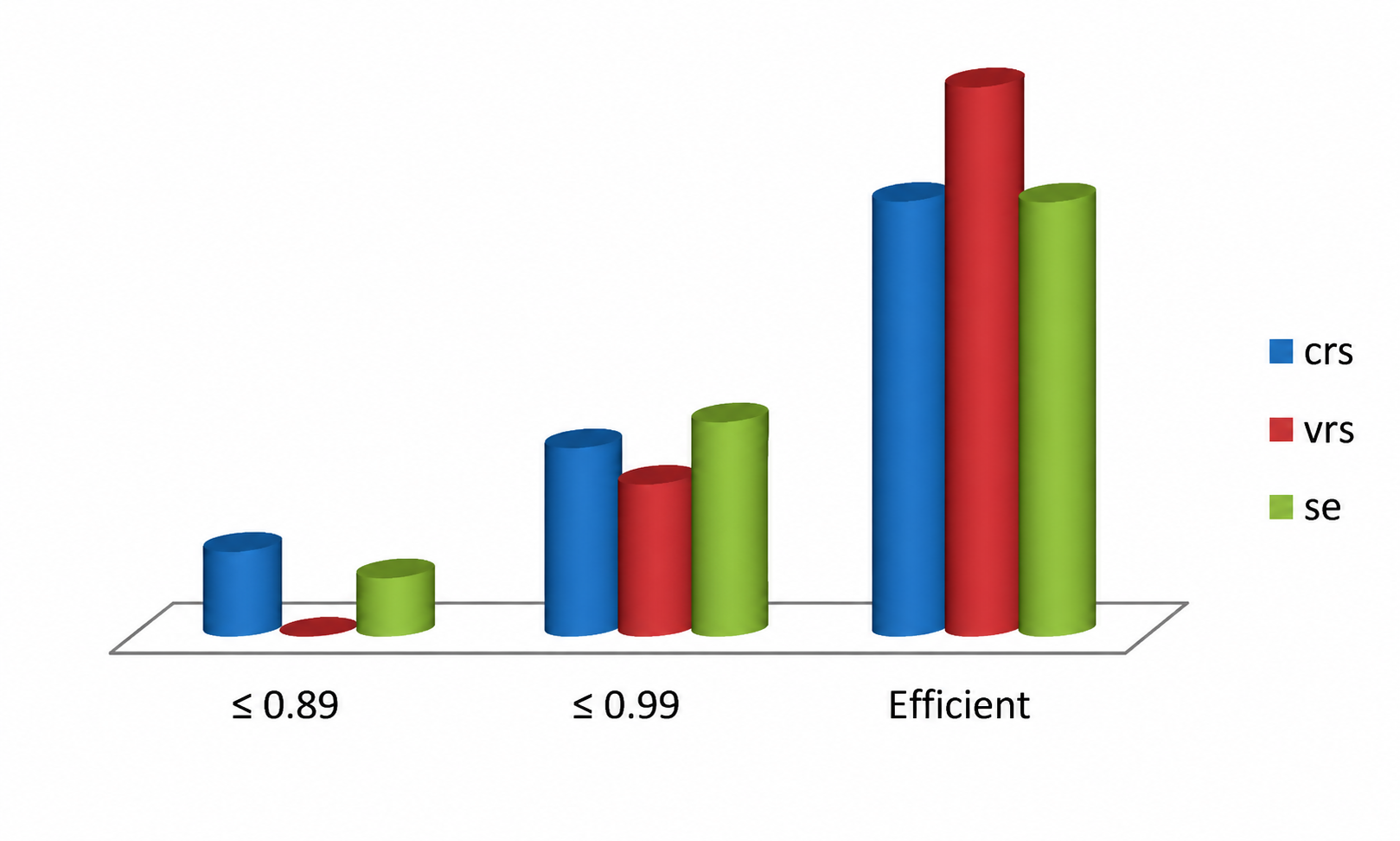
This study applied a non-parametric method in determining the efficiency of farmers, discriminating efficient farmers from inefficient ones, and identifying wasteful uses of energy in order to optimize the energy inputs for broiler production. Furthermore, the effect of energy optimization on greenhouse gas (GHG) emission was investigated and the total amount of GHG emission of efficient units was compared with inefficient units. A total sample size of 55 broiler farmers were selected from Kaduna State viz. multi-stage sampling technique. Total energy used in various operations during broiler production was 77916.14 MJ (500bird)-1. Results revealed that 63% of producers were technically efficient, while 43 producers under PTE were identified efficient (79.6%). Additionally, it was concluded that 1.38 percent [1071.54 MJ (500birds)-1] of overall input energies can be saved if the performance of inefficient farms rose to a high level. Finally, comparative results of GHG emissions revealed that the amount of CO2 emissions in efficient units was less than inefficient farms.
References
[1] M. D. Heidari, M. Omid and A. Akram (2011). Optimization of energy consumption of broiler production farms using Data Envelopment Analysis Approach. Mod. Appl. Sci., 5: 69-78
[2] S. H. Pishgar-Komleh, M. Ghahderijani and P. Sefeedpari (2012). Energy consumption and CO2 emissions analysis of potato production based on different farm size levels in Iran. J. Clean. Prod., 33: 183-191.
[3] S. H. Pishgar-Komleh, M. Omid and M. D. Heidari (2013). On the study of energy use and GHG (greenhouse gas) emissions in greenhouse cucumber production in Yazd Province. Energy, 59: 63-71.
[4] A. Mohammadi, S. Rafiee, A. Jafari, T. Delgaard, M. T. Knudsen, and A. Keyhani (2013). Potential greenhouse gas emission reductions in soybean farming: a combined use of life cycle assessment and Data Envelopment Analysis. J. Clean. Prod., 54: 89-100.
[5] B. Khoshnevisan, S. Rafiee, M. Omid and H. Mousazadeh (2013a). Comparison of GHG emissions of efficient and inefficient potato producers based on Data Envelopment Analysis. J. Agri. Engi. Biotech., 1: 81-88.
[6] B. Khoshnevisan, S. Rafiee, M. Omid and H. Mousazadeh (2013b). Reduction of CO2 emission by improving energy use efficiency of greenhouse cucumber production using DEA approach. Energy, 55: 676-682.
[7] P. Qasemi-Kordkheili and A. Nabavi-Pelesaraei (2014). Optimization of energy required and potential of greenhouse gas emissions reductions for nectarine production using Data Envelopment Analysis Approach. Int. J. Ener. Environ., 5: 207-218
[8] A. Nabavi-Pelesaraei, R. Abdi, S. Rafiee and H. Ghasemi-Mobtaker (2014).Optimization of energy required and greenhouse gas emissions analysis for orange producers using Data Envelopment Analysis Approach. J. Clean. Prod., 65: 311-317.
[9] M. S. Sadiq, I. P. Singh, A. Suleiman, M. A. Isah, S. M. Umar and A. M. Maude et al., (2015). Application of data envelopment analysis (DEA) in determining GHG emission and carbon sequestration in small-scale maize production in Niger State, Nigeria. Agricultural and Bionutritional Res., 1: 1-19
[10] M. S. Sadiq, I. P. Singh, S. A. Makama, S. M. Umar, M. A. Isah and I. J. Grema (2016). Agrarian crisis and steps to combat it: Evidence of GHG emission (CO2) in sesame production in Jigawa State, Nigeria. Indian Journal of Economics and Development, 12: 73-80.
[11] T. Coelli (1996). A Guide to DEAP Version 2.1: A Data Envelopment Analysis (Computer) Program. Centre for efficiency and productivity analysis. University of New England, Australia. http://www.owlnet.rice.edu/~econ380/DEAP.PDF
[12] W. W. Cooper, L. M. Seiford and K. Tone (2006). Introduction to Data Envelopment Analysis and its uses: with DEA-solver software and references. Springer Science and Business Media.
[13] R. D. Banker, A. Charnes and W. W. Cooper (1984). Some models for estimating technical scale inefficiencies in data envelopment analysis. Manage Sci., 30: 1078-1092.
Downloads
Published
Issue
Section
License
Copyright (c) 2017 Author (s)

This work is licensed under a Creative Commons Attribution-NonCommercial-NoDerivatives 4.0 International License.
Copyright © The Author(s). This is an open access article distributed under the terms of the Creative Commons Attribution-NonCommercial-NoDerivatives 4.0 International License (CC BY-NC-ND 4.0), which permits unrestricted non-commercial use, distribution, and reproduction in any medium, provided the original author(s) and source are properly credited, and the work is not modified or adapted.