Microscopic features and chromatographic fingerprints of selected congolese medicinal plants: Aframomum alboviolaceum (Ridley) K. Schum, Annona senegalensis Pers. and Mondia whitei (Hook.f.) Skeels
DOI:
https://doi.org/10.7324/ELSR.2018.410110Keywords:
microscopic features, phytochemical screening, traditional medicineAbstract
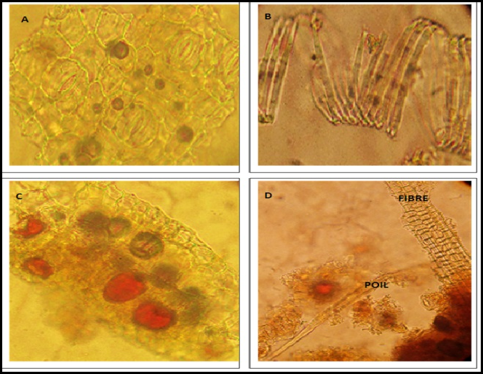
Nearly 80% of people depend on the traditional medicines for their primary health care according to the World Health Organization. In fact, the study of plant chemistry is still a relevant subject despite its antiquity. The main objective of this study was to determine the microscopic features of different Congolese taxa and to determine their chromatographic fingerprints. Three plant species used notably were: Aframomum alboviolaceum (Ridley) K. Schum., Annona senegalensis Pers. and Mondia whitei. The microscopic features of these plants were carried out along with their phytochemical screening by thin layer chromatography and the spectrophotometric determination of various secondary metabolites contained in these plant species. The microscopic study of A. Alboviolaceum, A. senegalensis and M. whitei revealed the presence of paracytic stomata, fibers, fragments of spiral bundles, non-glandular hairs, parenchyma with numerous starch grains, secreting hairs, fragments of punctuated vessels, as well as lignified fibers. Thin layer chromatographic analysis revealed the presence of flavonoids, phenolic acids, coumarins, anthraquinones, anthocyanins, tannins, irridoids, and the absence of alkaloids in all three plants. In the light of these results, it would be desirable to pursue thorough phytochemical studies in order to isolate the bioactive compounds and elucidate their structures.
References
[1] G. Bongo, C. Inkoto, C. Masengo, C. Tshiama, E. Lengbiye, R. Djolu and M. Kapepula et al. (2017). Antisickling, Antioxidant and Antibacterial Activities of Afromomum alboviolaceum (Ridley) K. Schum, Annona senegalensis Pers. and Mondia whitei (Hook. f.) Skeels. Am J. Lab. Med., 2: 52-59.
[2]. C. Muthu C., M. Ayyanar M., N. Raja N.. and S. Ignacimuthu (2006). Medicinal plants used by traditional healers in Kancheepuram District of Tamil Nadu, India. J. Ethnobio. Ethnomed., 2: 43. doi: 10.1186/1746-4269-2-43.
[3]. P. Iserin (2001). Encyclopédie des plantes médicinales. Identification-Préparation-pharmacologie. Etudiants et professionnels paramédicaux. 4eme Edition, pp. 426.
[4]. T. Bahorun., B. Gressier, F. Trotin, C. Brunet, T. Dine, M. Luyckx and J. Vasseur et al. (1996). Oxygen species scavenging activity of phenolic extracts from hawthorn fresh plant organs and pharmaceutical preparations. Arzneimittelforschung, 46: 1086-1089.
[5]. K. N. Ngbolua, S. O. Mihigo, C. I. Liyongo, M. C. Ashande, D. S. T. Tshibangu, B. G. Zoawe and R. Baholy et al. (2016). Ethno-botanical survey of plant species used in traditional medicine in Kinshasa city (Democratic Republic of the Congo), 3: 413-427.
[6] C. Orwa, A. Mutua, R. Kindt, R. Jamnadass and A. Simons (2009). Agroforestree Database:a tree reference and selection guide version 4.0 (http://www.worldagroforestry.org/af/treedb/).
[7] A. O. Aremu, L. Cheesman, J. F. Finnie and J. Van Staden (2011). Mondia whitei (Apocynaceae): A review of its biological activities, conservation strategies and economic potential. South Afri. J. Bot., 77: 960-971.
[8]. J. Bruneton (1999). Pharmacognosie, Phytochimie et Plantes médicinales. Edition Technique et Documentation-Lavoisier, 3e édition, Paris, 421- 499.
[9]. P. Tiwari, B. Kumar, M. Kaur, G. Kaur and H. Kaur (2011). Phytochemical Screening and Extraction: A review. Int. Pharmac, Scienc. 1: 98-106.
[10]. P.M. Kapepula, P.M. Mungitshi, T. Franck, A. Mouithys-Mickalad, D.M. Ngoyi, P.D.T. Kalenda and N.K. Ngombe et al. (2016). Antioxidant potentiality of three herbal teas consumed in Bandundu rural areas of Congo. Nat. Prod. Res., 31: 1940-1943. https://doi.org/10.1080/14786419.2016.1263844.
[11]. D. S. T. Tshibangu, K. N. Ngbolua, E. M. Lengbiye, D. D. Tshilanda, B. K. Mvingu and J. B. Iteku (2016). Chemical composition and bioactivity of canarium schweinfurthii stem bark extracts from DR Congo against Sickle cell disease and associated bacteria. J. Pharmacogn. Phytochem., 5: 181-187.
[12]. O. O. Fatoumata (2005). Traitement traditionnel des infections sexuellement transmissibles au Mali : Etudes de la phytochimie et des activités biologiques de l’Annona senegalensis L. (Annonaceae) et de Stachytarpheta angustifolia VALH (Verbenaceae). Thèse ; Faculté de médecine de pharmacie et d’Odontostomatologie, Université de Bamako. République du Mali, pp. 219.
[13]. S. A. Van Acker, M. N. Tromp, G. R. Haenen, W. J. Van Der Vijgh and A. Bast (1995). Flavonoids as scanvengers of nitric oxide radical. Bioch. Biophys. Res. Com., 214: 755-759.
[14]. P. Aruna (2001). Antioxidant activity. Anal. Progress 19: 1-4.
[15]. L. Hedhili (2001). Les antioxydants dans les aliments. IPEI-Nabeul de Tunis, inédit, 49 pp.
[16]. E. D. Djeussi, A. K. J. Noumedem, A. J. Seukep, G. A. Fankam, K. I. Voukeng, B. S. Tankeo, H. L. A. Nkuete and V. Kuete (2013). Antibacterial activities of selected edible plants extracts against multidrug-resistant Gram-negative bacteria. BMC Compl. Altern. Med., 13: 164. doi:10.1186/1472-6882-13-164
[17]. A. C. Igweh and O. D. Onabango (1989). Chemotherapic effets of Annona senegalensis in Trypasoma brucei. Ann. Trop. Parasitol., 83: 527-534.
[18]. O. Quasie, O. N. K. Martey, A. K. Nyarko, W. S. K. Gbewenoyo and L. K. N. Okine (2010). Modulation of penile erection in rabbits by Mondia whitei : Possible mechanism of action. Afr. J. Trad. Compl. Altern. Med., 7: 241-252.
[19]. Sahraoui (2015). UN1901. Laboratoire de pharmacognosie. Notes de cours, 7 pp. http://univ.ency-education.com/uploads/1/3/1/0/13102001/pharm3an_pharmacognosie19-iridoides.pdf. (Accessed on November 21, 2017 at 7:42pm).
[20]. A. A. Aganga and K. W. Mosase (2001). Tannins content, nutritive value and dry matter digestibility of Lonchocarous capussa, Ziziphus mucropata, Sclerocarya birrea, Kirkia acuminata and Rhus lancea seeds. An. l Feed Sc. Techn., 91: 107-113.
[21]. K. N. Ngbolua, H. Rafatro, H. Rakotoarimanana, S.U. Ratsimamanga, V. Mudogo, P.T. Mpiana and D. S. T. Tshibangu (2011a). Pharmacological screening of some traditionally-used antimalarial plants from the Democratic Republic of Congo compared to its ecological taxonomic equivalence in Madagascar. Intern. J. Biol. Chem. Sci. 5: 1797-1804.
[22]. K. N. Ngbolua, H. Rakotoarimanana, H. Rafatro, U. S. Ratsimamanga, V. Mudogo, P. T. Mpiana and D. S. T. Tshibangu (2011b). Comparative antimalarial and cytotoxic activities of two Vernonia species: V. amygdalina from the Democratic Republic of Congo and V. cinereasubspvialis endemic to Madagascar. Intern. J. Biol. Chem. Sci. 5: 345-353.
Downloads
Published
Issue
Section
License
Copyright (c) 2018 Author (s)

This work is licensed under a Creative Commons Attribution-NonCommercial-NoDerivatives 4.0 International License.
Copyright © The Author(s). This is an open access article distributed under the terms of the Creative Commons Attribution-NonCommercial-NoDerivatives 4.0 International License (CC BY-NC-ND 4.0), which permits unrestricted non-commercial use, distribution, and reproduction in any medium, provided the original author(s) and source are properly credited, and the work is not modified or adapted.