Effectiveness of ice massage in reduction of labor pain during first stage of labor among primigravida mothers
DOI:
https://doi.org/10.7324/ELSR.2018.411114Keywords:
energy meridian point, ice massage, labor pain, primigravida mothersAbstract
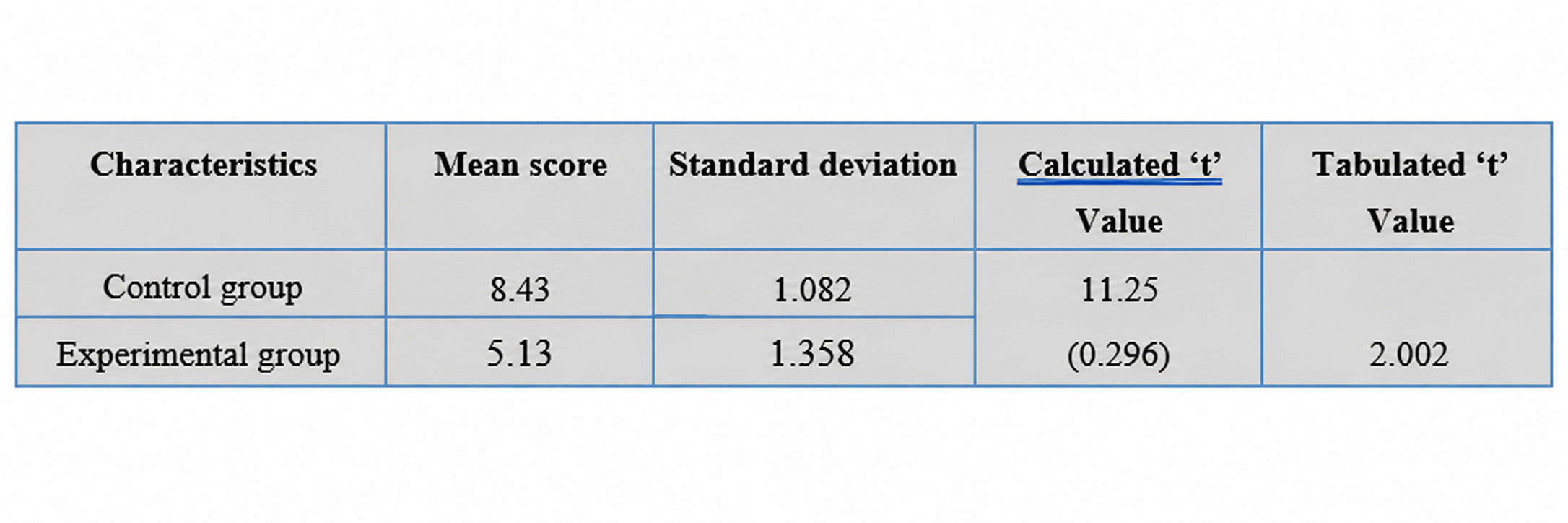
Labor is a stressful experience that has pain, fatigue, fear and negative moods reaching high levels as labor progresses. The objective of this study was to assess the effectiveness of ice massage in reduction of labor pain between control and experimental group. Quantitative research approach and Quasi experimental after research only design was adopted for this study. Sixty Primigravida mothers at first stage of labor were divided as 30 each in both the experimental and control group. Visual analogue scale was utilized to assess the labor pain. Experimental group participants received ice massage at energy meridian point that is known as Large intestine 4(LI 4) for subsequent 4 uterine contractions or for 20 minutes. This intervention was not followed in control group. The collected data were examined by descriptive and inferential statistics. Results of the study revealed that 23.3% of mothers had moderate pain and 76.67% had severe pain in control group and in experimental group, 3.33% of mothers had mild pain, 83.33% had moderate pain and 13.33% had severe pain. A significant difference at the level of p< 0.05 was found between the experimental and control group on labor pain. This experiment also revealed that there was significant association between the pain score in experimental group and their selected demographic variables such as type of family, residence and occupation. It was concluded that the ice massage at energy meridian point (LI 4) was the effective method to reduce labor pain during the first stage of labor.
References
[1] L. K. Low, K. Martin, C. Sampselle, B. Guthrie, D. Oakley (2003). Adolescents’ Experiences of childbirth: Contrasts with Adults. J. Midwifery Women’s Health, 48: 192-198.
[2] N. K. Lowe (2002). The nature of labor pain. Am. J. Obstet. Gynecol., 186: S16-24.
[3] A. D. Allaire (2001). Complementary and alternative medicine in the labor and delivery suite. Clin. Obstet. Gynecol., 44: 681-691.
[4] B. L. Waters and J. Raisler (2003). Ice massage for the reduction of labor pain. J. Midwifery Women’s Health.; 48: 317-321.
[5] R. Melzack and P. D. Wall (1965). Pain mechanisms: a new theory. Science; 150: 971-979.
[6] K. Edmonds (Ed.) (2011). Dewhurst’s Textbook of Obstetrics and Gynaecology. John Wiley and Sons, Ltd.
[7] K. R. Simpson (2013). AWHONN’s Perinatal nursing. Lippincott Williams & Wilkins.
[8] Delivery us from pain. Published an article in India today. (2009). http://m.indiatoday.in/story/Deliver+us+from +pain/1/55936.html.
[9] Labor and Delivery: complications of cesarean section – healthline.
https:// www.webmd.com+baby+cesarean delivery.
[10] Mercia Rekha D’Souza (2010). A window for health in action. Journal of Nightingale nursing times. 5: No. 12.
Downloads
Published
Issue
Section
License
Copyright (c) 2018 Author (s)

This work is licensed under a Creative Commons Attribution-NonCommercial-NoDerivatives 4.0 International License.
Copyright © The Author(s). This is an open access article distributed under the terms of the Creative Commons Attribution-NonCommercial-NoDerivatives 4.0 International License (CC BY-NC-ND 4.0), which permits unrestricted non-commercial use, distribution, and reproduction in any medium, provided the original author(s) and source are properly credited, and the work is not modified or adapted.