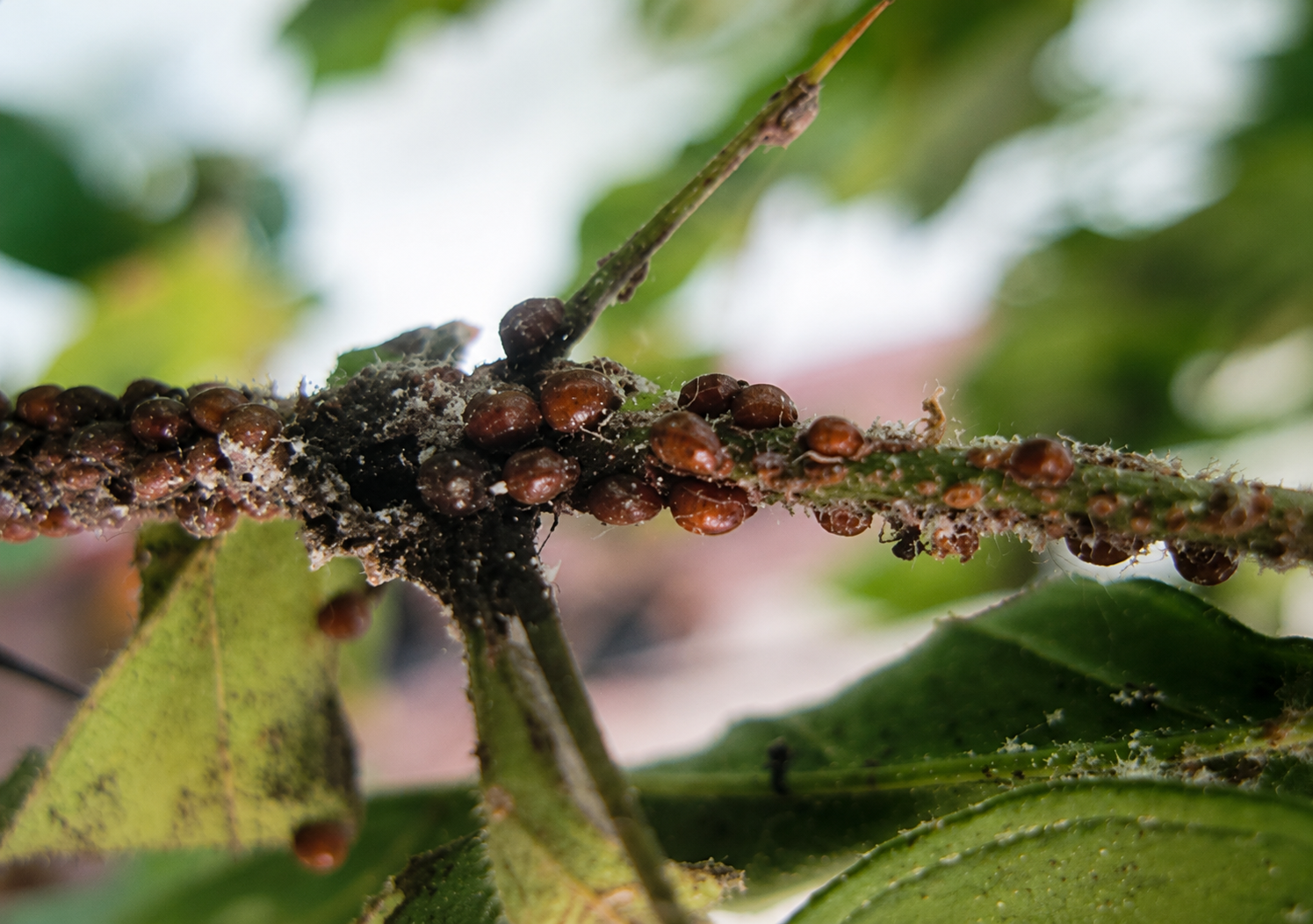
Saissetia coffeae (Walker) (Coccidae: Hemiptera) infestation on Meyna spinosa Roxb. ex Link-a new host plant and sap-sucker (pest) record from Assam, India
DOI:
https://doi.org/10.7324/ELSR.2018.411518Keywords:
medicinal plants pests, new record; polyphagy, sap sucker, scale insectAbstract
The hemispherical scale insect Saissetia coffeae (Walker) is reported for the first time from Assam, India infesting one-year old Meyna spinosa Roxb. ex Link (Rubiaceae) seedlings in nursery conditions. The host plant is attributed with medicinal properties amongst the inhabitants of the region; although occurring mostly as scanty populations in the wild, probably a cause of pest infestations.
References
[1] P. J. Gullan and J. H. Martin (2003). Sternorrhyncha (jumping plant-lice, white flies, aphids and scale insects). In: Resh, V. and Carde, R. Encyclopedia of Insects, Academis Press Amsterdam, pp. 1079-1089.
[2] P. J. Gullan and L. G. Cook (2007). Phylogeny and higher classification of scale insects (Hemiptera: Sternorrhyncha:Coccoidea). Zootaxa, 1668: 413-425
[3] A Dziedzicka (1988). Welnowce szklarniowe (Homoptera, Coccinea, Pseudococcidae) [in Polish]. Zeszyty Problemowe Postępów Nauk Rolniczych, 333: 87-91.
[4] M. Kosztarab (1996). Scale insects of Northeastern North America. Virginia Museum of Natural History, Martinsville, pp. viii – 650.
[5] Y. Ben-Dov and C. J. Hodgson (1997). Soft scale insects-Their Biology, Natural Enemies and Control. Elsevier, Amsterdam and New York, pp. 439.
[6] R. C. Henderson, A. Sultan and A. W. Robertson (2010). Scale insect fauna (Hemiptera: Sternorrhyncha: Coccoidea) of New Zealand’s pygmy mistletoes (Korthalsella: Viscacea) with description of three new species: Leucapsis albotecta, L. trilobata (Diaspididae) and Eriococcus korthalsellae (Eriococcidae). Zootaxa, 2644: 1-24.
[7] N. K. S. Singh, W. Radhapiyari, Md. A. H. Choudhury, Th. B. Singh, Kh. Bonny and Th. Sobita Devi (2015). Spectrospcopic study of antioxidant property and trace elements of Meyna spinosa Roxb. ex Link leaves. Indian Journal of Natural Products and Resources, 6: 51-55.
[8] C. J. Hodgson and R. C. Henderson (2000). Coccidae (Insecta: Hemiptera: Coccoidea). Fauna of New Zealand, 41.
[9] D. Nafus (2000). Hemispherical scale Insect (Saissetia coffeae [Walker]) Agricultural Pests of the Pacific. ADAP, Honolulu, US. https://www.ctahr.hawaii.edu/adap/Publications/ADAP_pubs/2000-8.pdf (accessed on 19 July, 2016).
[10] CABI (2017). Saissetia coffeae (hemispherical scale). In: Invasive Species Compendium. Wallingford, UK: CAB International. http://www.cabi.org/isc/datasheet/48202 (accessed on 19 July, 2016).
[11] A. J. Saikia and V. Parkash (2017). Hyposidra talaca Walker (Geometridae: Lepidoptera) a New Pest (Defoliator) Recorded for Meyna spinosa Roxb. ex Link from Assam, India. Indian Forester, 143: 714-715.
[12] Conservation Interbnational (2004). Hot Spots Revisited. https://biodiversityhotspots.org/XP/hotspots/himalaya (accessed on 19 July 2016).
Downloads
Published
Issue
Section
License
Copyright (c) 2018 Author (s)

This work is licensed under a Creative Commons Attribution-NonCommercial-NoDerivatives 4.0 International License.
Copyright © The Author(s). This is an open access article distributed under the terms of the Creative Commons Attribution-NonCommercial-NoDerivatives 4.0 International License (CC BY-NC-ND 4.0), which permits unrestricted non-commercial use, distribution, and reproduction in any medium, provided the original author(s) and source are properly credited, and the work is not modified or adapted.