Physicochemical properties of some tetrahydropyrimidine derivatives
DOI:
https://doi.org/10.7324/ELSR.2018.412739Keywords:
density, partition coefficients, refractive index, tetrahydropyrimidine compoundsAbstract
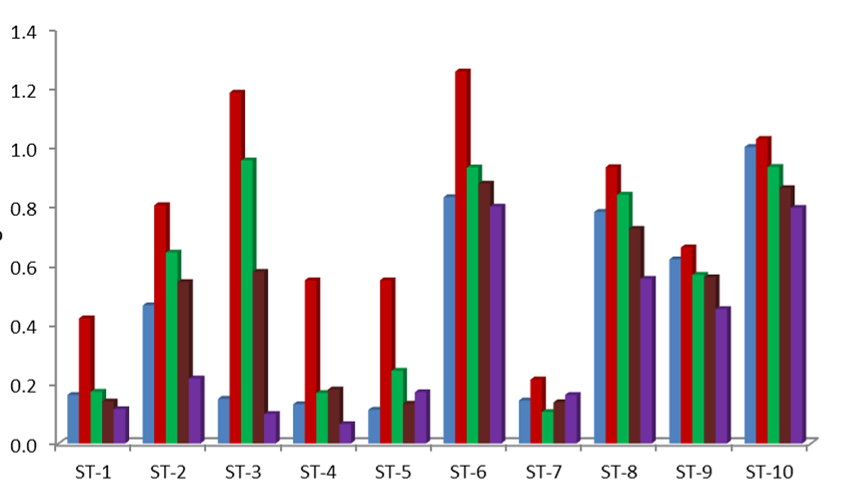
Production of tetrahydropyrimidine and their derivatives is of great importance in organic chemistry. Presence of pyrimidine piece in different biological compounds that are used in several medications makes it a crucial component. In this study, some new tetrahydropyrimidine compounds are synthesized and their physicochemical properties such as such as density, refractive index, partition coefficients have been studied in different solvents at 308.15K.
References
[1] M. G. A. van Eupen, M. T. Schram, H. M. Colhoun, N. M. Hanssen, H. W. Niessen, L. Tarnow and H. H. Parving et al., (2013). The methylglyoxal-derived AGE tetrahydropyrimidine is increased in plasma of individuals with type 1 diabetes mellitus and in atherosclerotic lesions and is associated with sVCAM-1. Diabetologia. 56:1845-1855.
[2] M. García-Valverde and T. Torroba (2005). Special issue: sulfur-nitrogen heterocycles. Molecules, 10: 318-320. doi:10.3390/10020318.
[3] A. Balkan, S. Uma, M. Ertan and W. Wiegrebe (1992). Thiazolo[3,2-a] pyrimidine derivatives as calcium antagonists. Pharmazie, 47: 687-688.
[4] A. Balkan, B. Tozkoparan, M. Ertan, Y. Sara and N. Ertekin (1996). New thiazolo[3,2-a] pyrimidine derivatives, synthesis and calcium antagonistic activities. Boll. chim. farm. 135: 648-652.
[5] K. Kaur and E. E. Knaus (2007). Synthesis of alkyl 6-methyl-4-(2-pyridyl)-1,2,3,4-tetrahydro-2H-pyrimidine-2-one-5-carboxylates for evaluation as calcium channel antagonists. J. Heterocyclic Chem., 44: 745-747.
[6] S. S. Bahekar and D. B. Shinde (2004). Synthesis and anti-inflammatory activity of some [4,6-(4-substituted aryl)-2-thioxo-1,2,3,4-tetrahydro-pyrimidin-5-yl]-acetic acid derivatives. Bioorg. Med. Chem. Lett., 14: 1733-1736.
[7] S. N. Mokale, S. S. Shinde, R. D. Elgire, J. N. Sangshetti and D. B. Shinde (2010). Synthesis and anti-inflammatory activity of some 3-(4,6-disubtituted-2-thioxo-1,2,3,4-tetrahydropyrimidin-5-yl) propanoic acid derivatives. Bioorg. Med. Chem. Lett., 20: 4424-4426.
[8] B. Tozkoparan, M. Ertan, P. Kelicen and R. Demirdamar (1999). Synthesis and anti-inflammatory activities of some thiazolo[3,2-a] pyrimidine derivatives. Farmaco, 54: 588-593.
[9] N. Arora and S. N. Pandeya (2011). Synthesis and analgesic activity of novel pyrimidine derivatives. Int. J. Pharm. Sci. Rev. Res., 11: 48-52. http://globalresearchonline.net/journalcontents/volume11issue1/Article-010.pdf.
[10] L. Linsheng, Z. Guibao, Y. Chuanlin, Z. Qun and C. Nana (2011). Application of 1,3-dicyclohexyl-1,2,3,6-tetrahydropyrimidine-4,5-dicarboxylic acid diethyl ester in preparing anti-inflammatory and analgesic medical preparations” Faming Zhuanli Shenqing, CN 102228461 A 20111102.
[11] B. Li; L. Li and G. Ji Gao (2011). Antitumor composition comprising gemcitabine and tetrahydropyrimidine or tetrahydropyrimidine derivative for treating pancreatic cancer. Faming Zhuanli Shenqing, CN 102274238 A 20111214.
[12] J.-X. Yuan.; X.-Q. Cai, D.-M. Chen and M.-L., Hu (2007). Synthesis, Structure Analysis, and Antitumor Activity of (R)-2,4-Dioxo-5-fluoro-1-[1-(methoxycarbonyl) Ethylaminocarbonylmethyl]-1,2,3,4-tetrahydropyrimidine. Chin. J. Chem., 25: 417-421.
[13] K. Weinhardt, M. B.Wallach and M. Marx (1985). Synthesis and antidepressant profiles of phenyl-substituted 2-amino- and 2-[(alkoxycarbonyl)amino]-1,4,5,6-tetrahydropyrimidines. J. Med. Chem., 28: 694-698.
[14] H. R. Champaneri, S. R. Modi and H. B. Naik. (1994). Studies on pyrimidines. Part II. Synthesis and antibacterial activity of 7-(2-hydroxy-5-methylphenyl)-2-acetyl-5-phenyl-3-oxo-2,3,4,5-tetrahydrothiazolo[3,2-a] pyrimidines. Asian J. Chem., 6: 737-738.
[15] K. Satyavathi, T. N. R. Kiran, P. B. Raju and M. Sharmila (2010). Synthesis and screening of 3-formyl-2-thio-1,2,3,4-tetrahydro pyrimidine analogues as antibacterial agents” Asian J. Chem., 22: 5182-5186.
[16] H. S. Basavaraja, P. Basavaraj, M. M. J. Vijaykumar, M. Hussain and B. N. Chidananda (2011). Synthesis and antimicrobial screening of some substituted INH- and THPHM-linked pyrimidines. Ind. J. Het. Chem., 20: 237-240.
[17] O. S. Heavens, and R. W. Ditchburn (1991). Insight into optics Insight into optics. by Heavens, OS; Ditchburn, RW. Wiley, Chichester (UK), pp.327, ISBN 0-471-92901-8
[18] M. de. Angelis, S. de. Nicole, P. Ferraro, A. Finizio and G. Pierattini (2000). Liquid refractometer based on interferometric fringe projection. Optics Commun., 175: 315-321.
[19] F. Wooten, (2013). Optical properties of solids. Academic press.
[20] Y. Wen-Jie, K. Liang, Z. Li-Han, B. Feng-Wu (2009). Simultaneous determination of ethanol, sugar and organic acids in Kluveromyces marxious broth by high performance liquid chromatography-ultraviolet/refractive index detector [J]. Chinese J. Anal. Chem., 37: 850-854.
[21] R. K. Rekha, and A. Ramalingam (2009). Nonlinear characteristic and optical limiting effect of oil red azo dye in liquid and solid media. J. Modern Optics. 56: 1096-1102.
[22] J. G. Kirchner and J. M. Miller (1957). Canning and storage effects, Volatile water-soluble and oil constituents of valencia orange juice. J. Agric. Food Chem., 5: 283-291.
[23] J. A. Patindol, B. C. Gonzalez, Y.-J. Wang and A. M. McClung (2007). Starch fine structure and physicochemical properties of specialty rice for canning” J Cereal Sci., 45: 209-218.
[24] J. C. Zillies, K. Zwiorek, G. Winter and C. Coester (2007). Method for Quantifying the PEGylation of Gelatin Nanoparticle Drug Carrier Systems Using Asymmetrical Flow Field-Flow Fractionation and Refractive Index Detection. Anal. Chem., 79: 4574-4580.
[25] Y. K. Park, M. Diez-Silva, G. Popescu, G. Lykotrafitis, W. Choi, M. S. Feld and S. Suresh (2008). Refractive index maps and membrane dynamics of human red blood cells parasitized by Plasmodium falciparum. Proc. Natl. Acad. Sci. U. S. A., 105: 13730-13735.
[26] W. Z. Song, X. M. Zhang, A. Q. Liu, C. S. Lim, P. H. Yap and H. M. M. Hossein (2006). Refractive index measurement of single living cells using on-chip Fabry-Perot cavity. App. Phys. Lett., 89: 20390. doi: 10.1063/1.2387965.
[27] B. Kemper; S. Dartmann, F. Schlichthaber, A. Vollmer, S. Ketelhut and G. von Bally (2012). Self-interference digital holographic microscopy for live cell imaging. Proc. SPIE 8427, Biophotonics: Photonic Solutions for Better Health Care III, 842709 (8 May 2012); doi: 10.1117/12.921857, https://doi.org/10.1117/12.921857.
[28] L. Weng, Y. Lu, L. Shi, X. Zhang, L. Zhang and X. Guo, J. Xu (2004). In Situ Investigation of Drug Diffusion in Hydrogels by the Refractive Index Method. Anal. Chem., 76: 2807-2812.
[29] L. S. Levitt (1981). Determination of the dissociation constant and limiting equivalent conductance of a weak electrolyte from conductance measurements on the weak electrolyte. Anal. Chim. Acta., 125: 219-220.
[30] L. Tang, and C. O. Huber (1994). Electroosmotic flow and injection: application to conductometry. Talanta, 41: 1791-1795.
[31] S. I. Kargov and O. V. Davydova (2005). Application of conductometry for studying conformational changes in polyelectrolytes in aqueous solutions” Žurnal fizičeskoj himii,79: S81-S85.
[32] P. Cañizares, A. Beteta, C. Sáez, L. Rodriguez and M. A. Rodrigo (2008). Use of electrochemical technology to increase the quality of the effluents of bio-oxidation processes. A case studied. Chemosphere, 72: 1080-1085.
[33] F. Bordi, R. H. Colby, C. Cametti, L. De Lorenzo and T. Gili (2002). Electrical conductivity of polyelectrolyte solutions in the semidilute and concentrated regime: The role of counterion condensation. J. Phys. Chem. B, 106: 68876893.
[34] F. M. Gilles, M. Tagliazucchi, O. Azzaroni, and I. Szleifer (2016). Ionic conductance of polyelectrolyte-modified nanochannels: Nanoconfinement effects on the coupled protonation equilibria of polyprotic brushes. J. Phys. Chem. C, 120: 4789-4798.
[35] H. Kubinyi (1979). Nonlinear dependence of biological activity on hydrophobic character: the bilinear model. Farmaco Sci., 34: 248-276.
[36] D. Eisenberg and A. D. McLachlan (1986). Solvation energy in protein folding and binding. Nature, 319: 199-203.
[37] S. Miyamoto and P. A. Kollman (1993). What determines the strength of noncovalent association of ligands to proteins in aqueous solution?. Proc. Natl. Acad. Sci. U. S. A., 90: 8402-8406.
[38] J. Yuan, S. Yu, T. Zhang, X. Yuan, Y. Cao, X. Yu and X. Yang et al., (2016). QSPR models for predicting generator-column-derived octanol/water and octanol/air partition coefficients of polychlorinated biphenyls, Ecotoxico. Environ. Saf., 128: 171-180.
[39] E. Dolgikh, I. A. Watson, P. V. Desai, G. A. Sawada, S. Morton, T. M. Jones and T. J. Raub (2016). QSAR Model of Unbound Brain-to-Plasma Partition Coefficient, Kp,uu,brain: Incorporating P-glycoprotein Efflux as a Variable. J. Chem. Inf. Model., 56: 2225-2233
[40] L. Gaohua, S. Neuhoff, T. N. Johnson, A. Rostami-Hodjegan and M. Jamei (2016). Development of a permeability-limited model of the human brain and cerebrospinal fluid (CSF) to integrate known physiological and biological knowledge: Estimating time varying CSF drug concentrations and their variability using in vitro data, Drug Metab. Pharmacokinet., 31: 224-233.
[41] I. Hoque, A. Chatterjee, S. Bhattacharya and R. Biswas (2017). An approach of computer-aided drug design (CADD) tools for in silico pharmaceutical drug design and development. Int. J. Adv. Res. Biol. Sci., 4: 60-71
[42] D. J. C. Constable, C. Jimenez-Gonzalez and R. K. Henderson (2007) Perspective on solvent use in the pharmaceutical industry. Org. Process; Res. Dev., 11: 133-137.
[43] H. Chieh-Ming, S. Wang, S.-T. Lin. and S. I. Sandler (2011). A predictive model for the solubility and octanol-water partition coefficient of pharmaceuticals. J. Chem. Eng. Data, 56: 936-945.
[44] W. Jorgensen (2004). The many roles of computation in drug discovery. Science, 303: 1813-1818.
[45] U. Gala and H. Chauhan (2015). Principles and applications of Raman spectroscopy in pharmaceutical drug discovery and development, Expert Opin. Drug Discov., 10: 187-206.
[46] J. A. Riddick, W. B. Bunger and T. K. Sakano (1986). Organic solvents, physical properties and method of purification. Wiley-Interscience, New York.
[47] M. Singh and B. B. Prasad (1996). Electrolytic conductivity of the N-chloranil- and N-xylylene-based polyelectrolytes in dimethylformamide and dimethyl sulfoxide. J. Chem. Eng. Data, 41: 409-413.
Downloads
Published
Issue
Section
License
Copyright (c) 2018 Author (s)

This work is licensed under a Creative Commons Attribution-NonCommercial-NoDerivatives 4.0 International License.
Copyright © The Author(s). This is an open access article distributed under the terms of the Creative Commons Attribution-NonCommercial-NoDerivatives 4.0 International License (CC BY-NC-ND 4.0), which permits unrestricted non-commercial use, distribution, and reproduction in any medium, provided the original author(s) and source are properly credited, and the work is not modified or adapted.