
Variation of some micro-morphological characters of leaves of Aesculus hippocastanum based on growing environment
DOI:
https://doi.org/10.7324/ELSR.2018.414552Keywords:
Aesculus hippocastanum L., buckeye, micro-morphological character, SEM, StomaAbstract
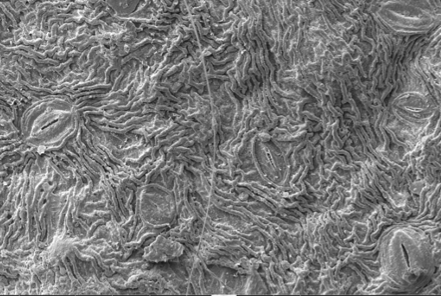
Buckeye (Aesculus hippocastanum L.) is a member of the family Sapindaceae and is an exotic species for Turkey. It is a kind of tree that can grow up to an average of 15-20 m and is deciduous, which we often see in parks, gardens and roadsides. Although it is not in the natural flora of Turkey due to the use of different areas especially in the city centers, it is being used in the areas where many different climate types dominate. In this study, it was aimed to determine the variation of some micromorphological characters of the leaves of Aesculus hippocastanum L. depending on the growing environment. Samples were grown on 6 different cities which are dominated by different climate types. With this purpose, leaf samples were collected from Aesculus hippocastanum L. individuals growing in 6 different cities (Rize, Samsun, İzmir, Antalya, Sivas and Ankara) in the Central and Western Anatolia regions where the Black Sea, Mediterranean and continental climate types predominate. Scale images were obtained with the help of electron microscope (SEM = Scanning Electron Microscope) of the collected leaf samples and stoma length (μm), stoma width (μm), por length (μm), por width and stoma density (per mm2 field) were determined. Variance analysis and Duncan test were applied to the obtained data with the help of SPSS package program and the variation of the indicated characters according to the growing environment was evaluated statistically.
References
[1] S. Mansuroğlu, T. Birişçi, Z. Söğüt and Ö. A. Kalaycı (2016). The importance of ecological balance protection of roof garden applications in mediterranean climate, 1st International Mediterranean Science and Engineering Congress (IMSEC 2016), October, pp 26-28.
[2] T. Birişçi, S. G. Mansuroğlu, Z. Söğüt and A. K. Önaç (2017a). Ağaç, Çevre ve Toprak. Yaşamın Her Karesinde Toprak. İstanbul Aydın Üniversitesi Yayınları. ISBN: 978-605-4303-80-9. http://yasaminherkaresindetoprak.aydin.edu.tr/yaseminherkaresindetoprak.pdf
[3] T. Birişçi, S. Mansuroğlu, Z. Söğüt, A. Kalaycı Önaç and V.Dağ (2017b). Doğa Dostu Peyzaj Uygulamaları. International Conference on Agriculture, Forest, Food Sciences and Technologies. 15-17 Mayıs, Kapadokya.
[4] C. Yücedağ and L. G. Kaya (2016). Impacts of air pollutants to plants. MAKÜ, FEBED., 7: 67-74.
[5] C. O. Alpay, A. Kalaycı and T. Birişçi (2013). Ekolojik tasarım kriterlerine göre kent parkı iyileştirme modeli; izmir kültürpark örneği, TMMOB 2. Kent Sempozyumu, İzmir.
[6] N. Yiğit, A. Ozturk and H. Şevik (2014). Ecologıcal impact of urban forests (example of kastamonu urban forest). Int. J. Eng. Scı. Res. Technol., 3: 558-562.
[7] S. Öztürk and E. Bozdoğan (2015). The contribution of urban road trees on improving the air quality in an urban area. Fresenius Environ. Bull., 24: 1822-1829.
[8] T. B. Randrup, C. Konijnendijk, M. K. Dobbertin and R. Prüller (2005). The concept of urban forestry in europe. In urban forests and trees (pp. 9-21). Springer, Berlin, Heidelberg.
[9] Z. Söğüt, S. Mansuroğlu, T. Birişçi and Ö. A.Kalaycı (2016). Improving the active green space ratio in coastal cities in turkey. . 5th fábos conference on landscape and greenway planning. pp515-522. 30 June- 3 July 2016, Budapest, Hungary. https://drive.google.com/file/d/0B0SDfwlPIez6cktlbXZYU3J0TUk/view.
[10] C. Yücedağ, L. G. Kaya and A. Ulu (2017). Investigation of landscape design efficiency in the housing development and the apartment complexes of burdur city, turkey. MAKÜ FEBED., 8: 114-122.
[11] L. G. Kaya, C. Yücedağ and B. Bingöl (2017). Usage of ineffective mining quarries for recreational purposes: the case study of burdur city, turkey. The Journal of Graduate School of Natural and Applied Sciences of Mehmet Akif Ersoy University, 8: 184-190.
[12] F. Zarinkamar (2006). Density, size and distribution of stomata in different monocotyledons. Pak. J. Biol. Sci., 9: 1650-1659.
[13] E. Kırdar, H. B. Özel and M. Ertekin (2010). Effects of pruning on height and diameter growth at stone pine (Pinus pinea L.) Afforestations. Bartın Orman Fakültesi Dergisi, 12: 1-10.
[14] H. B. Özel and M. Ertekin (2012). The change of stand structure in uludağ fir (Abies nordmanniana subsp. bornmuelleriana mattf.) forests along an altitudinal gradient. Kastamonu University Journal of Forestry Faculty, 12(3): 96-104.
[15] M. D. Kantarcı, H. B. Özel, M. Ertekin and E. Kırdar (2011). An assessment on the adaptation of 6 tree species to steppe habitat during konya-karapinar sand-dune afforestations. Bartın Orman Fakültesi Dergisi, 13: 107-127.
[16] H. B. Özel (2008). Impact of forest restoration practices on the some soil properties in bartýn-ardýç district. Ekoloji J., 18: 14-19.
[17] M. Ertuğrul, T. Varol and H. B. Özel (2014). Climate changes in prospect for the west black sea forests. Bartın Orman Fakültesi J., 16: 35-43.
[18] A. K. Önaç and T. Birişçi (2017). Evaluating ege unıversity campus transportation network based on human-oriented design criteria. The Journal of Academic Social Science Studies. 54: 333-349. Doi: http://dx.doi.org/10.9761/JASSS6906
[19] M. Cetin, N. Yigit, H. B. Ozel and H. Sevik (2017). The changing of leaf micromorphogical characters on grown in different growth conditions in Buxus sempervirens plants. Nature, Environment and Earth Science (In Press)
[20] Z. Lu, M.A. Quinones and E. Zeiger (1993). Abaxial and adaxial stomata from pima cotton (Gossypium barbadense L.) differ in their pigment content and sensitivity to light quality. Plant Cell Environ., 16: 851-885.
[21] G. J. Retallk (2001). A 300-million-year record of atmospheric carbon dioxide from fossil plant cuticles. Nature, 411: 287-290.
[22] İ. Aslanboğa (1986). Kentlerde yol ağaçlaması. Tübitak Yapı Araştırma Enstitüsü Yayını, No: U3, Ankara.
[23] A. Yıldırım (1993). Biyocografya. Palme Yayınları, Ankara.
[24] H. Sevik, M. Cetin and B. Aricak (2017b). The variable of leaf micromorphogical characters on grown in distinct climate conditions in some landscape plants. International Journal of Arts & Sciences’ (IJAS) International Conference for Physical, Life and Health Sciences, Las Vegas, Nevada, USA. 13-17 March 2017.
[25] J. Cohen (1988). Statistical Power Analysis for the Behavioral Sciences. 2nd edn.
[26] J. Galmés, J. Flexas, R. Savé and H. Medrano (2007). Water relations and stomatal characteristics of mediterranean plants with different growth forms and leaf habits: responses to water stress and recovery. Plant and Soil, 290: 139-155.
[27] A. M. Hetherington and F. I. Woodward (2003). The role of stomata in sensing and driving environmental change. Nature, 424: 901-908.
[28] J. M. Dunlap and R. F. Stettler (2001). Variation in leaf epidermal and stomatal traits of populus trichocarpa from two transects across the washington cascades. Can. J. Bot., 79: 528-536.
[29] A. M. Bosabalidis and G. Kofidis (2002). Comparative effects of drought stress on leaf anatomy of two olive cultivars. Plant science, 163: 375-379.
[30] M. Guerfel, O. Baccouri, D. Boujnah, W. Chaïbi and M. Zarrouk (2009). Impacts of water stress on gas exchange, water relations, chlorophyll content and leaf structure in the two main Tunisian olive (Olea europaea L.) cultivars. Sci. Hort., 119: 257-263.
[31] H. Sevik, Z. Yahyaoglu and I. Turna (2012). Determination of genetic variation between populations of abies nordmanniana subsp. bornmulleriana mattf according to some seed characteristics, Genetic Diversity in Plants, InTech, ISBN 978-953-51-0185-7, Chapter 12, pp:231-248.
[32] A. Turkyilmaz, H. Sevik and M. Cetin (2018). The use of perennial needles as biomonitors for recently accumulated heavy metals. Landsc. Ecol. Eng., 14: 115-120.
[33] H. Sevik and M. Cetin (2015). Effects of water stress on seed germination for select landscape plants. Pol. J. Environ. Stud., 24: 689-693.
[34] O. Topacoglu, H. Sevik and E. Akkuzu (2016). Effects of Water Stress on Germination of Pinus nigra Arnold. Seeds, Pak. J. Bot., 48: 447-453.
[35] H. Sevik (2012). Variation in seedling morphology of Turkish fir (Abies nordmanniana subsp. bornmulleriana Mattf), Afr. J. Biotechnol., 11: 6389-6395.
[36] C. Yücedağ, B. Bingöl, L.G. Kaya (2016). Forest Genetic Resources in Burdur, Turkey. Mehmet Akif Ersoy Üniversitesi, Journal of Economics and Administrative Sci., 3: 6-12.
[37] N. Yigit, H. Sevik, M. Cetin and N. Kaya (2016). Determination of the effect of drought stress on the seed germination in some plant species. In Water Stress in Plants, In Tech. chapter pp: 43-62. ISBN: 978-953-51-2621-8.
[38] N. Bilir, K. Canpolat and M. D. Ulusan (2010). Morphological characters and quality in Stone pine (Pinus pinea L.) seedlings of aydin provenance. Kastamonu University Journal of Forestry Faculty, 10: 37-43.
[39] Z. Yahyaoğlu, A. Demirci, N. Bilir and M. Genç (2001). Comparison of 22 taurus cedar (Cedrus libani A. Rich.) origins by seedling morphological distance. Turk. J. Biol., 25: 221-228.
[40] Z. Xu and G. Zhou (2008). Responses of leaf stomatal density to water status and its relationship with photosynthesis in a grass. J. Exp. Bot., 59: 3317-3325.
[41] F. B. Salisbury and C. W. Ross (1985). Plant Physiology. (Third Edition). Wadsworth Publishing Co., Belmont, California, 540p.
[42] H. M. Yang and G. X. Wang (2001). Leaf stomatal densities and distribution in Triticum aestivum under drought and CO2 enrichment. Acta Phytoecologica Sinica, 25: 312-316.
[43] S. Liu, J. Liu, J. Cao, C. Bai and R. Shi (2006). Stomatal distribution and character analysis of leaf epidermis of jujube under drought stress. Journal of Anhui Agricultural Science, 34: 1315-1318.
[44] R. X. Zhao, Q. B. Zhang, X. Y. Wu and Y. Wang (2001). Effects of drought on epidermal cells and stomatal density of wheat leaves. Inner Mongolia Agricultural Science and Technology. 6: 6-7.
[45] R. Romero-Aranda, T. Soria and J. Cuartero (2001). Tomato plant-water uptake and plant-water relationships under saline growth conditions. Plant Sci., 160: 265-272.
[46] R. Ferris, I. Nijs, T. Beaeghe and I. Impens (1996). Elevated CO2 and temperature have different effects on leaf anatomy of perennial ryegrass in spring and summer. Ann. Bot. 78, 489-497.
[47] S. Banon, J. A. Fernandez, J. A. Franco, A. Torrecillas, J. J. Alarcón and M. J. Sánchez-Blanco (2004). Effects of water stress and night temperature preconditioning on water relations and morphological and anatomical changes of Lotus creticus plants. Sci. Hort., 101: 333-342.
[48] D. J. Beerling, C. K. Kelly and E. J. Salisbury (1997). Stomatal density of temperature woodland plants over the past seven decades of CO2 increase: a comparison of Salisbury (1927) with contemporary data. Am. J. Bot., 84: 1572-1583.
Downloads
Published
Issue
Section
License
Copyright (c) 2018 Author (s)

This work is licensed under a Creative Commons Attribution-NonCommercial-NoDerivatives 4.0 International License.
Copyright © The Author(s). Effective from 1 July 2026, articles published in Emergent Life Sciences Research (ELSR) are distributed under the Creative Commons Attribution 4.0 International License (CC BY 4.0), which permits use, sharing, distribution, reproduction, and adaptation in any medium or format, provided that appropriate credit is given to the original author(s) and the source, a link to the license is provided, and any changes made are indicated.
Articles published before 1 July 2026 remain subject to the license applicable at the time of their original publication, including the Creative Commons Attribution-NonCommercial-NoDerivatives 4.0 International License (CC BY-NC-ND 4.0), where applicable.