Allelopathic effect of Niger Plant (Guizotia abyssinica L.) on abundance of selected weeds
DOI:
https://doi.org/10.31783/elsr.2018.423844Keywords:
allelopathy, metabolites, Niger plant, weedsAbstract
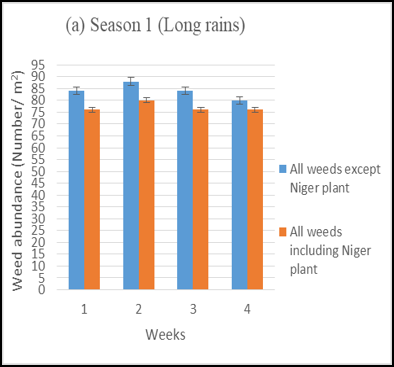
Plants release many secondary metabolites to the environment that can be harnessed for important uses. These secondary metabolites are known as allelochemicals. The current worldwide demand for cheaper, more environmentally-friendly weed management technologies have motivated a number of studies on the allelopathic interaction between crops and weeds. Niger plant has been observed to have allelopathic effects on certain weeds. In order to evaluate the influence of Niger plant on selected weeds, an experiment was laid out in Randomized Complete Block Design (RCBD) with three replicates. Three cultivars of beans (Rosecoco, Mwitemania and Mwezi Mbili) were used. Data collection included the total number of four prominent weeds over a span of four weeks. A 50 x 50 quadrat was laid on the same spot in all the treatments and the weeds enclosed within were counted separately. Data analysis was done by ANOVA in Genstat and results were presented using graphs. Results showed that Niger plant enhanced the bean growth and development, whereas it inhibited the germination and growth of some weeds i.e. field mustard, broom weed, double thorn and couch grass. It was concluded that Niger plant exhibited negative allelopathy on the weeds that were studied and positive allelopathy on all the bean cultivars. From the results, it is recommended that further research needs to be carried out on more crops and more weeds to have an in-depth understanding of this subject.
References
[1] H. S. Patil, A. R. G. Ranganatha, S. Paroha and A. Tripathi (2013). Niger (Guizotia abyssinica L.) Book chapter in breeding of field crops. Agrobioscience. (India): pp. 567-587.
[2] D. Chikoye, J. Ellis-Jones, C. Riches and L. Kanyomeka (2007). Weed Management in Africa: experiences, challenges and opportunities. XVI International Plant Congress pp652-653. 15-18 October, Glasgow, Scotland.
[3] A. Zohaib, T. Abbas and T. Tabassum (2016). Weeds cause losses in field crops through allelopathy. Not. Sci. Biol., 8: 47-56.
[4] A. C. D. Wandscheer, M. A. Rizzardi and M. Reichert (2013). Competitive ability of corn in coexistence with goose grass. Planta Daninha, 31: 281-289.
[5] P. Nikneshan, H. Karimmojeni, M. Moghanibashi and N. A. S. Hosseini (2011). Allelopathic potential of sunflower on weed management in safflower and wheat. Aust. J. Crop Sci. 5: 1434-1440.
[6] Inderjit, C. C. von Dahl and I. T. Baldwin (2003). Use of silenced plants in allelopathy bioassays: A novel approach. Planta, 229: 569-575.
[7] H. S. Saudy (2015). Maize-cowpea intercropping as an ecological approach for nitrogen-use rationalization and weed suppression. Arch. Agron. Soil Sci., 61: 1-14.
[8] M. Asaduzzaman, M. F. Mondal, T. Ban and T. Asao (2013). Selection of ideal succeeding crops after asparagus, taro and beans replanting field in seedling growth bioassay. Allelopathy Journal. 32: 1-22.
[9] E. R. Gallandt, M. Liebman and D. R. Huggins (1999). Improving soil quality: implications for weed management. J. Crop Prod., 2: 95-121.
[10] L. A. Weston, I. S. Alsaadawi and S. R. Baerson (2013). Sorghum allelopathy from ecosystem to molecule. J. Chem. Ecol., 39: 142-153.
[11] F. A. Macías, J. M. Molinillo, R. M. Varela and J. C. G. Galindo (2007). Allelopathy - a natural alternative for weed control. Pest Manag. Sci., 63: 327-348.
[12] C. M. Roth, J. P. Shroyer and G. M. Paulsen (2000). Allelopathy of sorghum on wheat under several tillage systems. Agron. J., 92: 885-860.
[13] R. Cloyd (2004). Natural instincts: Are natural insecticides safer and better than conventional insecticides? American Nurseryman, 200: 38-41.
[14] B. Field, F. Jord´an and A. Osbourn (2006). First encounters-deployment of defence-related natural products by plants. New Phytol., 172: 193-207.
[15] A. Verma M., A. Kumar P., D. Kavitha, K. B. Anurag (2011). Anti-denaturation and antioxidant activities of Annona cherimola in vitro. Int. J. Pharm. Bio. Sci., 2: 1-6.
[16] EL-Rokiek, K. G., EL-Masry, R. R., Messiha, N. K. and Ahmed, S. A. (2010): The allelopathic effect of mango leaves on the growth and propagative capacity of purple nutsedge (Cyperus rotundus L.). Journal of Science. 6(9): 151-159.
[17] K. El-Rokiek (2007). Evaluating the physiological influence of benzoic and cinnamic acids, alone or in combination on wheat and some infested weeds comparing with the herbicide isoproturon. Annals Agric. Sci. (Cairo), 52: 45-58.
[18] S. Sisodia and M. B. Siddiqui (2010). Allelopathic effect by aqueous extracts of different parts of Croton bonplandianum on some crop and weed plants. J. Agric. Ext. Rural Dev., 2: 022-028.
[19] E. A. Khan, A. A. Khakwani and A. Ghazanfarullah (2015). Effects of allelopathic chemicals extracted from various plant leaves on weed control and wheat crop productivity. Pak. J. Bot. 47: 735-740.
[20] J. L. Herro and R. M. Callaway (2003). Allelopathy and exotic plant invasion. Plant and Soil. 256: 29-39.
[21] M. A Turk and A. M. Tawaha (2003). Allelopathic effect of black mustard (Brassica nigra L.) on germination and growth of wild oat (Avena fatua L.). Crop Prot., 22: 673-677.
[22] H. F. Hussein (2003). Estimation of critical period of crop-weed competition and nutrient removal by weeds in onion (Allium cepa L.) in sandy soil. Egypt. J. Agron., 24: 43-62.
[23] S. U. Chon, J. A. Jennings and C. J. Nelson (2006). Alfalfa (Medicago sativa L.) autotoxicity: Current status. Allelopathy Journal. 18: 57-80.
[24] B. A. Kumbhar and D. D. Patel (2016). Allelopathic effects of different weed species on crops. J. Pharm. Sci. Bioscientific Res., 6: 801- 805.
Downloads
Published
Issue
Section
License
Copyright (c) 2018 Author (s)

This work is licensed under a Creative Commons Attribution-NonCommercial-NoDerivatives 4.0 International License.
Copyright © The Author(s). This is an open access article distributed under the terms of the Creative Commons Attribution-NonCommercial-NoDerivatives 4.0 International License (CC BY-NC-ND 4.0), which permits unrestricted non-commercial use, distribution, and reproduction in any medium, provided the original author(s) and source are properly credited, and the work is not modified or adapted.