Recent advances in chemical methods for remediation of heavy metals contaminated soils: A Review
DOI:
https://doi.org/10.31783/elsr.2018.424550Keywords:
advance techniques, chemical remediation, heavy metal (loids)Abstract
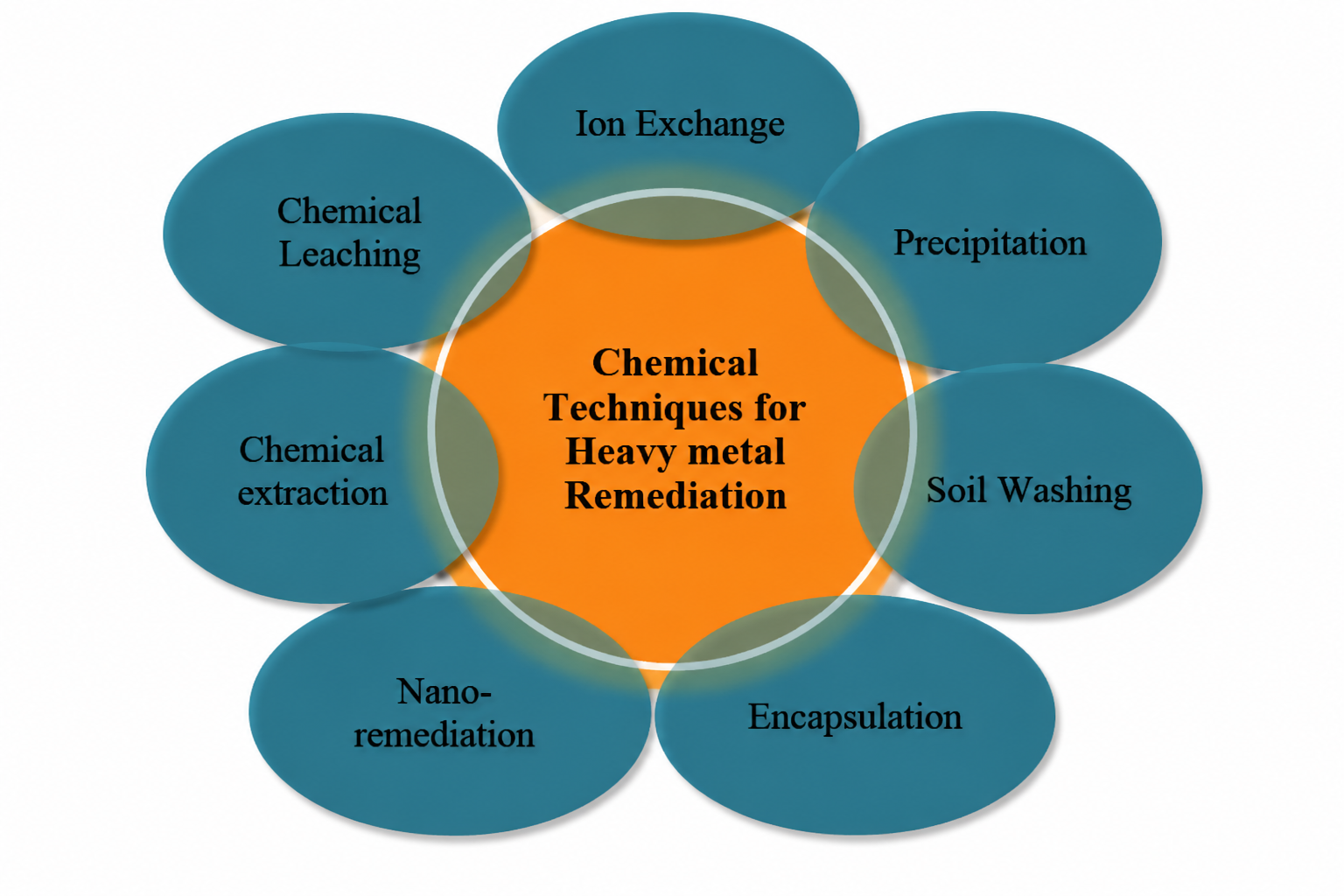
Heavy metal remediation has been an important concern of agriculture sector since decades and development of new and sound remediation techniques has become the need of the hour. These potentially harmful and persistent metals (loids) are posing great threat to environment and human health. Chemical remediation techniques are long been used for the remediation of all hazardous metals and to bring them back to safe and acceptable level in soils, but these conventional methodologies have their own setbacks. These techniques ae not cost-effective, consume a lot of time and mostly generate by-products that are toxic in nature. Hence, to overcome these issues, recently scientists have come up with more refined chemical methods to ameliorate heavy metal contamination in soils. In this review, we have highlighted some of the cost-effective and effective chemical methods, including precipitation, ion exchange, and chemical extraction and leaching, nanoremediation, encapsulation and soil washing. All these methods have shown effective results in the recent literature for the efficient removal of heavy metals from the contaminated soils along with economic feasibility.
References
[1] A. Ghosh, M. G. Dastidar and T. R. Sreekrishnan (2015). Recent advances in bioremediation of heavy metals and metal complex dyes. J. Environ. Eng., 142: C4015003.
[2] Z. He, J. Shen, Z. Ni, J. Tang, S. Song, J. Chen and L. Zhao (2015). Electrochemically created roughened lead plate for electrochemical reduction of aqueous CO2. Catal. Commun., 72: 38-42.
[3] G. Wu, H. Kang, X. Zhang, H. Shao, L. Chu and C. Ruan (2010). A critical review on the bio-removal of hazardous heavy metals from contaminated soils: issues, progress, eco-environmental concerns and opportunities. J. Hazard. Mater., 174: 1-8.
[4] Y. Foucault, T. Lévèque, T. Xiong, E. Schreck, A. Austruy, M. Shahid and C. Dumat (2013). Green manure plants for remediation of soils polluted by metals and metalloids: Ecotoxicity and human bioavailability assessment. Chemosphere., 93: 1430-1435.
[5] S. Goix, T. Leveque, T. T. Xiong, E. Schreck, A. Baeza-Squiban, F. Geret and G. Uzu, et al., (2014). Environmental and health impacts of fine and ultrafine metallic particles: assessment of threat scores. Environ. Res., 133: 185-194.
[6] A. Olaniran, A. Balgobind and B. Pillay (2013). Bioavailability of heavy metals in soil: impact on microbial biodegradation of organic compounds and possible improvement strategies. Int. J. Mol. Sci., 14: 10197-10228.
[7] C. Garbisu and I. Alkorta (2003). Basic concepts on heavy metal soil bioremediation. Ejmp. & ep (European Journal of Mineral Processing and Environmental Protection), 3: 58-66
[8] Z. Aksu and E. Balibek (2010). Effect of salinity on metal-complex dye biosorption by Rhizopus arrhizus. J. Environ. Manage, 91: 1546-1555.
[9] A. Ghosh and P. D. Saha (2013). Optimization of copper bioremediation by Stenotrophomonas maltophilia PD2. J. Environ. Chem. Eng., 1: 159-163.
[10] N. Verbruggen, C. Hermans and H. Schat (2009). Molecular mechanisms of metal hyperaccumulation in plants. New Phytol., 181: 759-776.
[11] G. Murtaza G., Murtaza B., Niazi N., Sabir M. (2014) Soil Contaminants: Sources, Effects, and Approaches for Remediation. In: Ahmad P., Wani M., Azooz M., Phan Tran LS. (eds) Improvement of Crops in the Era of Climatic Changes. Springer, New York, NY.
[12] M. Sabir, E. A. Waraich, K. R. Hakeem, M. Öztürk, H. R. Ahmad and M. Shahid (2015). Phytoremediation, Soil Remediation and Plants. Elsevier Inc.
[13] D. Leštan, C. L. Luo and X. D. Li (2008). The use of chelating agents in the remediation of metal-contaminated soils: a review. Environ. Pollut., 153: 3-13
[14] L. K. Wang, Y. T. Hung and N. K. Shammas (Eds.). (2005). Physicochemical treatment processes. Humana Press.
[15] C. N. Albers, O. S. Jacobsen, E. M. M. Flores and A. R. Johnsen (2017). Arctic and subarctic natural soils emit chloroform and brominated analogues by alkaline hydrolysis of trihaloacetyl compounds. Environ. Sci. Technol., 51: 6131-6138.
[16] C. S. Bhogle and A. B. Pandit (2017). Ultrasound-assisted alkaline hydrolysis of waste poly (ethylene terephthalate) in aqueous and non-aqueous media at low temperature. Indian Chem. Eng., 2: 1-19.
[17] H. A. Aziz, M. N. Adlan and K. S. Arifn (2008). Heavy metals (Cd, Pb, Zn, Ni, Cu and Cr(III)) removal from water in Malaysia: Post treatment by high quality limestone. Bioresour. Technol., 99: 1578-1583.
[18] A. Dabrowski, Z. Hubicki, P. Podkościelny and E. Robens (2004). Selective removal of the heavy metal ions from waters and industrial wastewaters by ion-exchange method. Chemosphere, 56: 91-106.
[19] W. S. Kim, S. O. Kim, K. W. Kim (2005). Enhanced electrokinetic extraction of heavy metals from soils assisted by ion exchange membranes. J. Hazard. Mater., 118: 93-102.
[20] Z. Li, L. Wang, J. Meng, Liu X, J. Xu, F. Wang and P. Brookes (2018). Zeolitesupported nanoscale zero-valent iron: new fndings on simultaneous adsorption of Cd(II), Pb(II), and As(III) in aqueous solution and soil. J. Hazard. Mater., 344: 1-11.
[21] J. Wen, Z. Peng, Y. Liu, Y. Fang, G. Zeng and S. Zhang (2018). A case study of evaluating zeolite, CaCO 3, and MnO 2 for Cd-contaminated sediment reuse in soil. J. Soils Sed., 18: 323-332.
[22] E. Boros-Lajszner, J. Wyszkowska and J. Kucharski (2017). Use of zeolite to neutralise nickel in a soil environment. Environ. Monit. Assess., 190: 54. doi: 10.1007/s10661-017-6427-z
[23] X. Xue, K. Hanna, C. Despas, F. Wu and N. Deng (2009). Efect of chelating agent on the oxidation rate of PCP in the magnetite/H2O2 system at neutral pH. J. Mol. Catal. A: Chem., 311: 29-35.
[24] D. Kulikowska, Z.M. Gusiatin, K. Bulkowska and B. Klik (2015). Feasibility of using humic substances from compost to remove heavy metals (Cd, Cu, Ni, Pb, Zn) from contaminated soil aged for different periods of time. J. Hazard. Mater., 300: 882-891.
[25] M. Udovic and D. Lestan (2010). Fractionation and bioavailability of Cu in soil remediated by EDTA leaching and processed by earthworms (Lumbricus terrestris L.). Environ. Sci. Pollut. Res. Int., 17: 561-570.
[26] Q. Wu, Y. Cui, Q. Li, J. Sun (2015). Efective removal of heavy metals from industrial sludge with the aid of a biodegradable chelating ligand GLDA. J. Hazard Mater., 283: 748-754.
[27] F. Asadzadeh, M. Maleki-Kaklar, N. Soiltanalinejad and F. Shabani (2018). Central composite design optimization of zinc removal from contaminated soil, using citric acid as biodegradable chelant. Sci, Rep., 8: 2633.
[28] G. Dermont, M. Bergeron, G. Mercier, M. Richer-Lafèche (2008). Soil washing for metal removal: a review of physical/chemical technologies and field applications. J. Hazard Mater., 152: 1-31.
[29] S. I. Alghanmi, A. F. Al Sulami, T. A. El-Zayat, B. G. Alhogbi and M. A. Salam (2015). Acid leaching of heavy metals from contaminated soil collected from Jeddah, Saudi Arabia: kinetic and thermodynamics studies. Int. Soil Water Conserv. Res., 3: 196-208.
[30] P. Venkatachalam, M. Jayaraj, R. Manikandan, N. Geetha, E. R. Rene, N. Sharma and S. Sahi (2017). Zinc oxide nanoparticles (ZnONPs) alleviate heavy metal-induced toxicity in Leucaena leucocephala seedlings: a physiochemical analysis. Plant Physiol. Biochem., 110: 59-69.
[31] R. Nagarajah, K. T. Wong, G. Lee, K. H. Chu, Y. Yoon, N. C. Kim and M. Jang (2017). Synthesis of a unique nanostructured magnesium oxide coated magnetite cluster composite and its application for the removal of selected heavy metals. Sep. Purif. Technol., 174: 290-300.
[32] S. Ucaroglu and İ. Talinli (2012). Recovery and safer disposal of phosphate coating sludge by solidification/stabilization. J. Environ. Manag., 105: 131-137.
[33] B. Pandey, S.D. Kinrade and L. J. J. Catalan (2012). Effects of carbonation on the leachability and compressive strength of cement-solidified and geopolymer-solidified synthetic metal wastes. J. Environ. Manag., 101: 59-67.
[34] A. Navarro, E. Cardellach, I. Cañadas and J. Rodríguez (2013). Solar thermal vitrification of mining contaminated soils. Int. J. Miner. Process, 119: 65-74.
[35] J. He and J. P. Chen (2014). A comprehensive review on biosorption of heavy metals by algal biomass: materials, performances, chemistry, and modeling simulation tools. Bioresour. Technol., 160: 67-78.
[36] X. Guo, Z. Wei, Q. Wu, C. Li, T. Qian and W. Zheng (2016). Effect of soil washing with only chelators or combining with ferric chloride on soil heavy metal removal and phytoavailability: field experiments. Chemosphere, 147: 412-419.
[37] B. Park and Y. Son (2016). Ultrasonic and mechanical soil washing processes for the removal of heavy metals from soils. Ultrason. Sonochem, 35: 640-645.
[38] A. Ferraro, E. D. van Hullebusch, D. Huguenot, M. Fabbricino and G. Esposito (2015). Application of an electrochemical treatment for EDDS soil washing solution regeneration and reuse in a multi-step soil washing process: case of a Cu contaminated soil. J. Environ. Manag., 163: 62-69.
Downloads
Published
Issue
Section
License
Copyright (c) 2018 Author (s)

This work is licensed under a Creative Commons Attribution-NonCommercial-NoDerivatives 4.0 International License.
Copyright © The Author(s). This is an open access article distributed under the terms of the Creative Commons Attribution-NonCommercial-NoDerivatives 4.0 International License (CC BY-NC-ND 4.0), which permits unrestricted non-commercial use, distribution, and reproduction in any medium, provided the original author(s) and source are properly credited, and the work is not modified or adapted.