Modification of the properties of wood via combination of treatments: Freeze treatment and silicone oil heat treatment - Part 2
DOI:
https://doi.org/10.31783/elsr.2018.425157Keywords:
crystallinity index, freeze treatment, silicone oil heat treatment, x-ray diffraction, woodAbstract
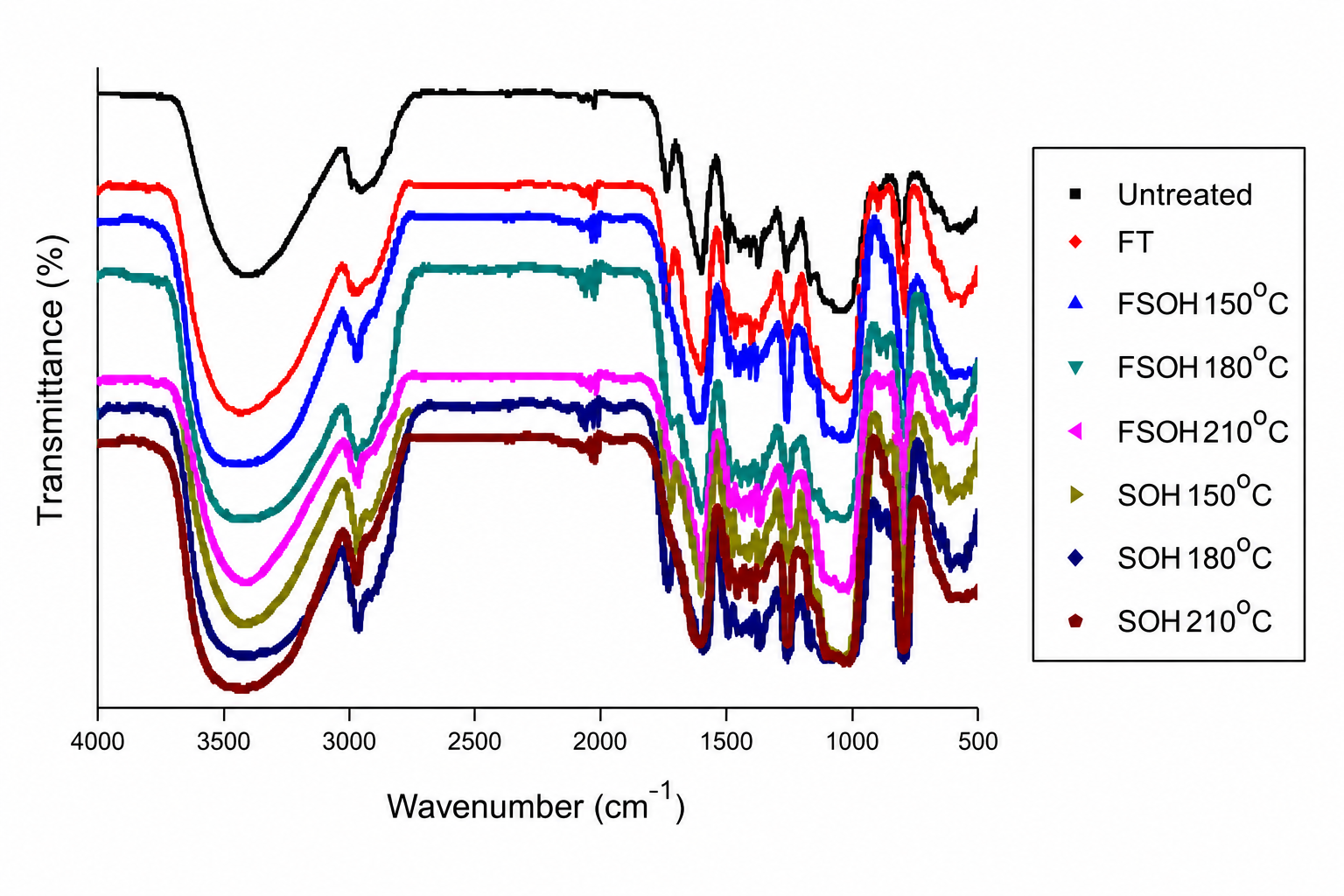
The effects of freeze-silicone oil heat treatment (combination of treatments) on the chemical properties of wood were investigated using fourier transform infrared (FTIR), X-ray diffractometer (XRD) and thermogravimetric analysis (TGA). Results obtained showed that the impact of combine treatments on the wood was positive. FTIR results showed apparent changes in the chemical composition of the treated wood, XRD results indicated relative increase in the crystallinity index of the treated wood compared to the untreated and TGA showed reduction in the weight loss of the treated as compared with the untreated wood samples.
References
[1] J. Guo, K. Song, L. Salmén, and Y. Yin (2015). Changes of wood cell walls in response to hygro-mechanical steam treatment. Carbohydr. Polym., 115: 207-214.
[2] S. A. Ahmed and T. Morén (2012). Moisture properties of heat-treated Scots pine and Norway spruce sapwood impregnated with wood preservatives. Wood and fiber Sci., 44: 85-93.
[3] A. J. Stamm (1956). Thermal degradation of wood and cellulose. Ind. Eng. Chem., 48: 413-417.
[4] J. J. Weiland and R. Guyonnet (2003). Study of chemical modifications and fungi degradation of thermally modified wood using DRIFT spectroscopy. Holz als Roh-und Werkstoff, 61: 216-220. doi: 10.1007/s00107-003-0364-y
[5] M. Boonstra and B. Tjeerdsma (2006). Chemical analysis of heat-treated softwoods. Holz Roh-werkst, 64: 204-211. doi: 10.1007/s00107-005-0078-4
[6] C. A. Hill (2007). Wood modification: chemical, thermal and other processes (Vol. 5). John Wiley & Sons.
[7] B. M. Esteves and H. M. Pereira (2009). Wood modification by heat treatment: Review. BioResources, 4: 370-404.
[8] ASTM (2004). Standard practice for sampling forest trees for determination of clear wood properties,” ASTM International, West Conshohocken, PA.
[9] L. Segal, J. J. Creely, A. E. Martin Jr. C. M. Conrad (1959). An empirical method for estimating the degree of crystallinity of native cellulose using the X-ray diffractometer. Textile Research Journal, 29: 786-794. doi: 10.1177/004051755902901003
[10] J. Qian, Z. He, J. Li, Z. Wang, L. Qu and S. Yi (2018). Effect of Wax and Dimethyl Silicone Oil Pretreatment on Wood Hygroscopicity, Chemical Components, and Dimensional Stability. BioResources, 13: 6265-6279.
[11] B. F. Tjeerdsma and H. Militz (2005). Chemical changes in hydrothermal treated wood: FTIR analysis of combined hydrothermal and dry heat-treated wood. Holz als roh-und Werkstoff, 63: 102-111. https://doi.org/10.1007/s00107-004-0532-8
[12] G. Shou, W. Zhang, Y. Gu, and D. Zhao (2014). Application of near infrared spectroscopy for discrimination of similar rare woods in the Chinese market. J. Near Infrared Spectrosc., 22: 423-432.
[13] K. K. Pandey (1999). A study of chemical structure of soft and hardwood and wood polymers by FTIR spectroscopy. J. Appl. Polym. Sci., 71: 1969-1975.
[14] J. Yin, T. Yuan, Y. Lu, K. Song, H. Li, G. Zhao and Y. Yin (2017). Effect of compression combined with steam treatment on the porosity, chemical composition and cellulose crystalline structure of wood cell walls. Carbohydr. Polym., 155:163-172.
[15] X. Wang, X. Chen, X. Xie, Y. Wu, L. Zhao, Y. Li, and S. Wang (2018). Effects of thermal modification on the physical, chemical and micromechanical properties of Masson pine wood (Pinus massoniana Lamb.). Holzforschung. 72: 1063-1070. doi: 10.1515/hf-2017-0205
[16] X. Ji, Y. Dong, T. T. Nguyen, X. Chen and M. Guo (2018). Environment-friendly wood fibre composite with high bonding strength and water resistance. R. Soc. Open Sci, 5: 172002. doi: 10.1098/rsos.172002.
Downloads
Published
Issue
Section
License
Copyright (c) 2018 Author (s)

This work is licensed under a Creative Commons Attribution-NonCommercial-NoDerivatives 4.0 International License.
Copyright © The Author(s). This is an open access article distributed under the terms of the Creative Commons Attribution-NonCommercial-NoDerivatives 4.0 International License (CC BY-NC-ND 4.0), which permits unrestricted non-commercial use, distribution, and reproduction in any medium, provided the original author(s) and source are properly credited, and the work is not modified or adapted.