Determination of Aerobic Bacterial Composition of Dental Plaque Biofilms and Their Role in Oral health
Keywords:
Dental plaque biofilms, composition, role in oral healthAbstract
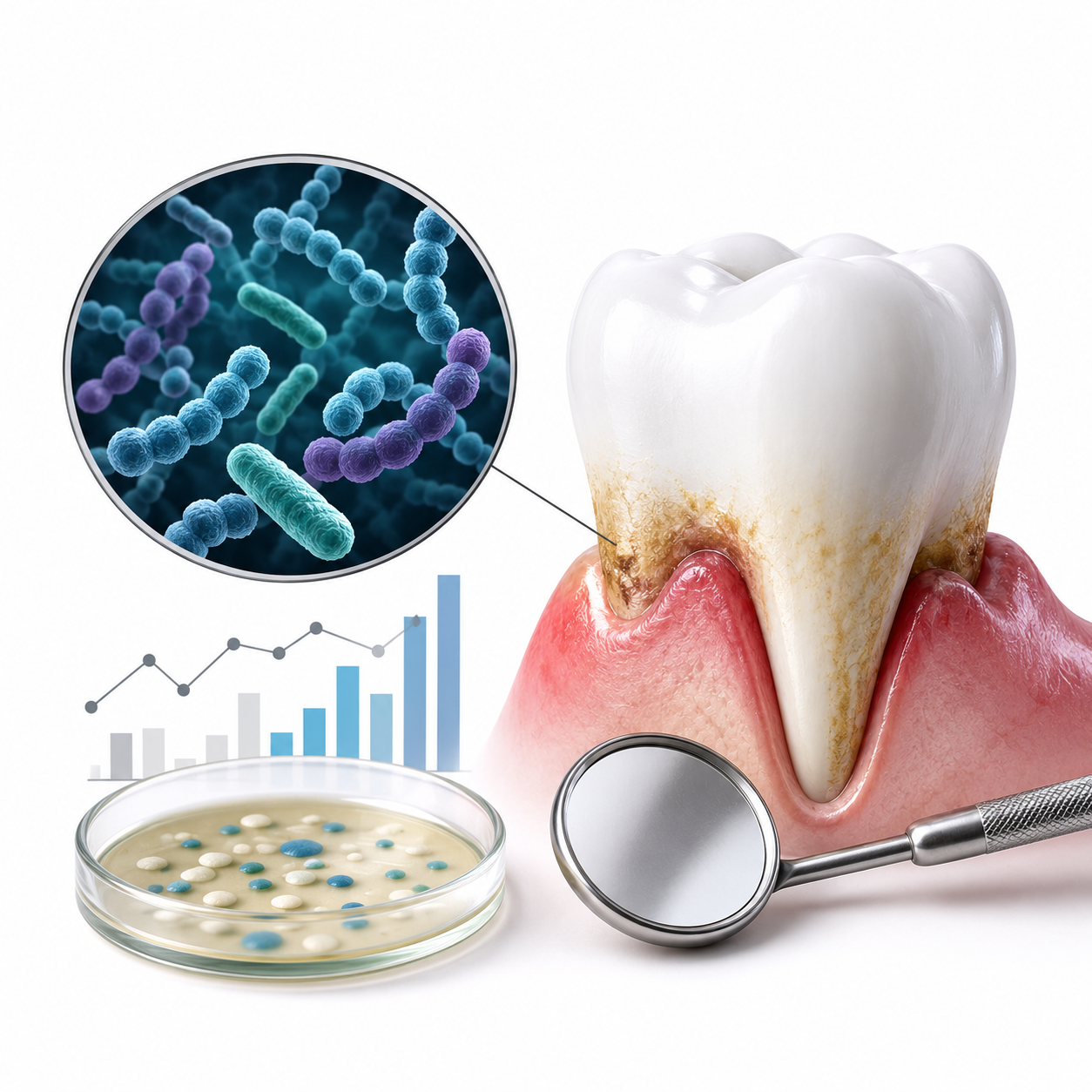
Dental plaque is the biofilm found naturally on teeth and it is the etiologic agent in dental caries and periodontal diseases. A better understanding of bacterial communities found in biofilms provides opportunities for new methods to control biofilm formation. Therefore, control of the dental plaque biofilm is a major objective of dental professionals and critical to the maintenance of optimal oral health. The aim of this study was to isolate and identify aerobic bacteria from dental plaque biofilm on the external surface of the teeth and gums and to determine their role in the etiology of gingivitis and dental caries. Fifty nine samples of dental plaque from gingiva and teeth were collected randomly from patients attending Sebha dental clinic, Libya, males and females of different age groups. All samples were cultured on different media, conventional methods used for isolation and identification. Results revealed that 52 samples (88%) were positive for culture, and they were polymicrobial. Bacteria isolated were 110 species, 93 (84.5%) were gram positive composed of Streptococcus species 43 (39%), Lactobacillus 27 (24.5%), Staphylococcus 23 (21%) and 17 were gram negative (15.5%), they were E.coli 7 (6.4%), Enterobacter 6 (5.5%), Proteus 4 (3.6%).
References
A. Abid (2004). Oral health in Tunisia. Int. Dent. J., 54: 389-94.
A. Gaffar, D. Scherl, J. Afflitto and E.J. Coleman (1995). The effect of triclosan on mediators of gingival inflammation. J. Clin. Periodontol., 22: 480-484.
A. Scheie, W.M. Luan, G. Dahle´n and O. Fejerskov (1996). Plaque pH and microflora of dental plaque on sound and carious root surfaces. J. Dent. Res., 75: 1901-8.
American Academy of Periodontology (1999). The pathogenesis of periodontal diseases. J Periodontol., 70: 457-470.
D.D. Simonović, B. Kocić, N.S. Nedeljković, J. Gašić, S. Dačić and N. Jovanović (2002). Microbiological Status of Different Areas of Tooth. FactaUniversitatis Series: Medicine and Biology. 9: 236-239.
D.J. Bradshaw and P.D. Marsh (1998). Analysis of pH-driven disruption of oral microbial communities in vitro. Caries Res., 32: 456-462.
D.L. Mager, L.A. Ximenez-Fyvie, A.D. Haffajee and S.S. Socransky (2003). Distribution of selected bacterial species on intraoral surfaces. J. Clin. Periodontol. 30: 644-654.
E.C.S. Chan, W. AL-Joburi, S. Cheng and F. Delorme F. (1989). In Vitro Susceptibilities of Oral Bacterial Isolates to Spiramycin. Antimicrob. Agents Ch., 33: 2016-2018.
E.M. Kulik, K. Lenkeit, S. Chenaux and J.Meyer (2008). Antimicrobial susceptibility of periodontopathogenic bacteria. J. Antimicrob. Chemother., 61: 1087-1091.
G.H.W. Bowden (2000). The Microbial Ecology of Dental Caries. Microb. Ecol. Health D., 12: 138-148.
G.I. Barrow, and R.K.A. Feltham (2003). Cowan and Steels Manual for identification of Medical bacteria. 3rd edition. Cambridge University Press pp.(45-120).
H. Whab and A. Alkabi (2011). Study of the composition of dental plaque biofilm of adults and children. Journal of Babylon University, Pure and Applied Sciences, 19: 75-93.
J.J. de Soet, B. Nyvad and M. Kilian (2000). Strain-related acid production by oral streptococci. Caries Res., 34: 486-490.
J.R. Gurenlian (2007). The Role of Dental Plaque Biofilm in Oral Health. J. Dent. Hyg., 81: 4-12.
J.R. Lukacs and L.L. Largaespada (2006). Explaining sex differences in dental caries prevalence: saliva, hormones, and "life-history" etiologies. Am. J. Hum. Biol., 18: 540-55.
L.L. Kirkevang, M. Væth and A.Wenzel (2011). Incidence of caries lesions in approximal surfaces: a radiographic study of a general adult Danish population. Caries Res., 45: 538-46.
M. Sharma, S.C. Tiwari, K. Singh and K. Kishor (2011). Occurrence of Bacterial Flora in Oral Infections of Diabetic and Non-Diabetic Patients. LSMR ., http://astonjournals.com/manuscripts/Vol2011/LSMR-32_Vol2011.pdf.
M.R. Becker, B.J. Paster, E.J. Leys, M.L. Moeschberger, S.G. Kenyon, J.L. Galvin and S.K. Boches et al., (2002). Molecular analysis of bacterial species associated with childhood caries. J. Clin. Microbiol., 40: 1001-1009.
P.D. Marsh (1999). Microbiologic aspects of dental plaque and dental caries. Dent. Clin. North Am. 43: 599-614.
P.D. Marsh (2010). Microbiology of dental plaque biofilms and their role in oral health and caries. Dent. Clin. North Am. 54: 441-54.
S. Saini, N. Gupta, A. Mahajan and D.R. Arora (2003). Microbial Flora in Orodental Infections. Indian J. Med. Microbiol., 21: 111-114.
S.L. Filstrup, D. Briskie, M. da Fonseca, L. Lawrence, A. Wandera and M.R. Inglehart (2003). Early childhood caries and quality of life: child and parent perspectives. Pediatr. Dent., 25: 431-440.
S.S. Socransky and A.D.Haffajee (2002): Dental biofilms: difficult therapeutic targets. Periodontology, 28: 12-55.
W.G. Wade (2010). New aspects and new concepts of maintaining “microbiological” health. J. Dent., 38: 21-25.
W.J. Loesche (2006). Role of Streptococcus mutans in human dental decay. Microbiol. Rev., 50: 353-380.
Downloads
Published
Issue
Section
License
Copyright (c) 2015 Author (s)

This work is licensed under a Creative Commons Attribution-NonCommercial-NoDerivatives 4.0 International License.
Copyright © The Author(s). This is an open access article distributed under the terms of the Creative Commons Attribution-NonCommercial-NoDerivatives 4.0 International License (CC BY-NC-ND 4.0), which permits unrestricted non-commercial use, distribution, and reproduction in any medium, provided the original author(s) and source are properly credited, and the work is not modified or adapted.