Ricinoleic acid esters from castor oil modifying male reproductive system of Amblyomma cajennense (Fabricius 1787)
Keywords:
Amblyomma cajennense, esters, control, castor oil, testesAbstract
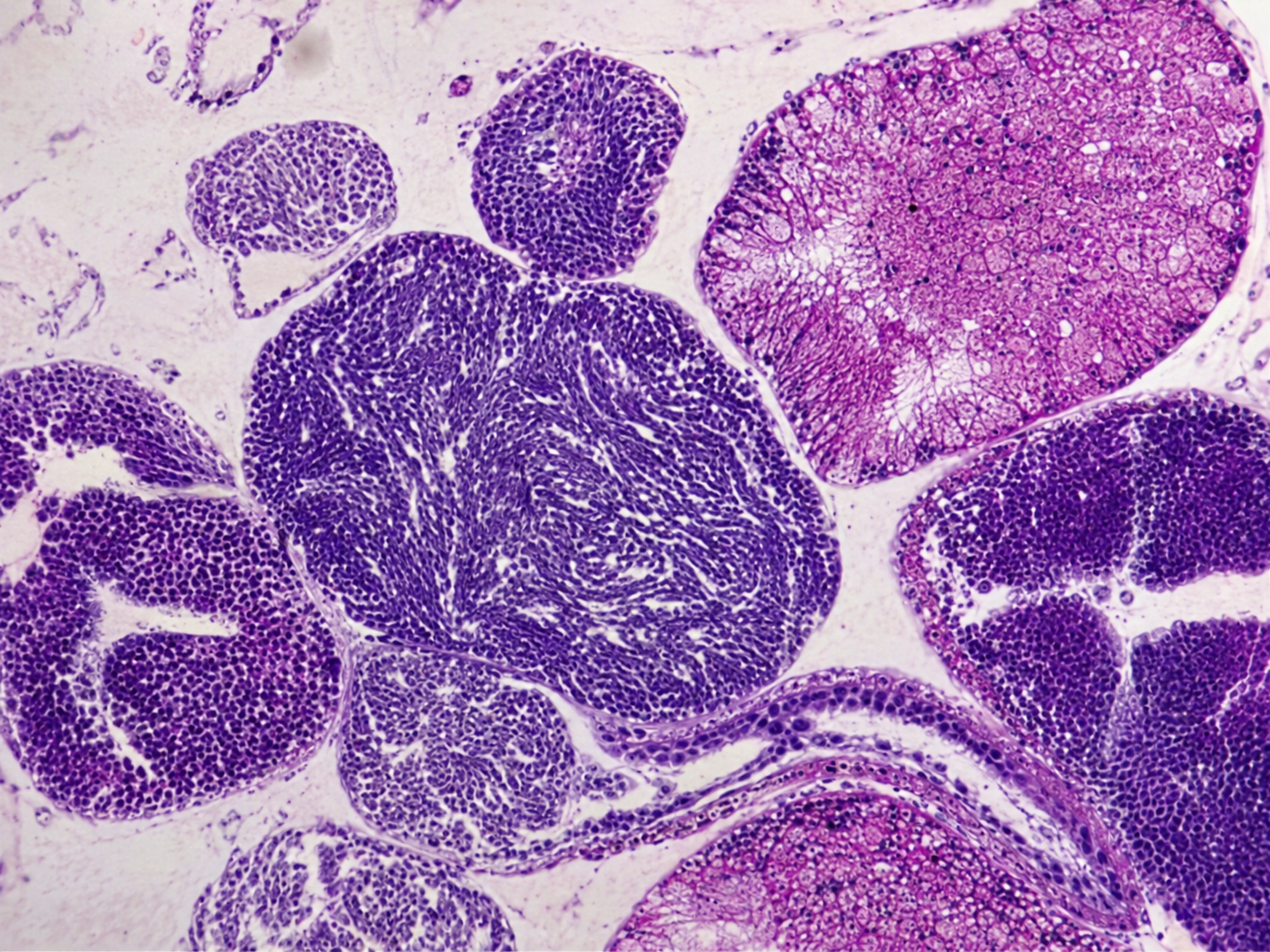
Ticks of the genus Amblyomma have medical and veterinary importance because they can transmit pathogens to humans, as well as domestic, wild and livestock animals. The management and control of this tick has led livestock farmers to an inadequate use of synthetic chemical acaricides, consequently creating environmental problems and selecting resistant populations. Thus, the search for new substances that can be efficient in tick control and have low toxicity to the environment and non-target organisms is latent. Therefore, the present study aimed to evaluate the effect of ricinoleic acid esters from castor oil as modifying agents of A. cajennense male reproductive system, seeking an alternative method to control these parasites. Hence, esters from castor oil were incorporated to the diet of rabbits, which were then infested with A. cajennense. Male ticks were collected from the hosts and their reproductive systems were removed and prepared for histological and histochemical techniques. The results showed that the effects of esters became more evident at the highest concentration available, leading to morphophysiological changes in the secretory cells of the accessory gland complex, altering the secretion content and causing morphological changes in spermatids. The esters changed development dynamics and gamete production, probably affecting the production of spermatophores and seminal fluid. Our results confirmed that these substances have the potential to interfere with reproduction, one of the most important biological processes for a species.
References
A.Arnosti, P.D. Brienza, K.C.S. Furquim, G.O. Chierice, G.H. Bechara, I.B. Calligaris, M.I. Camargo-Mathias (2011a). Effects of ricinoleic acid esters from castor oil of Ricinus communis on the vitellogenesis of Rhipicephalus sanguineus (Latreille, 1806) (Acari: Ixodidae) ticks. Exp. Parasitol., 127: 575–580.
A.Arnosti, P.D. Brienza, K.C.S. Furquim, G.O. Chierice, S.C. Neto, G.H. Bechara, B.R. Sampieri, M.I. Camargo-Mathias (2011b). Effects of Ricinus communis oil esters on salivary glands of Rhipicephalus sanguineus (Latreille, 1806) (Acari: Ixodidae). Exp. Parasitol., 127: 569–574.
B. Feldman-Muhsan, S. Borut, S. Saliternik-Givant, C. Eden (1973). On the evacuation of sperm from the spermatophore of the tick, Ornithodoros savignyi. J. Insect. Physiol.,19: 951-962.
B.R. Sampieri, A. Arnosti, P.H. Nunes, K.C.S. Furquim, G.O. Chierice, M.I. Camargo-Mathias (2012). Ultrastructural changes in the ovary cells os engorged Rhipicephalus sanguineus female ticks trated with esters of ricinoleic acid from castor oil (Ricinus communis). Micros. Res. Techniq. 75: 683-690.
B.R. Sampieri, K.C.S. Furquim, P.H. Nunes, M.I. Camargo-Mathias (2013). Rhipicephalus sanguineus (Acari: Ixodidae) female ticks exposed to castor oil (Ricinus communis): an ultrastructural overview. Parasitol. Res., 12: 611-619.
B.R. Sampieri, M.B. Labruna, O.C. Bueno, M.I. Camargo-Mathias (2014). Dynamics of cell and tissue genesis in the male reproductive system of ticks (Acari: Ixodidae) Amblyomma cajennense (Fabricius, 1787) and Amblyomma aureolatum (Pallas, 1772): a comparative analysis. Parasitol. Res., 113: 1511-1519.
C.M. Ferreira, O.P.S. Rosa, S.A. Torres, F.B.A. Ferreira, N. Bernardinelli (2002). Activity of endodontic antibacterial agents against selected anaerobic bacteria. Braz. Dent. J.,13: 118-122.
D.E. Sonenshine(1970). A contribution to the internal anatomy and histology of the bat tick Ornithodoros kelleyi Cooley and Kohls 1941. J. Med. Ent., 7: 289-312.
D.E Sonenshine(1991). Biology of ticks. Oxford University Press.
E.P.S. Freitas, M.T.A.G. Zapata, F.F. Fernandes (2011). Monitoring of resistance or susceptibility of adults and larvae of Amblyomma cajennense (Acari: Ixodidae) to synthetic acaricides in Goias, Brazil. Exp. Appl. Acarol., 53: 189-202.
F.A. Politi, G.M. Figueira, A.M. Araújo, B.R. Sampieri, M.I. Camargo-Mathias, M.P. Szabó, G.H. Bechara, L.C. Dos Santos, W. Vilegas, R.C. Pietro (2012). Acaricidal activity of ethanolic extract from aerial parts of Tagetespatula L. (Asteraceae) against larvae and engorged adult females of Rhipicephalus sanguineus (Latreille, 1806). Parasite. Vector. 5: 295-300.
F.S. Krawczak, F.A. Nieri-Bastos, F.P. Nunes, J.F. Soares, J. Moraes-Filho, M.B. Labruna (2014).Rickettsial infection in Amblyomma cajennense ticks and capybaras (Hydrochoerus hydrochaeris) in a Brazilian spotted fever-endemic area. Parasite. Vector., 7: 7.
M. Ogrzewalska, A. Uezu, M.B. Labruna (2011). Ticks (Acari: Ixodidae) infesting wild birds in the Atlantic Forest in northeastern Brazil, with notes on rickettsial infection in ticks. Parasitol. Res., 108: 665-670.
M. Rodriguez-Valle, A. Taoufik, M. Váldes, C. Montero, H. Ibrahin, S.M. Hassan, F. Jongejan, J. De La Fuente (2012). Efficacy of Rhipicephalus (Boophilus) microplus Bm86 against Hyalomma dromedarii and Amblyomma cajennense tick infestations in camels and cattle. Vaccine, 30: 3453-3458.
M.A. Alonso-Diaz, A. Fernández-Salas, F. Martínez-Ibáñez, J. Osorio-Miranda (2013). Amblyomma cajennense (Acari: Ixodidae) tick populations susceptible or resistant to acaricides in the Mexican Tropics. Vet. Parasitol, 197: 326-331.
M.A. Messetti, A.M. Santos, D.F. Angelis, G.O. Chierice, S.C. Neto (2010). Estudo dos derivados do óleo de Ricinus communisL. (Mamona) como agente biocida e redutor da viscosidade produzida por Leuconostoc mesenteroides em indústrias sucroalcooleiras. Arq. Inst. Biol. 77: 301-308.
M.C.R. Vendramini, M.I. Camargo-Mathias, A.U. De Faria, K.C.S. Furquim, L.P. De Souza, G.H. Bechara, G.C. Roma (2012). Action of Andiroba Oil (Carapa guianensis) on Rhipicephalus sanguineus (Latreille, 1806) (Acari: Ixodidae) Semi-engorged Females: Morphophysiological Evaluation of Reproductive System. Micros. Res. Techniq., 75: 1745-1754.
M.I. Camargo-Mathias (2013). Guia Básico de Morfologia Interna de Carrapatos Ixodídeos. EDUNESP.
M.R. Leonardo, L.A.B. Silva, M. Tanomaru Filho, K.C. Bonifacio, I.Y. Ito (2001). Invitro evaluacion of the antimicrobial activity of a castor oil-based irrigant. J. Endodont.12: 717-719.
S. Nava, L. Beati, M.B. Labruna, A.G. Cáceres, A.J. Mangold, A.A. Guglielmone(2014). Reassessment of the taxonomic status of Amblyomma cajennense (Fabricius, 1787) with the description of three new species, Amblyomma tonelliae n. sp., Amblyomma interandinum n. sp. and Amblyomma patinoi n. sp., and reinstatement of Amblyomma mixtum Koch 1844, and Amblyomma sculptum Berlese 1888 (Ixodida: Ixodidae). Tick. Tick. Borne. Dis., 5: 252-276.
T.O.S. Senra, F. Calmon, V. Zeringóta, C.M.O. Monteiro, R. Maturano, R.S. Matos, D. Melo, G.A. Gomes, M.G. De Carvalho, E. Daemon (2013). Investigation of activity of monoterpenes and phenylpropanoids against immature stages of Amblyomma cajennense and Rhipicephalus sanguineus(Acari: Ixodidae). Parasitol. Res. 112: 3471-3476.
J. Shephered, J.H. Oilver Jr, J.D. Hall (1981). A polypeptide from male accessory glands which triggers maturation of tick spermatozoa. Int. J. Inver. Rep., 5: 129-137.
Downloads
Published
Issue
Section
License
Copyright (c) 2015 Author (s)

This work is licensed under a Creative Commons Attribution-NonCommercial-NoDerivatives 4.0 International License.
Copyright © The Author(s). This is an open access article distributed under the terms of the Creative Commons Attribution-NonCommercial-NoDerivatives 4.0 International License (CC BY-NC-ND 4.0), which permits unrestricted non-commercial use, distribution, and reproduction in any medium, provided the original author(s) and source are properly credited, and the work is not modified or adapted.