Evaluation of Fruit Peels for Some Selected Nutritional and Anti-Nutritional Factors
Keywords:
antioxidants, carbohydrates, fruit peels, phytic acid, protease, tanninAbstract
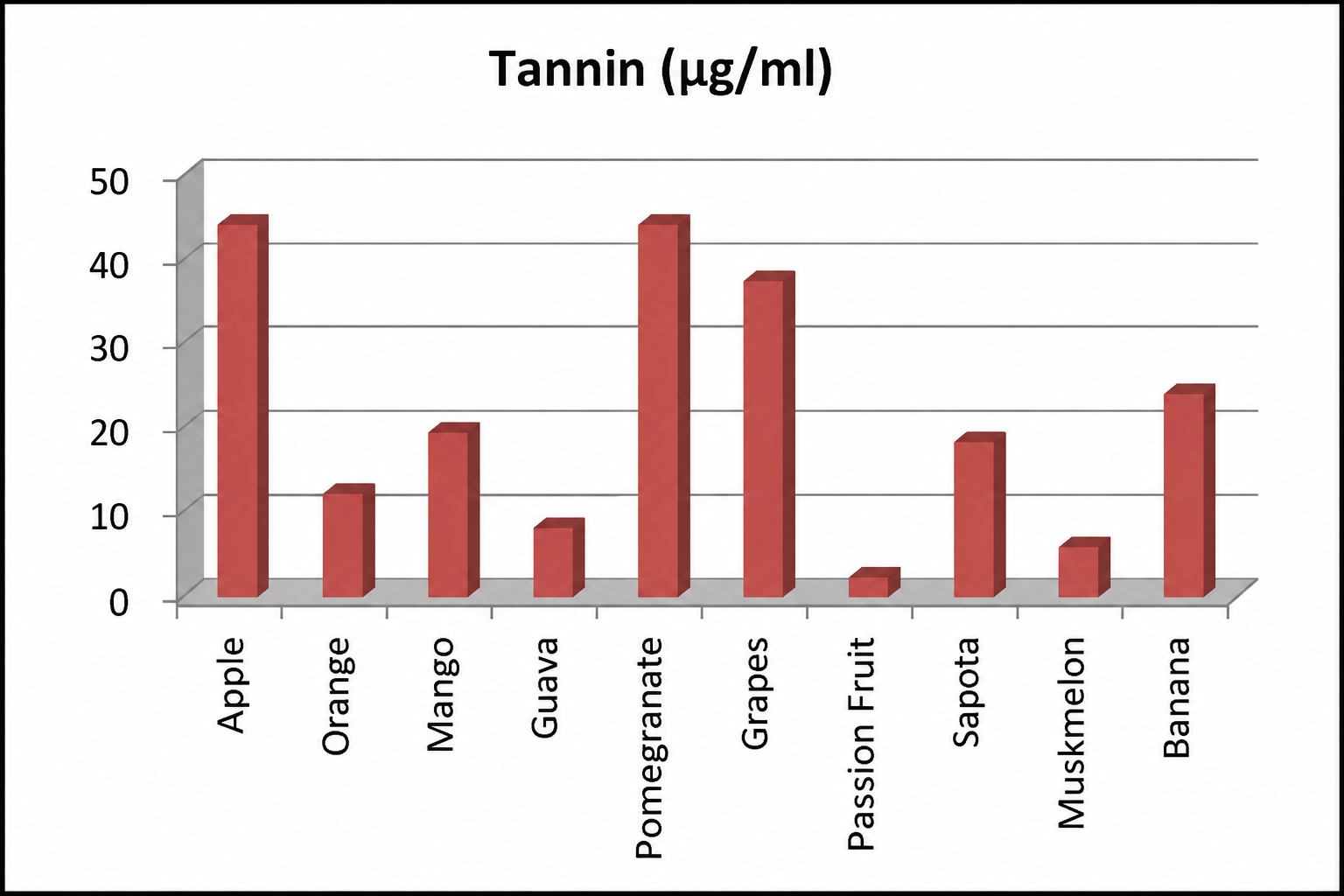
Fruit peels are an important source of bioactive compounds including anti-oxidants and proteins. The objective of the investigations performed was to evaluate the peels of selected fruits for some nutritional and anti-nutritional components including Carbohydrates, Protein, Antioxidants, Protease, Tannin and Phytic acid. Sundried and finely ground fruit peels are subjected to various reactions in order to estimate the quantities of each of the desired components. In the results accomplished, highest carbohydrate content was found in Guava (75 mg/ml) followed by Pomegranate (55.2 mg/ml), Apple (37.15) and Banana (32.64 mg/ml). Highest protein concentrations were observed in Musk melon (1.6 mg/ml) followed by Passion fruit (1.33 mg/ml), Sapota (1.06 mg/ml) and Mango (1.06 mg/ml). Highest antioxidant activity was noted in Pomegranate (0.57%) and Mango (0.57%) followed by Grapes (0.53%), Apple (0.5%) and Guava (0.47%). Phytic acid content was highest in peels of Mango (0.22 µg/ml) followed by Sapota (0.17 µg/ml). High Protease concentrations were noted in Pomegranate (1.06 mg/ml) followed by Mango (0.3 mg/ml). Highest Tannin content was observed in Apple and Pomegranate (42.46 µg/ml) followed by Grapes (35.72 µg/ml).
Society on the whole depends mainly on junk foods which ultimately lead to distressed lifestyle and poor health. So, many of these compounds under study are of special interest due to their ability to reduce the hazard caused by reactive oxygen and nitrogen species. There are several constituents in fruit peels that can be utilized in more efficient ways and hence suggested not to be discarded.
References
A. Adoki (2008). Factors affecting yeast growth and protein yield production from orange, plantain and banana wastes processing residues using Candida Spp. African J. Biotech., 7: 290-295.
B.A. Anhwange, T.J. Ugye, T.D. Nyiaatagher, (2009). Chemical composition of Musa sapientum (banana) peels. Electron. J. Environ. Agric. Food Chem, 8: 437-442.
C. Jose, Lilia Calderón-Jaimes, Eduardo Guerra-Hernández, Belén García-Villanov (2011). Antioxidant capacity, phenolic content and vitamin C in pulp, peel and seed from 24 exotic fruits from Colombia. Food Res. Int., 44: 2047-2053.
D.H. Lowry, N.J. Rosebrough, A.L. Tarr, R.J. Randall (1951). Protein measurement with the folin-Phenol reagent. J. Biol. Chem., 193: 265-276.
D. Aleksandra and T. Tarko (2007). Antioxidant properties of different fruit seeds and peels. Acta Sci. Pol., Technol. Aliment, 6: 29-36.
E. L. Wheeler and R. E. Ferrel (1971). A Method for Phytic Acid Determination in Wheat and Wheat Fractions. Cereal Chem 48: 312-320.
E.B. Robert (1971). Method for estimation of tannin in grain sorghum. Agro. J., 63: 511-512.
FAO (1990). “Roots, Tubers, Plantains, and Bananas in Human Nutrition”. FAO Corporate Document Repository: Rome, Italy.
G. C. Yen and P. D. Duh (1994). Scavenging effect of methanolic extracts of peanut hulls on free-radical and active-oxygen species. J. Agric. Food Chem., 42: 629-632.
G. Rowayshed, A. Salama, M. Abul-Fadl, S. Akila-Hamza, A.M. Emad (2013). Nutritional and Chemical Evaluation for Pomegranate (Punica granatum L.) Fruit Peel and Seeds Powders by Products. Middle East J. Appl. Sci., 3:169-179.
J.H. Roe (1955). The determination of sugarin blood and in spinal fluid with anthrone reagent. J. Biol. Chem., 212: 335- 343.
J.S. Kim (2013). Preliminary Evaluation for Comparative Antioxidant Activity in the Water and Ethanol Extracts of Dried Citrus Fruit (Citrus unshiu) Peel Using Chemical and Biochemical in Vitro Assays, Food Nutri. Sci., 4: 177-188.
M.L. Anson (1938). The estimation of pepsin, trypsin, papain, and cathepsin with hemoglobin. J. Gen. Physiol. 22: 79-89.
N. Saad, C. Delattre, M. Urdaci, J.M. Schmitter, P. Bressollier (2012). An overview of the last advances in probiotic and prebiotic field. food Sci. Technol., 50: 1-16.
P.O. Osarumwense, L.O. Okunrobo, E.G Uwumarongie-ilori (2013). Phytochemical screening, proximate and elemental analysis of Citrus sinensis peels (l.) Osbeck, J. Appl. Sci. Environ. Manage., 17: 47-50.
P. Schjonning, B.T. Christensen, S. Elmhol (2004). Managing Soil Quality — Challenges in Modern Agriculture, CAB International, Wallingford, UK pp. 69–84
R. Blomhoff, M.H. Carlsen, L.F. Andersen, D.R. Jacobs (2006). Health benefit of nuts: Potential role of antioxidants. Br. J. Nutr., 96: 52-60.
R.F. Hurrell (2004). Phytic acid degradation as a means of improving iron absorption. Int. J. Vitam. Nutr. Res., 74: 445-52.
S. Chitturi, V. Gopichand, Talatam, S. Vuppu (2013). Studies on protein content, protease activity, antioxidants potential, melanin composition, glucosinolate and pectin constitution with brief statistical analysis in some medicinally significant fruit peels. Der. Pharmacia Lettre., 5: 13-23.
K. Wolfe, X. Wu, R.H. Liu (2003). Antioxidant Activity of Apple Peels. J. Agri. Food Chem., 51: 609-614.
Downloads
Published
Issue
Section
License
Copyright (c) 2015 Author (s)

This work is licensed under a Creative Commons Attribution-NonCommercial-NoDerivatives 4.0 International License.
Copyright © The Author(s). This is an open access article distributed under the terms of the Creative Commons Attribution-NonCommercial-NoDerivatives 4.0 International License (CC BY-NC-ND 4.0), which permits unrestricted non-commercial use, distribution, and reproduction in any medium, provided the original author(s) and source are properly credited, and the work is not modified or adapted.