
Fatty Acid Profile Investigation of Blue Whiting Fish (Micromesistius poutassou) Flesh from Agbalata Market Badagry, Lagos West, Nigeria
Keywords:
blue whiting fish, fatty acid composition, monounsaturated fatty acids, polyunsaturated fatty acids, saturated fatty acidsAbstract
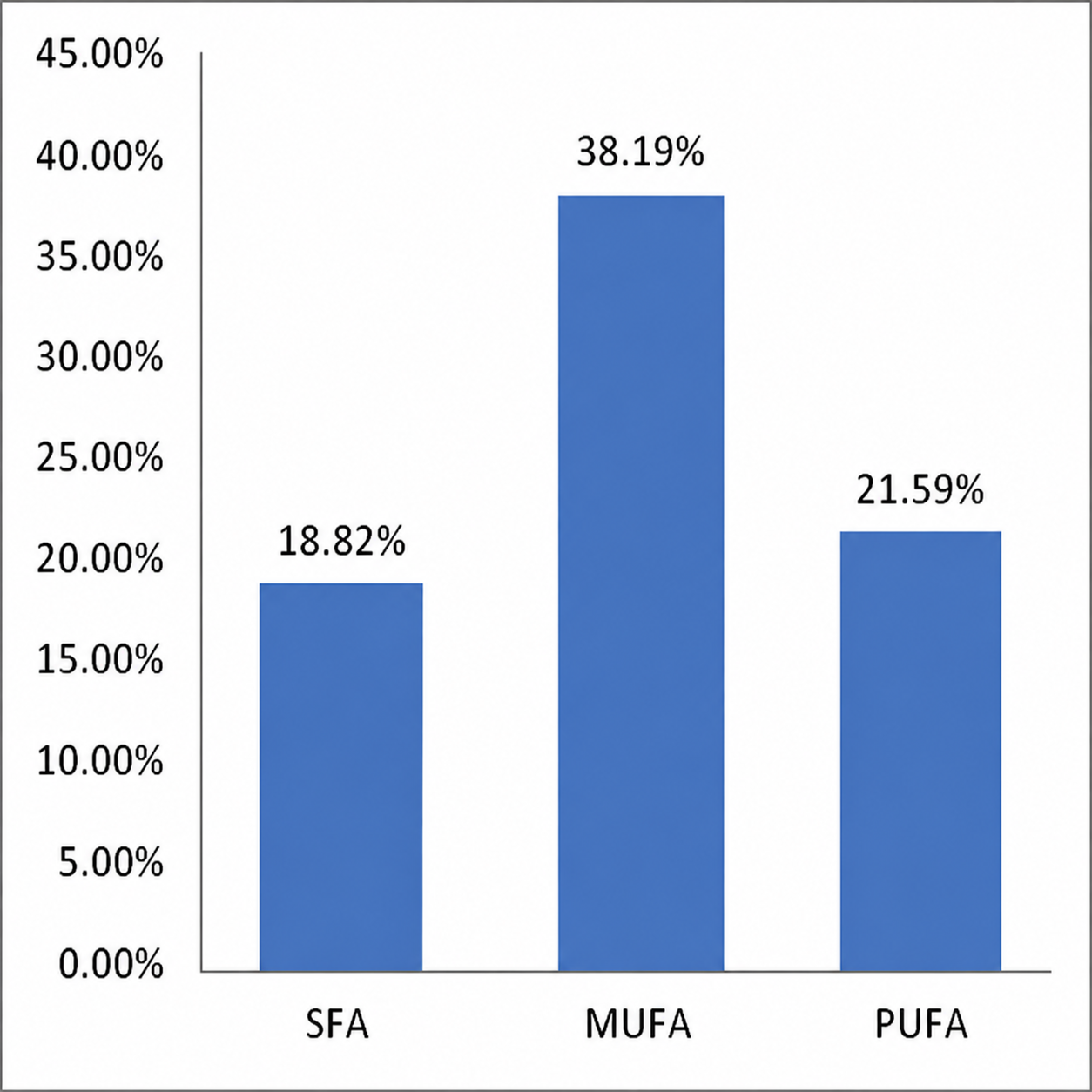
Fish meat possesses high nutritional value and is therefore a particularly recommended dietary component. Fish tissue is known as the main source for long chain polyunsaturated fatty acids (PUFAs) supply, which positively influence human health. These PUFAs favorably improve lipid profiles and reduce the risk of coronary heart diseases (CHD). Thus, this study was carried out to determine the fatty acid composition in the flesh of Blue whiting fish (Micromesistius poutassou) brought from Badagry market, Lagos west, Nigeria using gas chromatographic method. A total of twelve different fatty acids were obtained in the muscle of Blue whiting fish. The composition of saturated fatty acids (SFA), monounsaturated fatty acids (MUFA) and polyunsaturated fatty acids (PUFA) was found to be 18.8%, 38.2% and 21.5%, respectively. Palmitic acid (C16:0) and erucic acid (C22:1w9) were identified as the major SFA and MUFA respectively. Docosahexaenoic acid (C22:6w3) and eicopentaenoic acid (C20:5w3) had the highest levels amongst the PUFAs. Results show that blue whiting fish is a good source of omega-3 fatty acids.
References
C. Alasalvar, K.D.A. Talyor, E. Zubcov, F. Shahidi, M. Alexis (2002). Differentiation Of Cultured and Wild Sea bass (Dicentrarchuslabrax):Total Lipid Content, Fatty Acid and Trace Mineral Composition. Food Chem., 79: 145-150.
C. Alasalvar, K. Miyashita, F. Shahidi, U. Wanasundra (2011). Handbook of Seafood Quality, Safety and Health Applications. New Delhi: Blackwell Publishing Ltd: pp.13-29.
A.W.O.A. Louly, E.M. Gaydou, M.V.O. El-Kebir, (2011). Muscle Lipids and Fatty acid profiles of three edible fishes from the Mauritanian coast: Ephinephelus aenus, Cephalopholis taeniops and Serranus sciba. J. Food Chem., 124: 24-28.
R.G. Ackman (1988). Concerns for Utilization of Marine Lipids and oils. Food Tech., 42:151-155.
R.G. Ackman (1989). Fatty Acids. In Ackman RG (Ed), Marine Biogenic Lipids, Fats and Oils (pp 145-178).CRC Press. Boca Rato.
A. Bayir, H.I. Haliloglu, A.N. Sirkecioglu, N.M. Aras (2006). Fatty acid Composition of Some Selected Marine Fish Species Living Turkish Waters. J. Sci. Food Agric., 86:163-168.
E.G. Bligh and W.J. Dyer (1959). A rapid method of total lipid extraction. Can. J. Biochem. Phys., 37: 911-917.
M.Celik, and M.A. Gokce (2003). Cukurova (Adana) Bolgesi’nden Bes Ayri Tilapia TurununYag Asidi Iceriklerinin Tespiti. Turk. J. Vet. Anim. Sci., 27: 75-79.
D.M. Cohen, T. Inada, T. Iwamato, N. Scialaba (1990). FAO species catalogue. Vol.10. Gadiform fishes of the world (Order Gadiformes). An annotated and illustrated catalogue of cods, hakes, grenadiers and other gadiform fishes known to date. FAO Fisheries Synopsis. 10(125).
W.E. Conner (1997). The beneficial effect of omega-3 fatty acids in cardiovascular diseases and neurodevelopment. Curr. Opin. Lipidol., 8: 1-3.
A.P. DeFilippis, M. Blaha, T.A. Jacobson (2010). Omega-3 fatty acids for cardiovascular disease prevention. Curr. Treat. Options Cardiovasc. Med., 12: 365-380.
S.S. DeSilva, R,M, Gunasekera, B.A. Ingram, (2004). Performance of Intensively Farmed Murray Cod Maccullochella peeliipeelii (Mitchell) Fed Newly Formulated vs. Currently Used Commercial Diets , and a Comparison of Filled Composition of Farmed and wild fish. Aquacult. Res., 35: 1039-1052.
D.B. Duncan (1995). New multiple range and multiple F-tests. Biometrics, 11: 1-42.
L. Eboh, H.D. Mepba, M.B. Ekpo (2006). Heavy metal contaminant and processing effects on the composition, storage stability and fatty acid profiles of five common commercially available fish species in Oron Local Government, Nigeria. Food Chem., 97: 490-497.
F. Gao, A.Y. Taha, K. Ma, L. Chang, D. Kiesewetter, S.I. Rapoport (2012)."Aging decreases rate of docosahexaenoic acid synthesis-secretion from circulating unesterified α-linoleic acid by rat liver" . Postag. Leukotr. Essen. fatty acids, 75: 213-217.
J. Glogowski and A. Ciereszko (2001). Why we should increase fish consumption, especially that of Rainbow Trout Magazine Przemysl Rybn. 2: 95-102 (In Polish, with English abstract).
D.T. Gordon and V. Ratliff (1992). The Implications of Omega-3 Fatty Acids In Human Health, in Martins, R.E. Flicks eds, Advances in Seafood Biochemistry Consumption and Quality 69-98. Technomic Publishing Co. Inc. Gogus, A.K. and Kolsarici,N. (1992). Su UrunleriTeknolojisi. A.U. ZiraatFak. Yay: 1243, Ankara, Turkey.
M.I. Gurr (1984). Roles of Fat and nutrition :In Fats in Health and Diseases, Elsevier Applied Science Publishers, Barking, Essex, UK,
D.J. Holub and B.J. Holub (2004). Omega-3 fatty acids from fish oils and cardiovascular disease- Molec. Cell. Biochem., 263: 217-225.
P.M. Kris-Etherton, W.S. Harris, L.J. Appel (2002). AHA Scientific statement: Fish Consumption, fish oil, omega-3 fatty acids and cardiovascular disease. Circulation, 106: 2747-2757.
J.M. Lecerf (2007). Produits de la peche et acidesgras omega-3.Interet en prevention cardio-vasculaire. Phytotherapie, 5: 14-21.
A. Mnari and I. Bouhle (2007). Fatty acids in muscle and liver of Tunisian Wild and Farmed Gilthead Sea Bream Sparus aurata. Food Chem., 100: 1393-1397.
H. Osman, A. Suriah, C. Law (2001). Fatty acid composition and cholesterol content of selected marine fish in Malaysian waters. Food Chem., 73: 55-60.
R. Rossano, M.A. Caggiano, L. Mastrangelo, R. Di-Lauro, N. Ungaro, M. Ettore, P. Riccio (2005). Proteins, Fatty Acids, and Nutritional Value in the muscle of the Fish Species Mora moro (Risso,1810). Mol. Nut. Food Res., 49: 926-931.
S. Saglik and S. Imre (2001). N-3-Fatty acids in some fish species from Turkey. J. Food Sci., 66: 210-212.
G.F. Sengor, O. Ozden, N. Erkan, M. Tuter, H.A. Aksoy (2003). Fatty Acid Composition of Flathead Grey Mullet (Mugilcephalus) (L.1758) Fillet, Raw, and Beeswaxed Caviar Oils. Turk. J. Fish. Aquat. Sci. 3: 93-96.
L. Sensor, M.D. Suarez, T. Ruiz-Cara, M. Garcia-Gallego (2007). Possible effects of Harvesting Seasoned and Chilled Storage on the Fatty Acid Profile of the Filled of Farmed Gilthead Sea Bream (Sparus aurata). Food Chem., 101: 298-307.
A.R. Suriah, T.S. Huah, O. Hassan, N.M. Daud (1995). Fatty acid composition of some Malaysian fresh water fish. Food Chem., 54: 45-49.
V.V. Vladau, I. Bud, R. Stefan (2008). Nutritive value of fish meat comparative to some animal meat. Bulletin of University of Agricultural Sciences and Veterinary Medicine. Animal Sciences and Bio technologies, 65: 301-305.
S.C. Wheeler and T.C. Morrissey (2003). Quantification and Distribution of Lipid Moisture, and fatty Acids of West Coast Albacore Tuna (Thunnus alalunga). Journal of Aquatic Food Product Technology, 12: 3-16.
J.D. Wood, M. Enser, A.V. Fisher, G.R. Nute, P.R. Sheard, R.I. Richardson, S.I. Huges, F.M. Whittington (2008). Fat deposition, fatty acid composition and meat quality: A review. Meat Sci., 78: 343-358.
Downloads
Published
Issue
Section
License
Copyright (c) 2015 Author (s)

This work is licensed under a Creative Commons Attribution-NonCommercial-NoDerivatives 4.0 International License.
Copyright © The Author(s). This is an open access article distributed under the terms of the Creative Commons Attribution-NonCommercial-NoDerivatives 4.0 International License (CC BY-NC-ND 4.0), which permits unrestricted non-commercial use, distribution, and reproduction in any medium, provided the original author(s) and source are properly credited, and the work is not modified or adapted.