Cypselas Diversity as Novel Taxonomic Marker in the Tribe Astereae (Family Asteraceae)
Keywords:
Astereae, cypsela, mesocarp, pappus, surface hair, testaAbstract
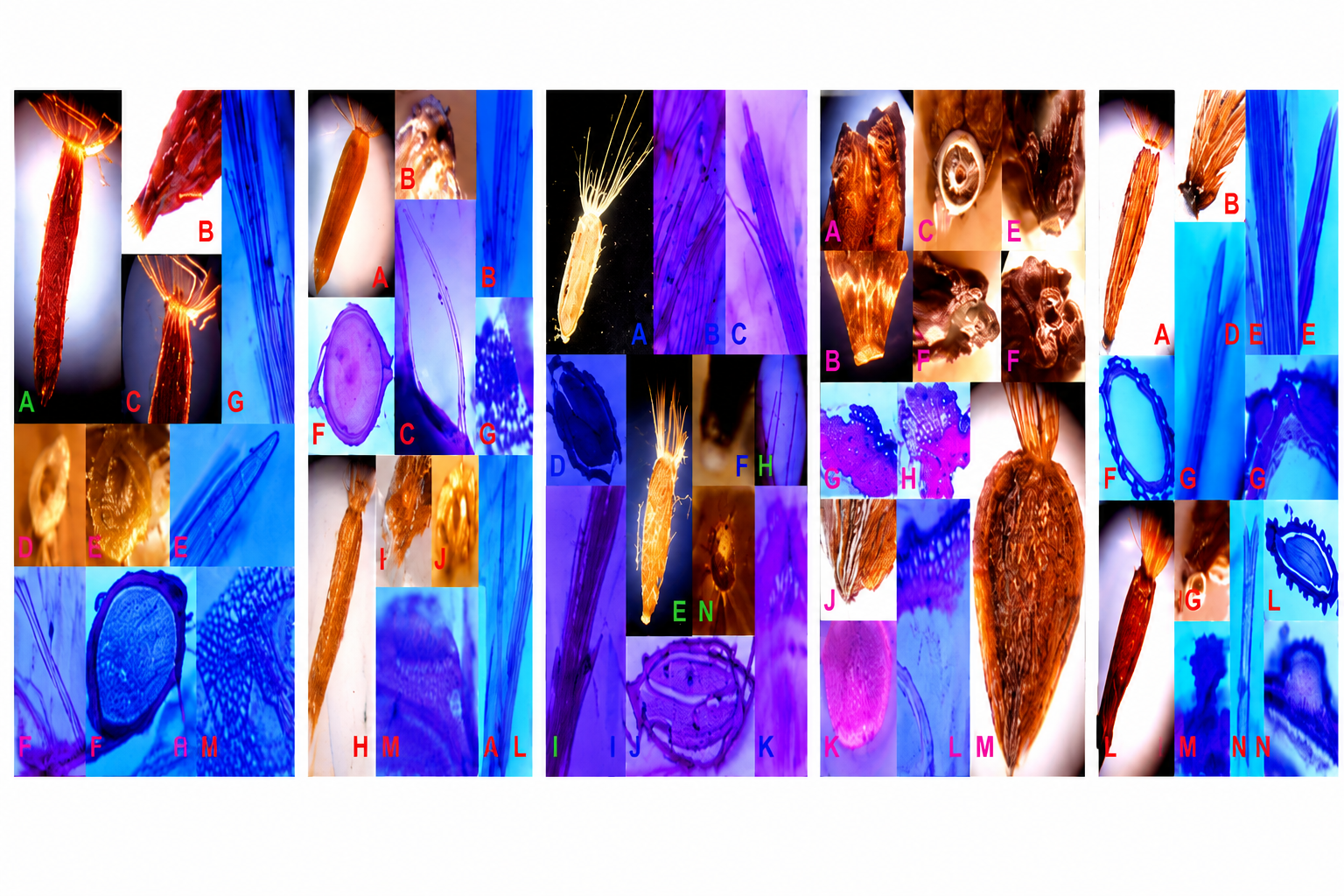
Despite the second largest tribe of the family Asteraceae and immense importance of morphology of cypsela for taxonomic delimitation at tribe level, no work has been done in this direction in the tribe Astereae. In order to evaluate taxonomic implication of cypselas features, diversity of morpho-anatomical features has been carried out in the tribe Astereae. Detail macro as well as micro-morphology and anatomy of cypselas of nine taxa including two species of Aster, two species of Conyza and one species each of Erigeron, Grindelia, Kalimeris, Solidago and Vittadinia of the tribe Astereae (Family Asteraceae) have been examined using Light Microscope. Experiments showed that surface characteristics like distribution arrangement, hair type, ribs and their number, pappus diversity and presence and absence of wing were taxonomically more important features in comparison to colour, size and shape of cypsela. Among anatomical features, mesocarpic characters like type of tissue (whether parenchymatous or sclerenchymatous), their distribution pattern, and nature of testal layer were found to be significant for the tribe Astereae. Finally, involving all these cypselas features an artificial key to the studied species is constructed. The key based on morpho-anatomical fearures could be used as reference key to identify taxa of the tribe Astereae solely based on its cypsela in absence of their flowering stage.
References
A. K. Pandey (2003). Embryology of Compositae. Advances in Plant Reproductive Biology 2: 21-76.
A. K. Pandey, S. Chopra and R. P. Singh (1982). Anatomy of seeds and fruits in some Asteraceae (Compositae). Geophytology 12: 105-110.
B. Jana and S. K. Mukherjee (2014). Inter tribal variations of fruit structure among four tribes of the family Compositae. Indian Journal of Applied & Pure Biology 29(2): 291-301.
C. De Mirbel (1815). Elements of Plant Physiology and Botany.
D. A. Johansen (1940). Plant microtechnique. McGraw Hill, New York.
G. L. Nesom and H. Robinson (2007). Astereae. in JW Kadereit, C Jeffrey (eds.), Springer, Berlin, pp. 284-342.
H. Merxmuller and J. Grau (1977). Fruchtanatomische Untersuchungen in der Inula-Gruppe (Asteraceae). Publications of Cairo University, Egypt 7-8: 9-20.
H. P. Sharma and Y. S. Murty (1977). Embryological studies in the Compositae :tribe Astereae, Brachycome iberidifolia Benth., a casual apomicts. Journal of Indian Botanical Society 56: 321-328.
I. Breitwieser and J. M. Ward (2005). Morphological evidence for the tribal position of Haastia (Asteraceae). New Zealand Journal of Botany 43: 767-777.
J. Grau (1977). Asteraceae-systematic review. in V H Heywood, JB Harborne, BL Turner (eds.), Academic Press, London, pp. 567-576.
J. Kothari, K. C. Sharma and M. Sharma (2012). Micromorphology of fruit surfaces in some taxa of the tribe Astereae (Asteraceae) and their taxonomic significance. Indian Journal of Plant Sciences 1: 240-262.
J. Marzinek, O. C. De-Paula and D. M. T. Oliveira (2008). Cypsela or achene? Refining terminology by considering anatomical and historical factors. Revista Brasileira de Botânica 31: 549-553.
K. Bremer (1987). Tribal interrelationships of the Asteraceae. Cladistics 3: 210-253.
K. Bremer (1994). Asteraceae. Cladistics and Classification. Timber Press, Portland.
K. Bremer and C. Humphries (1993). Generic monograph of the Asteraceae-Anthemideae. Bulletin of the Natural History Museum, Botany Series 23: 71-177.
L. Brouillet, T. K. Lowrey, L. Urbatsch, V. Karaman-Castro, G. Sancho, S. Wagstaff and J. C. Semple (2009). Astereae. in Systematics, Evolution, and Biogeography of Compositae, Smithsonian Institution, Washington DC., USA, pp. 587-629.
M. Kynclova (1970). Comparative morphology of achenes of the tribe Anthemideae Cass. (Asteraceae) and its taxonomic significance. Preslia 42: 33-53.
M. Z. Haque and M. B. E. Godward (1984). New records of the carpopodium in Compositae and its taxonomic use. Botanical Journal of the Linnean Society 89: 321-340.
P.K. Holmgren, W. Keuken and E. K. Schofield (1981). Index Herbariorum. Part I. The Herbaria of the World. Edition 7 (Haque : Regnum Vegetabile, 106).
P.P.J. Herman (2013). Cypsela morphology in the genus Nolletia (Asteraceae, Astereae) and a revision of the genus. Phytotaxa 122 (1): 1-44.
S. Frangiote-Pallone and L. Antonio de Souza (2014). Pappus and cypsela ontogeny in Asteraceae: structural considerations of the tribal category. Revista Mexicana de Biodiversidad 85: 62-77.
S. K. Mukherjee and A. K. Sarkar (2001). Morphology and structure of cypselas in thirteen species of the tribe Astereae (Asteraceae). Phytomorphology 51(1): 17-26.
S. Sundberg (1985). Micromorphological characters as generic markers in the Astereae. Taxon 34: 31-37.
T. Talukdar (2008). Comparative study of cypselas in three common species of Asteraceae. Pleione 2(1): 147-149.
T. Talukdar and D. Talukdar (2013). Response of antioxidative enzymes to arsenic-induced phytotoxicity in leaves of a medicinal daisy, Wedelia chinensis Merrill. Journal of Natural Science, Biology and Medicine 4(2): 383-388.
T. Talukdar and S. K. Mukherjee (2014). Cypselar diversity in four species of Senecio L. (Asteraceae). Bangladesh Journal of Plant Taxonomy 21(1): 13-17.
V. H. Heywood, J. B. Harborne and B. L. Turner (1977). An overture to the Compositae. in V H Heywood, JB Harborne, BL Turner (eds.), Academic Press, London, pp. 1-19.
W. Barthlott (1981). Epidermal and seed surface characters of plants: systematic applicability and some evolutionary aspects. Nordic Journal of Botany 1(3): 345-355.
W. S. Judd, C. S. Campbell, E. A. Kellogg, P. F. Stevens and M. J. Donoghue (2002). Plant systematic - a phylogenetic approach, Sinauer Associates, Sunderland.
Z. Xiaoping and K. Bremer (1993). A cladistic analysis of the tribe Astereae (Asteraceae ) with notes on their evolution and subtribal classification. Plant Systematics and Evolution 184: 259-283.
Downloads
Published
Issue
Section
License
Copyright (c) 2015 Author (s)

This work is licensed under a Creative Commons Attribution-NonCommercial-NoDerivatives 4.0 International License.
Copyright © The Author(s). This is an open access article distributed under the terms of the Creative Commons Attribution-NonCommercial-NoDerivatives 4.0 International License (CC BY-NC-ND 4.0), which permits unrestricted non-commercial use, distribution, and reproduction in any medium, provided the original author(s) and source are properly credited, and the work is not modified or adapted.