Effect of Water Quality on Phytoplankton Abundance in Selected Ponds of Nedumangad Block Panchayat, Kerala
Keywords:
abundance, dissolved oxygen, phytoplankton, water quality, zooplanktonAbstract
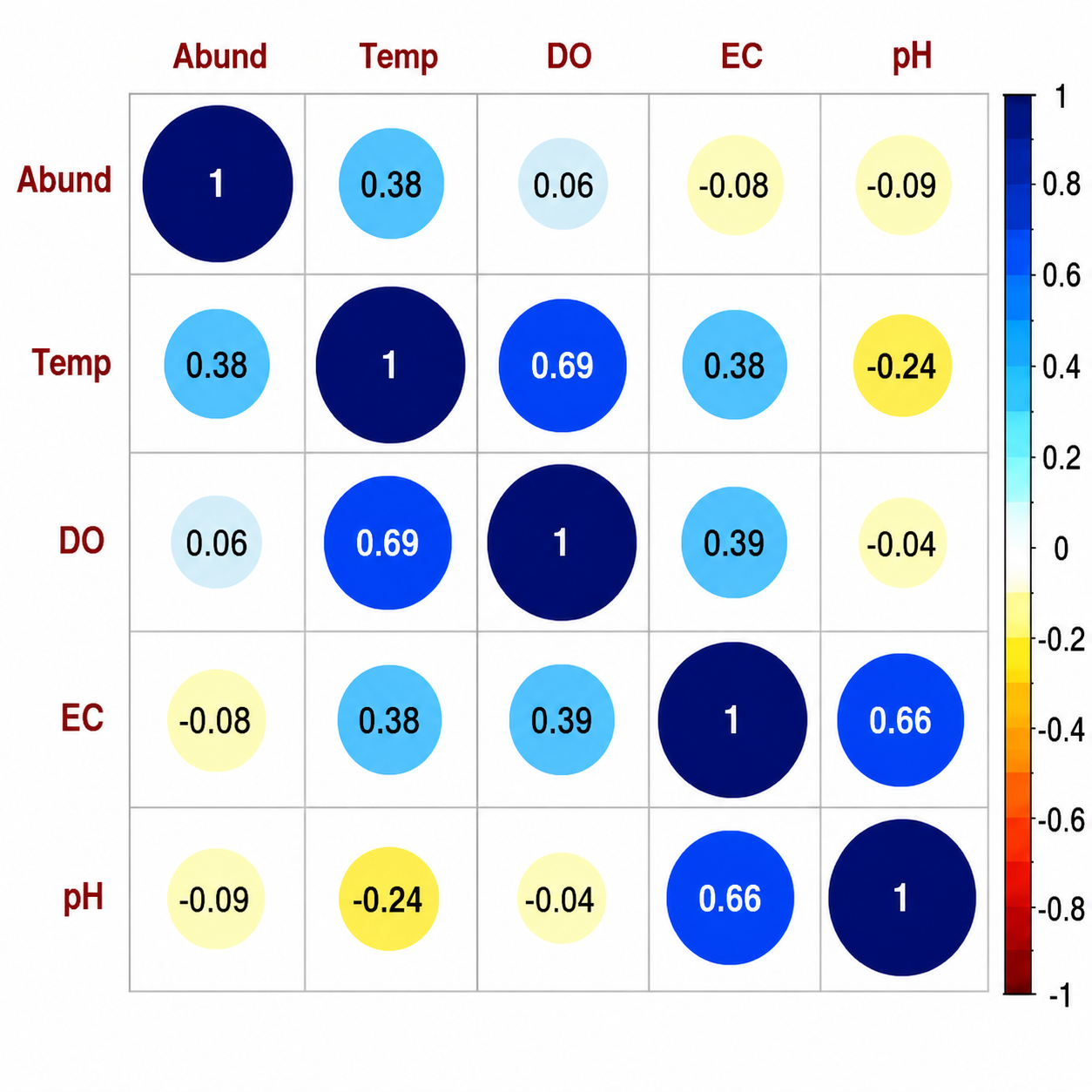
The present study was carried out to analyze the plankton diversity of 36 selected ponds in Nedumangad Block Panchayat. It is crucial to observe the physico-chemical features of a water body for different term investigations as the survival and activity of organisms depends on the environmental characteristics of that water body. Plankton analysis showed the presence of phytoplankton belonging to the class Cyanophyceae, Chlorophyceae, Bacillariophyceae and zooplanktons found are Zoea larvae and Mysis larvae of prawn. Moreover, phytoplankton reflects the water environmental condition at the time of growing and sampling. Phytoplanktons are greatly affected by ecological conditions like salt stress, temperature, pH, biological oxygen demand and other environmental factors. The plankton abundance was calculated for 10 selected ponds. Carl Pearson’s correlation coefficients were calculated for abundance with pH, EC, DO and temperature. Abundance depends on the temperature variations and levels of DO as they are positively correlated while abundance does not have any interdependence on both the EC and pH as they are negatively correlated. Results of plankton abundance of various ponds at Nedumangad as studied in the present investigation clearly shows that the water is not good for human consumption and also struggling for their existence. Algal analysis thus showed that water quality of the pond has reached at threshold level and therefore, it needs some corrective measures to maintain the water chemistry of the pond and this will help the society to get an awareness of the quality of the water.
References
APHA: Standard methods for examination of water and wastewater. 21st Edn. APHA, AWWA, WPCF, Washington DC, USA (2005).
B. Tas and. A. Gonulol (2007). An ecologic and taxonomic study on phytoplankton of a shallow lake, Turkey. J. Environ. Biol., 28: 439-445.
C. E. Boyd (2004). Water quality management for pond fish culture, Elsevier, New York eds.
C. E. Boyd and C. S. Tucker (1988). Pond Aquaculture Water Quality Management (Kluwer Academic Publisher London.
C. M. Palmer (1959). Algae in water supplies, US Department of Health, Education and Welfare, Public Health Service, Cincinnati. (Public Health Service publication No. 657).
J. P. Verma and R. C. Mohanty (1994). Evaluation of water quality of two fresh water ponds. Pollut. Res., 13: 69-74.
J. R. Karr, J. D. Allen and A. C. Benke (2000). River conservation in the United States and Canada. In P. J. Boon, Davies and B .R. Petts, G E (Ed.), Global perspectives on River conservation, pp 3–39 Science, Policy, and Practice. Wiley, New York.
K. Mahale and M. Malvankar (2013). The Study of Physico-Chemical Parameters and Plankton Diversity of the ponds in The V.P.M. Campus, Thane, Maharashtra, India. National Conference on Biodiversity: Status and Challenges in Conservation - ‘FAVEO’ Pp. 242-244.
L. R. Bhatt, P. Lacoul, H. D. Lekhal and P. K. Jha (1999). Physico-chemical characteristic and phytoplankton for Taudha lake, Kathmandu. Poll. Res., 18: 353-358.
M. L. Pace and A. T. Prairie (2004). Respiration in lakes. In P.A. del Giorgio and P. J. L. Williams [eds.], Respiration in aquatic systems. Oxford Univ. Press.
P. Williams, M. Whitfield, J. Biggs, S. Bray, G. Fox, P. Nicolet et al., (2003).Comparative biodiversity of rivers, streams, ditches and ponds in an agricultural landscape in Southern England, Biologic. Conserv., 115: 329–341.
R. G. Wetzel (1989). Limnology, 2nd edition (Saunders Co., Philadelphia, and PMCid: PMC534348V.
R. J. Stevenson and Y. Pan (1999). Assessing environmental conditions in Rivers and streams using diatoms. In E. F. Stoermer and J. P. Smol, (Ed.), The diatoms, Applications for the environmental and earth sciences, pp. 11–40 Cambridge University Press, Cambridge.
R. K. Trivedi and P. K. Goel (1986). Chemical and biological methods for water pollution studies, environmental publication, India.
S. Arya, V. Kumar, M. Raikwa, A. Dhaka and Minakshi (2011). Physicochemical Analysis of Selected Surface Water Samples of Laxmi Tal (Pond) in Jhansi City, UP, Bundelkhand Region, Central India, J. Exp. Sci., 2, 8, pp. 01-06.
S. Shekhar, S. Kiran, B. R. Puttaiah, Y. Shivaraj and K.M. Mahadevan (2008). Phytoplankton as index of water quality with reference to industrial pollution. J. Environ. Biol. 29: 233-236.
S. Zargar and T.K. Ghosh (2006). Influence of cooling water discharges from Kaiga nuclear power plant on selected indices applied to plankton population of Kadra reservoir. J. Environ. Biol., 27: 191-198.
S. B. Saha, S. B. Bhattacharya and A. Choudhury (2000). Diversity of phytoplankton of sewage pollution brackish water tidal ecosystems. Environ. Biol., 21: 9-14.
S. N. Nandan and A. H. Aher (2005). Algal community used for assessment of water quality of Haranbaree dam and Mosam river of Maharashtra. J. Environ. Biol., 26: 223-227.
U. G. Naik, S. H. Bhosale, J. L. Rathod and U. G. Bhat (2005). Diversity of phytoplankton groups in the river Kali, west coast of India. Proc.of the State Level UGC Sponsored Seminar on Biodiversity and its Conservation, Haveri, 28-29th July, pp. 192-196.
V. G. Jhingran (1991). Fish and Fisheries India. 3rd edition (Hindustan Publishing Corporation, India.
V. S. Bais and N. C. Agarwal (1990). Seasonal variations of nitrogen contents in the sediment and water of the Sagar lake. Bull. Environ. Sci., 8: 21-24.
Y. S. More and S. N. Nandan (2000). Hydro biological study of algae of Panzara River (Maharashtra). Ecol. Environ. Cons., 6: 99-103.
Downloads
Published
Issue
Section
License
Copyright (c) 2015 Author (s)

This work is licensed under a Creative Commons Attribution-NonCommercial-NoDerivatives 4.0 International License.
Copyright © The Author(s). This is an open access article distributed under the terms of the Creative Commons Attribution-NonCommercial-NoDerivatives 4.0 International License (CC BY-NC-ND 4.0), which permits unrestricted non-commercial use, distribution, and reproduction in any medium, provided the original author(s) and source are properly credited, and the work is not modified or adapted.