Documentation of Medicinal Plants based on Traditional Practices in the Indo-Burma Hotspots Region of Mizoram, North East India
Keywords:
documentation, ex-situ conservation, ethno-medicinal, ethno-veterinary, in-situ conservationAbstract
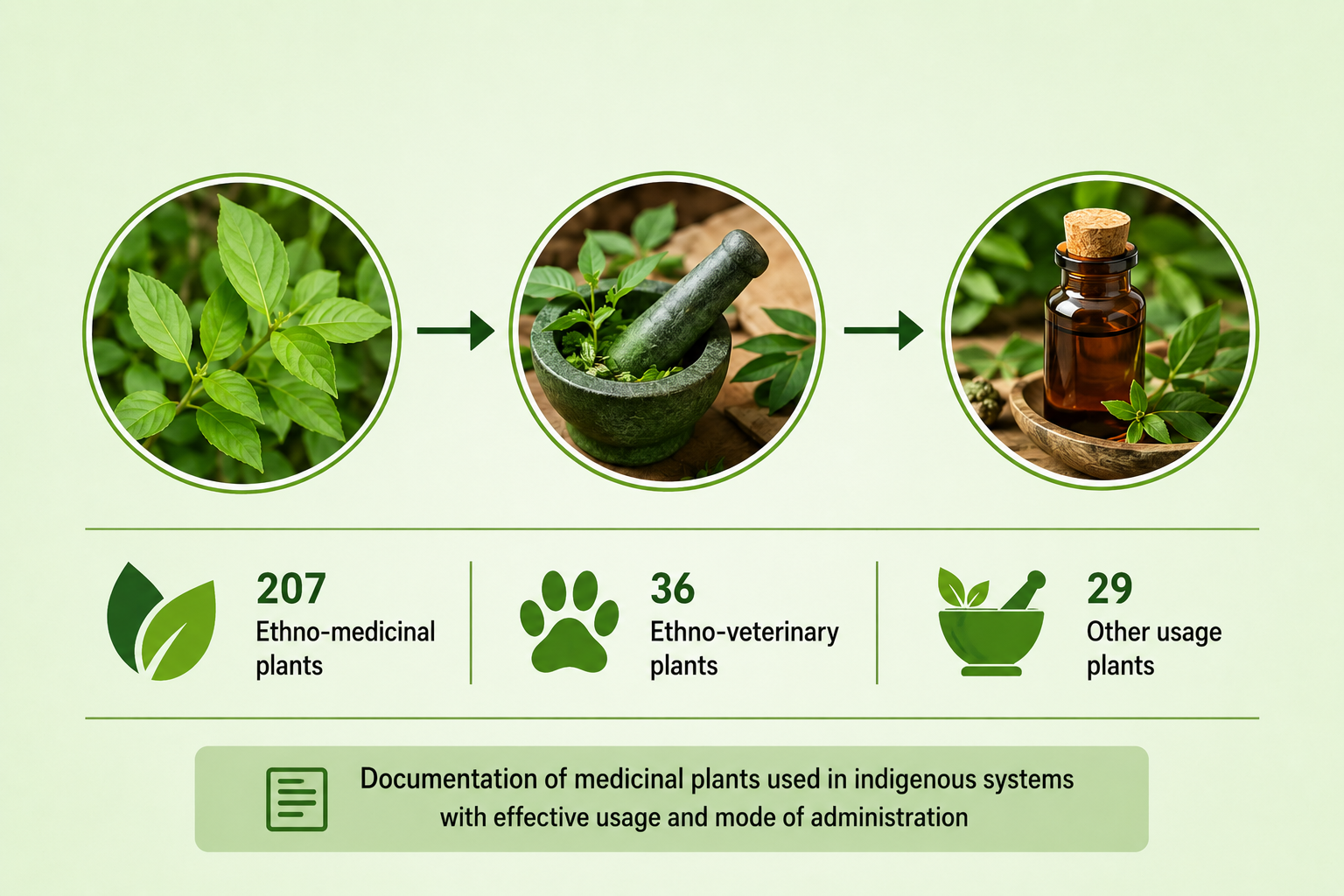
Present research is based on the documentation of the medicinal plants used in indigenous systems in Indo-Burma Hotspots Region of Mizoram, North East India. A total of 207 ethno-medicinal plants, 36 ethno-veterinary plants and 29 other usage plants were recorded from different regions of Mizoram. A detailed list of recorded plants with their effective usage and mode of administration has been provided.
References
[1] R. A. Mittemier, N. Myer, P. R. Gil, and C. G. Mittemier (2000). Earth’s biologically richest and most endangered Terrestrial Ecoregions. Comex, Conservation International and Agrupacion Sierra Madre. Monterrty, Mexico: 21- 67, 268-277.
[2] V. Ramakantha, A. K. Gupta and J. Kumar (2008). Biodiversity of Northeast India. http.# www.wii.gov.in/envis/rain forest/Chapter 1,htm.
[3] J. H. Lorrain (1940). Dictionary of the Lushai Langhuage.The Asiatic Society, Calcutta, 576p.
[4] Anonymous (2012). Statistical Hand Book Mizoram. Directorate of Economics & Statistics, Mizoram, Aizawl, pp.1-25.
[5] Lalchhuanawma Hrahsel (2014). Mizoram Statistics. SB Offset Printing Press, Dawrpui, Aizawl, pp.1-243.
[6] Anonymous (2015) India State of Forest Report, Forest Survey of India,2.11,& pp.201-206.
[7] G. H. Champion and S. K. Seth (1968). A revised survey of the forest types of India. Natraj Publishers, Dehradun, (Rep.2005), 404p.
[8] Anonymous (1979). Satelite Remote Sensing Survey of Mizoram: A report. National Remote Sensing Agency, Secudarabad.
[9] Anonymous (1992). Report of Forest Resources of Lunglei and Chhimtuipui Districts (Mizoram State), Forest Survey of India, p.4.
[10] Anonymous (2003). State of Forest Report. Forest Survey of India, Dehradun, pp. 117-121.
[11] Anonymous (2011). Indian State of Forest Report. Forest Survey of India, pp. 187-190.
[12] A. T. Gage (1899). A Botanical Tour to the Southern Lushai Hills, Periodical Expert Book Agency, Delhi, pp.331-369.
[13] N. E. Parry (1932). The Lakhers, Appendix VII, (Rep. 1976). Firma KLM Private Limited Calcutta, on behalf of Tribal Research Institute, Aizawl, Mizoram, pp.586-613.
[14] C. E. C. Fischer, R. L. Badhwar and H. N. Dixon (1938). Flora of the Lushai Hills. Records of Botanical Survey of India, 12: 61-75.
[15]M. Sawmliana (2003). Plants of Mizoram.Louis Bet, Chanmari, Aizawl.
[16] H. Lalramnghinglova (2003). Ethnomedicinal Plants of Mizoram. Bishen Singh Mahendra Pal Singh, DehraDun, pp333.
[17] Zoram Upa Pawl Thurawn Bu (1978). (Advice to the Public),(Mizo Version). L.B. Press, Treasury Square, Aizawl, pp1-80.
[18] P. K. Rai and H. Lalramnghinglova (2011). Threatened and less known ethnomedicinal plants of an Indo-Burma hotspot region: conservation implications. Environ. Monit. Assess., 178: 53-62.
[19] S. K. Jain and R. R. Rao (1977). Handbook of field and herbarium methods. Today & Tomorrow’s Printers and Publishers, New Delhi.
[20] D. Bridon and L. Forman (1999). The herbarium handbook (3rd edition). Royal Botanic Gardens, Kew, UK. pp334.
[21] Anonymous (2002). Mizoram Statistical Hand Book. Directorate of Economics & Statistics, Mizoram. Aizawl, pp21.
[22]Anonymous (2008). Economic Survey of Mizoram. Planning & Programme Iimplementation Department, Govt. of Mizoram, pp1-130.
[23] D. R. Given (1996). How plants become extinct? Principles and Practices of Plant Conservation. Timber Press, Portland, Oregon, pp15-17.
[24] P. A. Cox (1994). The ethnobotanical approach to drug discovery: strength and limitations. Ciba Found. Symp., 185: 25-36. http://www.ncbi.nlm.nih.gov/pubmed/7736859.
Downloads
Published
Issue
Section
License
Copyright (c) 2016 Author (s)

This work is licensed under a Creative Commons Attribution-NonCommercial-NoDerivatives 4.0 International License.
Copyright © The Author(s). This is an open access article distributed under the terms of the Creative Commons Attribution-NonCommercial-NoDerivatives 4.0 International License (CC BY-NC-ND 4.0), which permits unrestricted non-commercial use, distribution, and reproduction in any medium, provided the original author(s) and source are properly credited, and the work is not modified or adapted.