
A Comparative Study of Land use Classification using Remote Sensing Techniques, in and around Selected Sacred Groves of Thiruvananthapuram District
Keywords:
accuracy estimation, biodiversity, remote sensing, sacred grovesAbstract
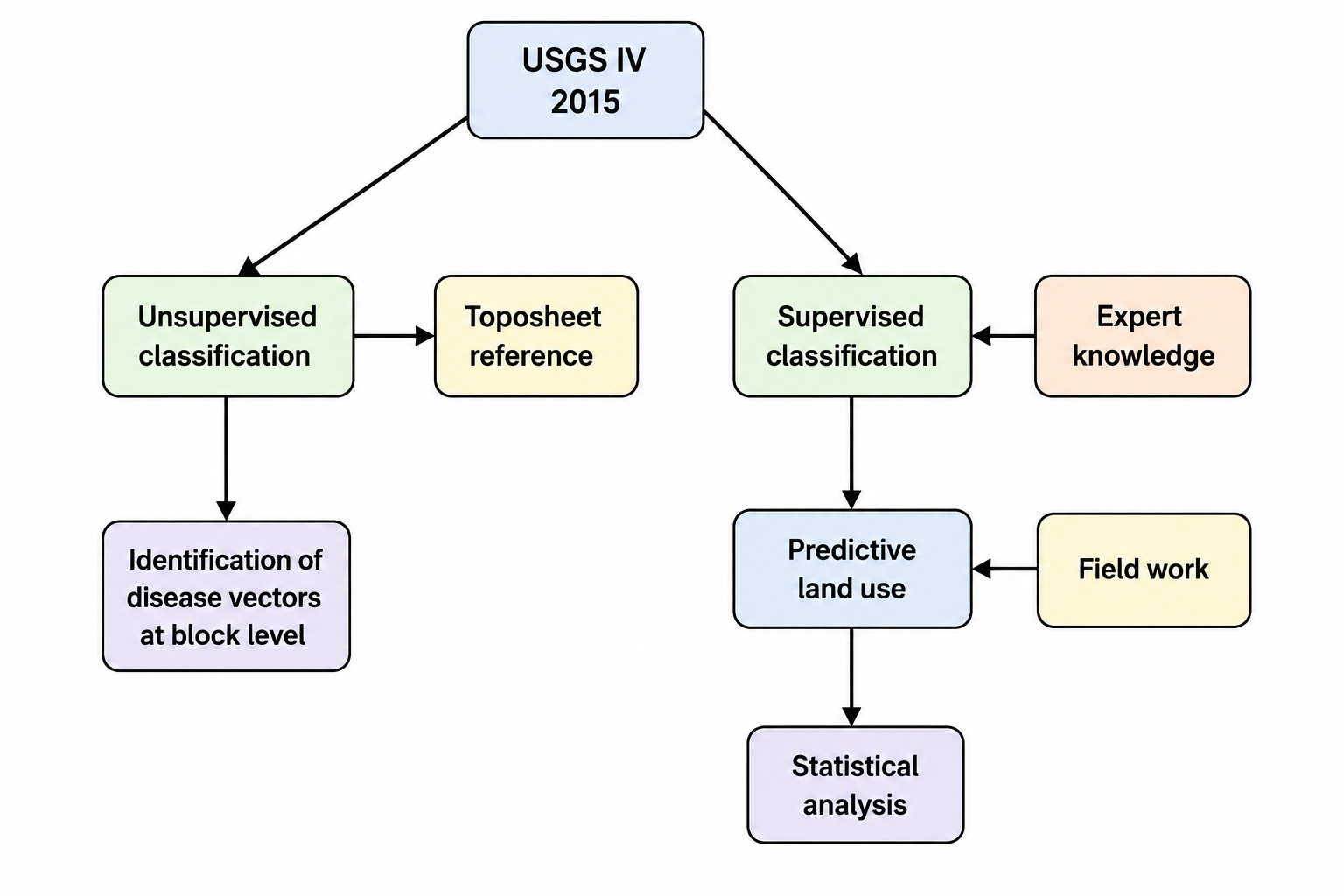
Sacred groves are small forest patches or remnants of forests that are biodiversity-rich areas and revered in the name of God. Rapid urbanization and the concomitant development of infrastructure have taken a heavy toll on these unique ecosystems. The present study has identified and mapped seven selected Sacred groves in Thiruvananthapuram district and also analyzed the land use in the area using Remote Sensing data. The accuracy of unsupervised classification-based image and supervised classification-based predicted land use was compared and Kappa accuracy was assessed. The results showed moderate classification accuracy. The area-wise details of different land use categories were also obtained as part of the study.
References
[1] M. P. Ramanujam and P. K. Cyril (2003). Woody species diversity of four sacred groves in the Pondicherry region of south India. Biodiversity and Conservation, 12: 289-299.
[2] R. S. Tripathi (2005). Sacred groves of north-east India and their floristic richness and significance in biodiversity conservation. EnviroNews Newsletter of ISEB India, 11: 1-2.
[3] C. G. Kushalappa and S. A. Bhagwat (2001). Sacred groves: Biodiversity, threats and conservation. Pages 21-29, In: Uma Shaanker, R., Ganeshaiah, K.N. and Bawa, K.S.(Editors) Forest Genetic Resources: Status, Threats andConservation Strategies. Oxford and IBH Publishing, New Delhi.
[4] J. D. Hughes and M. D. S. Chandran (1998). Sacred groves around the Earth: an overview. Pages 69-86 in P. S. Ramakrishnan, K. G. Saxena and U. M. Chandrashekara, editors. Conserving the sacred for biodiversity management. Oxford and IBH, New Delhi.
[5] P. S. Ramakrishnan (1996). Conserving the sacred: from species to landscapes. Nature and Resources, 32: 11-19. UNESCO
[6] R. K. Bhakat (1990). Tribal ethics of forest conservation. Yolanda (March 16-31): 23-27.
[7] M. Gadgil and V. D. Vartak (1976). The sacred groves of the Western Ghats in India. Economic Botany, 30: 152-60.
[8] R. J. J. Burman (1992). The institution of sacred grove. Journal of Indian Anthropology and Society 27: 219-238.
[9] S. S. Gaikwad, S.N. Paralikar, V. Chavan and S. Krishnan (2004). Digitizing Indian sacred groves – an information model for web interfaced multimedia database. Pages 123-128, In: Ghate, V., Hema, S. and Ranade, S.S. (Editors) Focus on Sacred Groves and Ethnobotany: Prisam publications, Mumbai.
[10] K. G. Saxena, K. S. Rao and R. K. Maikhuri (1998). Religious and cultural perspective of biodiversity conservation in India: A review. Pages 153-161, In: Ramakrishnan, P.S., Saxena, K.G. and Chandrasekhar U.M. (Editors) Conserving the Sacred for Biodiversity Management. UNESCO and Oxford-IBH Publishing, New Delhi.
[11] R. G. Congalton (1991). A review of assessing the accuracy of classifications of remotely sensed data. Remote Sensing of Environment, 37: 35-46.
[12] M. T. Lillesand, R. W. Kiefer and J. W. Chipman (2008). Remote sensing and image interpretation (6th ed.). Hoboken, NJ: Wiley.
[13] G. H. Rosenfield and K. Fitzpatrick-Lins (1986). A coefficient of agreement as a measure of thematic classification accuracy. Photogrammetric Engineering and Remote Sensing, 52: 223-227.
[14] J. Carletta, (1996). Assessing agreement of classification tasks: The Kappa statistic. Computational Linguistics, 22: 249-254.
Downloads
Published
Issue
Section
License
Copyright (c) 2016 Author (s)

This work is licensed under a Creative Commons Attribution-NonCommercial-NoDerivatives 4.0 International License.
Copyright © The Author(s). This is an open access article distributed under the terms of the Creative Commons Attribution-NonCommercial-NoDerivatives 4.0 International License (CC BY-NC-ND 4.0), which permits unrestricted non-commercial use, distribution, and reproduction in any medium, provided the original author(s) and source are properly credited, and the work is not modified or adapted.