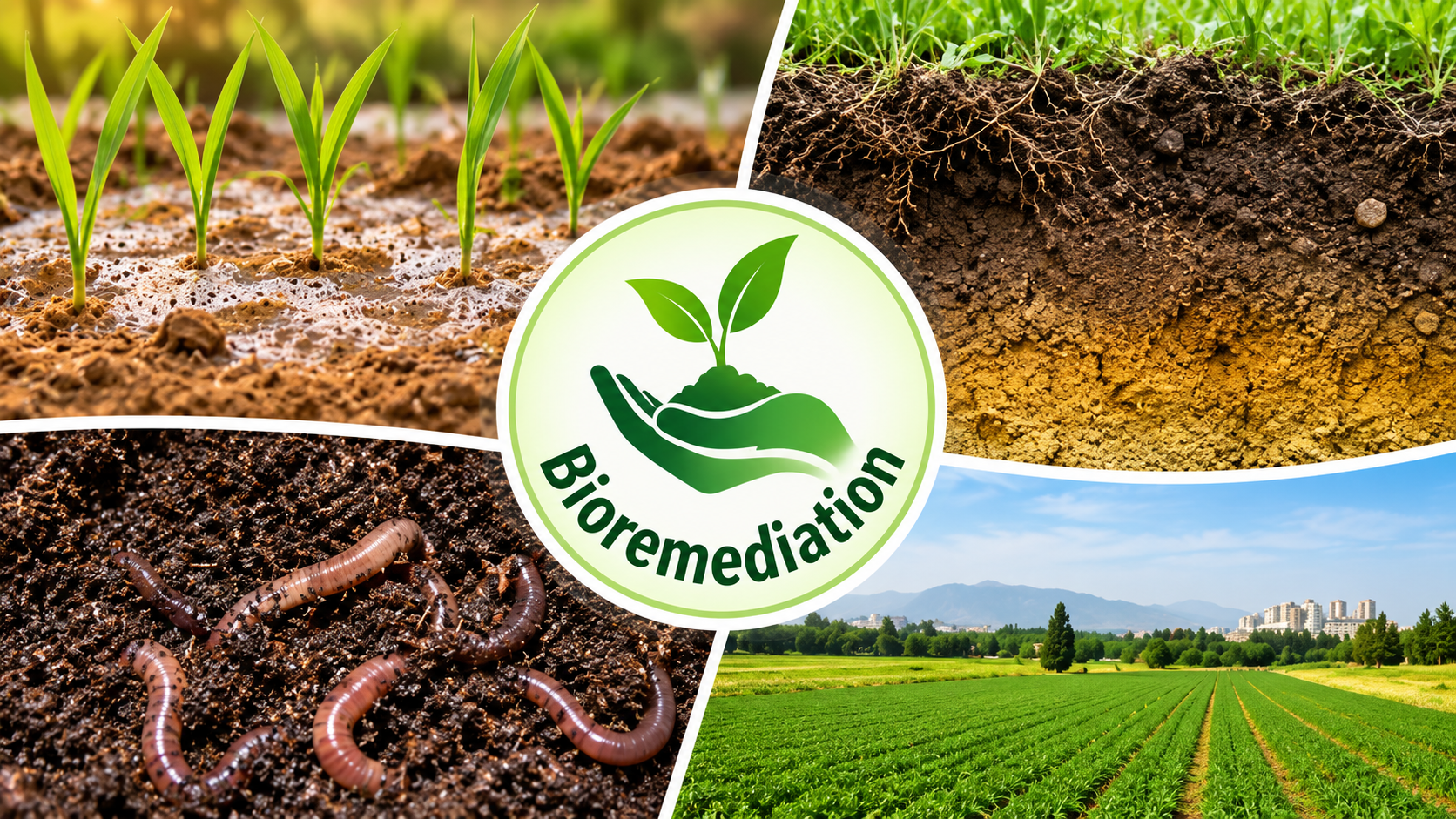
Bioremediation: An Eco-friendly Approach for Polluted Agricultural Soil
Keywords:
agriculture, organic, soilAbstract
A wide variety of synthetic organic compounds are used in agricultural practices. These compounds are used mainly to control pests and increase crop productivity. However, after utilization these agricultural compounds enter into the soil, water, air and plant tissues.
References
[1] M. McGuinness and D. Dowling (2009). Plant-Associated Bacterial Degradation of Toxic Organic Compounds in Soil. Int. J. Environ. Res. Public Health, 6: 2226-2247.
[2] M. C. Diez (2010). Biological Aspects Involved in the Degradation of Organic Pollutants. J. Soil. Plant. Nutr., 10: 244-267.
[3] K. Kannan, S. Tanabe, R. J. Willians and R. Tatsukawa (1994). Persistent Organochlorine Residues in Foodstuffs from Australia, Papua New Guinea and the Solomon Islands: Contamination Levels and Dietary Exposure. Sci. Total Env., 153: 29-49.
[4] P. Debarati, P. Gunjan, P. Janmejay and V. J. K. Rakesh (2005). Accessing Microbial Diversity for Bioremediation and Environmental Restoration. Trends Biotechnol., 23: 135-142.
[5] S. D. Finley, L. J. Broadbelt and V. Hatzimanikatis (2010). In Silico Feasibility of Novel Biodegradation Pathways for 1,2,4-Trichlorobenzene, BMC Syst. Biol., 4: 4-14.
[6] M. W. Aktar, D. Sengupta and A. Chowdhury (2009). Impact of pesticides use in agriculture: their benefits and hazards. Interdiscp. Toxicol., 2: 1-12.
[7] J. Jeyaratnam (1985). Health problems of pesticide usage in the third world. Br. J. Ind. Med., 42: 505-506.
[8] R. K. Kole, H. Banerjee and A. Bhattacharyya (2001). Monitoring of market fish samples for Endosulfan and Hexachlorocyclohexane residues in and around Calcutta. Bull. Environ. Contam. Toxicol., 67: 554-559.
[9] R. K. Kole and M. M. Bagchi (1995). Pesticide residues in the aquatic environment and their possible ecological hazards. J. Inland Fish Soc. India, 27: 79-89.
[10] S. H. Dreistadt, J. K. Clark and M. L. Flint (1994). Pests of landscape trees and shrubs. An integrated pest management guide. University of California Division of Agriculture and Natural Resources. Publication 3359.
[11] M. Pell, B. Stenberg and L. Torstensson (1998). Potential denitrification and nitrification tests for evaluation of pesticide effects in soil. Ambio, 27: 24-28.
[12] S. Tanabe, K. Senthilkumar, K .Kannan and A. N. Subramanian (1998). Accumulationn features of polychlorinated biphenyls and organochlorine pesticides in resident and migratory birds from south India. Arch. Environ. Contam. Toxicol., 34: 387-397.
[13] D. A. Vaccari, P. F. Strom and J. E. Alleman (2006). Environmental Biology for Engineers and Scientists. John Wiley&Sons, DOI: 10.1002/0471741795.
[14] S. Yair, B. Ofer, E. Arik, S. Shai, R. Yossi, D. Tzvika and K. Amir (2008). Organophosphate Degrading Microorganisms and Enzymes as Biocatalysts in Environmental and Personal Decontamination. Applications. Crit.Rev. Biotechnol., 28: 265-275.
[15] O. Suzuki and K. Watanabe (2005). Drugs and Poisons in Humans - A Handbook of Practical Analysis. In: Carbamate Pesticides. 559-570, DOI: 10.1007/3-540-27579-7-62. Springer.
[16] US SURF (United States Sustainable Remediation Forum) (2009). Sustainable remediation white paper-Integrating sustainable principles, practices, and metrics into remediation projects. Remed. J., 19: 5-114.
[17] J. Raymond, T. Rogers, D. Shonnard and A. Kline (2001). A review of structure-based biodegradation estimation methods. J. Hazard. Mater., 84: 189-215.
[18] L. Gianfreda and M. Rao (2004). Potential of extra cellular enzymes in remediation of polluted soils: a review. Enzyme Microb. Tech., 35: 339-354.
[19] D. K. Chaudhary and J. Kim (2016). Novosphingobium naphthae sp. nov., from oil-contaminated soil. Int J Syst Evol Microbiol, doi: 10.1099/ijsem.0.001164.
Downloads
Published
Issue
Section
License
Copyright (c) 2016 Author (s)

This work is licensed under a Creative Commons Attribution-NonCommercial-NoDerivatives 4.0 International License.
Copyright © The Author(s). This is an open access article distributed under the terms of the Creative Commons Attribution-NonCommercial-NoDerivatives 4.0 International License (CC BY-NC-ND 4.0), which permits unrestricted non-commercial use, distribution, and reproduction in any medium, provided the original author(s) and source are properly credited, and the work is not modified or adapted.