Evaluation of Salt Tolerance in Bread Wheat (Triticum aestivum L.) Genotypes during Early Ontogenesis
Keywords:
bread wheat, germination, influence, salinity, seedlingsAbstract
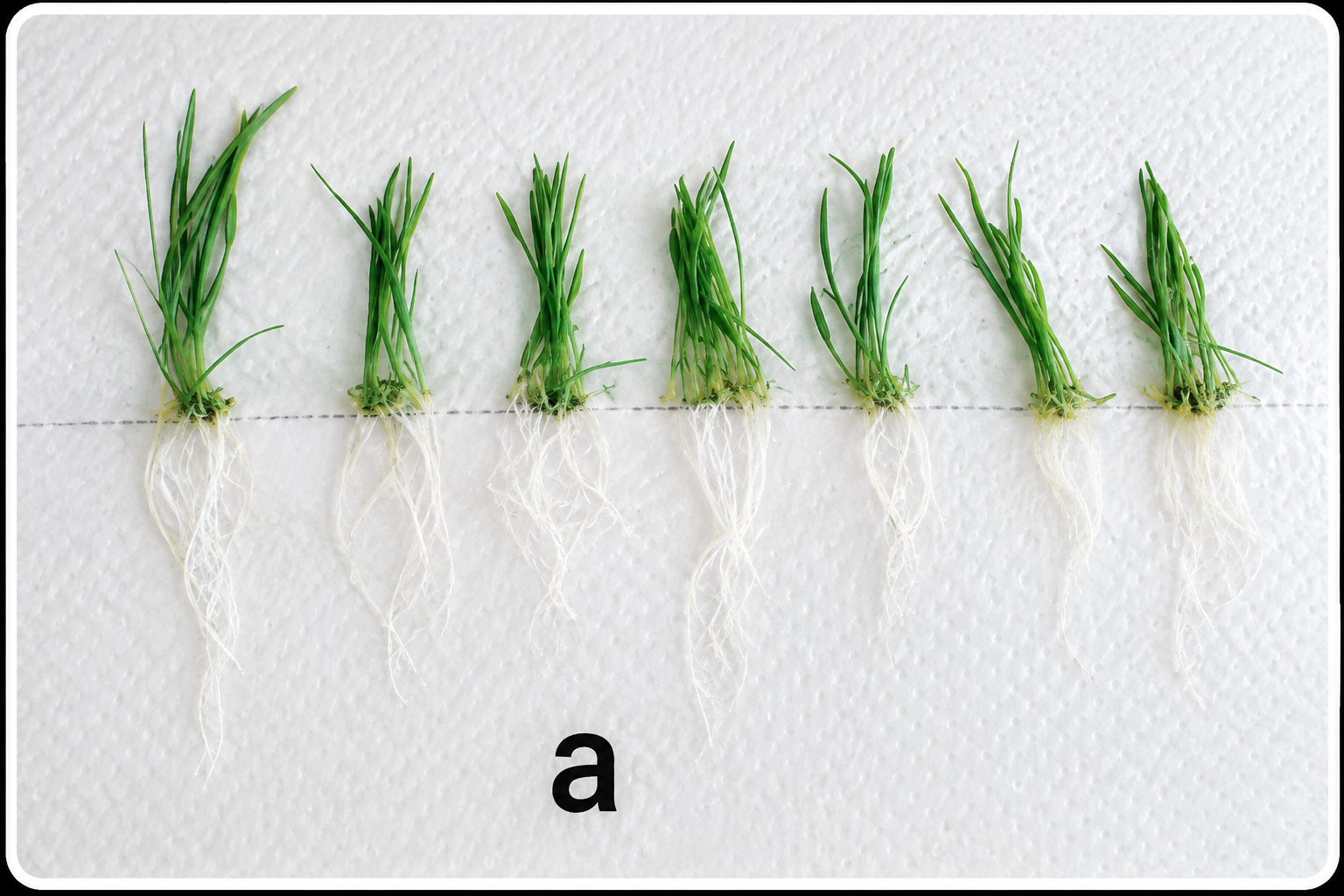
The influence of different concentrations of sodium chloride on the growth and development of bread wheat seedlings has been investigated. Seven productive bread wheat (Triticum aestivium L) genotypes (Gobustan, Leyagatli, Murov-2, Sheki-1, Mirbashir-128, Aghali, Bezostaya) were used as the investigation material. To study the effect of salt on bread wheat genotypes and their morphological growth, seeds were germinated in aqueous solutions of NaCl (0, 150, 200 mM) as an experimental variant and distilled water as a control using the paper roll method. Ten seeds of the each sample were kept on wet filter paper, at 20-22°C temperature, in the dark for 3 days and then germinated under 12h/12h (light/dark) photoperiod for 7 days. During 10 days, the response of wheat seedlings to salt stress, growth dynamics of the above- and underground organs (roots and seedlings) were studied and the varieties were compared according to the morphometric parameters. Germination energy and germination percentage were determined in 50 seeds of each variant of the studied genotypes on the 3rd and 7th day after germination, respectively. We found that 150 and 200 mM concentrations of NaCl have an inhibitory effect on the germination of seeds, growth of seedlings and root hairs of the studied bread wheat varieties. Mirbashir-128 was the most salt-tolerant genotype which could be used for developing more tolerant genotypes in breeding programs.
References
[1] S. Housmand, A. Arzani, S. Mirmohammadi-Maibody (2014).Effect of salinity and drought stress on grain quality of durum wheat. Commun. Soli Sci. And Plan., 45: 297-308.
[2] R. S.Yudina, I. N. Leonova, E. A. Salina, E. K. Khlestkina (2015). Alterations in salt-tolerance of bread wheat caused by the introgression of the genetic materials of Aegilops speltoides and Triticum timopheeii. Plant genetics and selection. (in Azeri).
[3] B. R. Stroganov, L. К. Klishev, R.А. Азимов (1989). Problems of plant salt-tolerance. Tashkent: FAN., p 184. (in Russian).
[4] G. V. Udovenco (1977). Plant salt-tolerance. p 215. (in Russian).
[5] V. V. Kuznetsov and N. I. Shevyakova (2010). Polyamines and plant adaptation to saline environment. Eds, K.G. Ramawat Desert plants. DOI-10.1007/978-3-642-02550-1_13, ISBN-978-3-642-02549-5 Springer – Verlag.
[6] А. Z. Shikhmuradov (2011). Tolerance of diploid wheat species to high NaCl content. South of Russia: Ecology, development. pp. 40-43 (in Russian).
[7] A. A. Belozerova and N. A. Bome (2014). Study of the reaction of spring wheat to salinity on the variability of morphometric parameters of seedlings. J. Fund. Res., 12: 300-306. (in Russian). (in Russian).
[8] R. T. Aliyev, M. A. Abbasov, V. R. Rahimli (2014). Stress and adaptation of plants. Baki – “Elm” – (in Azeri).
[9] D. Hasan, I. S. Kovtun, M. B.Yefimova (2011). Effect of chloride salinity on the germination of Canola (Brassica napus L.). Bulletin of the Tomsk State University. Biology, 4: 108-112. (in Russian).
Downloads
Published
Issue
Section
License
Copyright (c) 2016 Author (s)

This work is licensed under a Creative Commons Attribution-NonCommercial-NoDerivatives 4.0 International License.
Copyright © The Author(s). This is an open access article distributed under the terms of the Creative Commons Attribution-NonCommercial-NoDerivatives 4.0 International License (CC BY-NC-ND 4.0), which permits unrestricted non-commercial use, distribution, and reproduction in any medium, provided the original author(s) and source are properly credited, and the work is not modified or adapted.