Impact of Pelleting (Pre-storage) on the Germination Studies of two different Species of Ageing Bamboo Seeds
Keywords:
invigoration, membrane integrity, pelleting, seed quality, viabilityAbstract
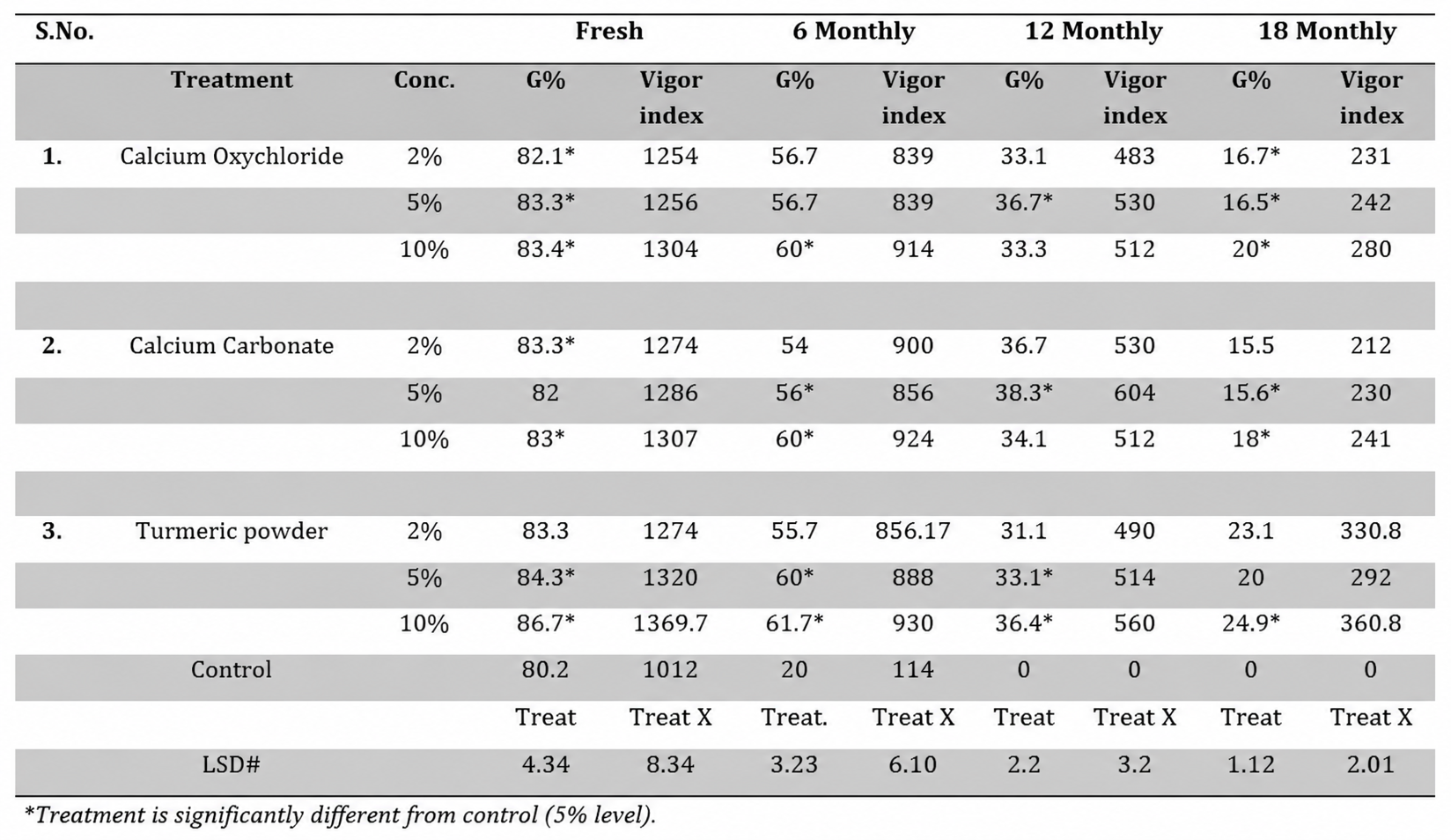
The effect of invigoration treatments of seed pelleting on various germination parameters of seeds of two bamboo species i.e. Dendrocalamus hamiltonii and Bambusa bambos have been studied for 18 months period. Our studies were directed to investigate the effectiveness of invigoration treatments on vigor and viability of seeds. During storage, treated seeds (Pre-storage seeds) were stored at controlled temperature and humidity (in desiccators at 4 °Celsius). Pelleting of seeds was done with Calcium oxychloride, Calcium carbonate and turmeric powder in both the species. Statistically, it was observed that pelleting with turmeric powder resulted in maximum germination percentage of 36.4 % and 24.9% over control at 12 and 18 months, respectively, which was zero in Dendrocalamus hamiltonii. In case of Bambusa bambos all the pelleting materials were effective but Calcium oxychloride was most effective in maintaining germination with maximum germination of 31.2% and 15.8% over control at 12 and 18 months, respectively which was zero after 12 months. Moreover, 10% concentration of turmeric powder in Dendrocalamus hamiltonii and 10% concentration of Calcium oxychloride in Bambusa bambos was statistically significant at 5% level in all the treatments for maintaining germination.
References
[1] Richa, M. L. Sharma, and N. Bala (2006). Studies on endogenous levels of plant growth hormones in relation to seed viability in some bamboo seeds. Indian J. Pl. Physiol., 11: 358-363.
[2] U. T. Aung and M. B. McDonald (1995). Changes in esterase activity associated with peanut (Arachis hypogeal L.) seed deterioration. Seed Sci. Technol., 23: 101-111.
[3] O. R. Chhetri, A. S. Rai and A. Bhattacharjee (1993). Chemical manipulation of seed longevity of four crop species in an unfavorable storage environment . Seed Sci. Technol., 21: 31-49.
[4] R. N. Basu (1994). An appraisal of research on wet and dry physiological seed treatments and their applicability with special reference to tropical and subtropical countries. Seed Sci. Technol., 22: 107-126.
[5] A. S. Rai, D. R. Chhetri and A. Bhatacharjee (1995). Influence of sodium-dikegulac on storage potential of selected seed species. Seed Sci. Technol., 23: 249-252.
[6] S. Maity, G. Banerjee, M. Roy, C. Pal, B. Pal, D. Chakarbarti and A. Bhattacharjee (2000). Chemical induced prolongation of seed viability and stress tolerance capacity of mung bean seedlings. Seed Sci. Technol., 28: 155-162.
[7] D. Chakrabarti, R. K. Das, U. K. Kanp and A. Bhattacharjee (2005). Chemical manipulation of seed viability and stress tolerance capacity of a horse gram cultivar. In: Stress Biology. U. Chakraborty and B. Chakraborty (Eds.), Narosa Publication House , New Delhi , pp.169-174.
[8] A. Ali, V. S. Machado and A. S. Hamil (1990). Osmo conditioning of tomato and onion seeds. Scientia Hort., 43: 213-224.
[9] A. S. Ahmed (1999). Effect of seed pelleting on field performance of black gram. Legume Res., 22: 109-112.
[10] S. Nargis and C. P. Thiagarajan (1991). Storage studies with pelleted seeds of tomato cv. PKM-1. South Indian Hort., 45: 181-183.
[11] I. Demir and H. A. Van De Venter (1999). Survival of watermelon (Citrullus lanatus (Thunb.) Matsum. and Nakai ) seeds at 40 degree Celsius prolonged by prior storage at 30 degree Celsius. Seed Sci. Res., 9: 259-261.
[12] T. Dogan and A. Zeybek (2009). Improving the traditional sesame seed planting with seed pelleting. African Journal of Biotechnology 8: 6120-6126.
[13] V. A. Tonpai (1988). Studies on the effect of foliar stress of maleic hydrizide on seed yield quality and seed treatment on storability in two cultivars of vegetable cowpea (Vigna uniquiculata L.) Mysore J. Agri. Sci., 22: 162-163.
[14] K. M. Parashivamurthy (1993). Role of chemical seed treatment on seed quality and longevity in soybean (Glycine max (L.) Merrill). M.Sc. (Agri.) Thesis, Uni. Agric. Sci. Dharwad, India.
Downloads
Published
Issue
Section
License
Copyright (c) 2016 Author (s)

This work is licensed under a Creative Commons Attribution-NonCommercial-NoDerivatives 4.0 International License.
Copyright © The Author(s). This is an open access article distributed under the terms of the Creative Commons Attribution-NonCommercial-NoDerivatives 4.0 International License (CC BY-NC-ND 4.0), which permits unrestricted non-commercial use, distribution, and reproduction in any medium, provided the original author(s) and source are properly credited, and the work is not modified or adapted.