Biopreservation of apple and pomegranate juice using bacteriocin of Lactobacillus acidophilus NCDC 343
Keywords:
bacteriocin, biopreservation, fruit juice, immobilization, Lactobacillus acidophilus NCDC 343Abstract
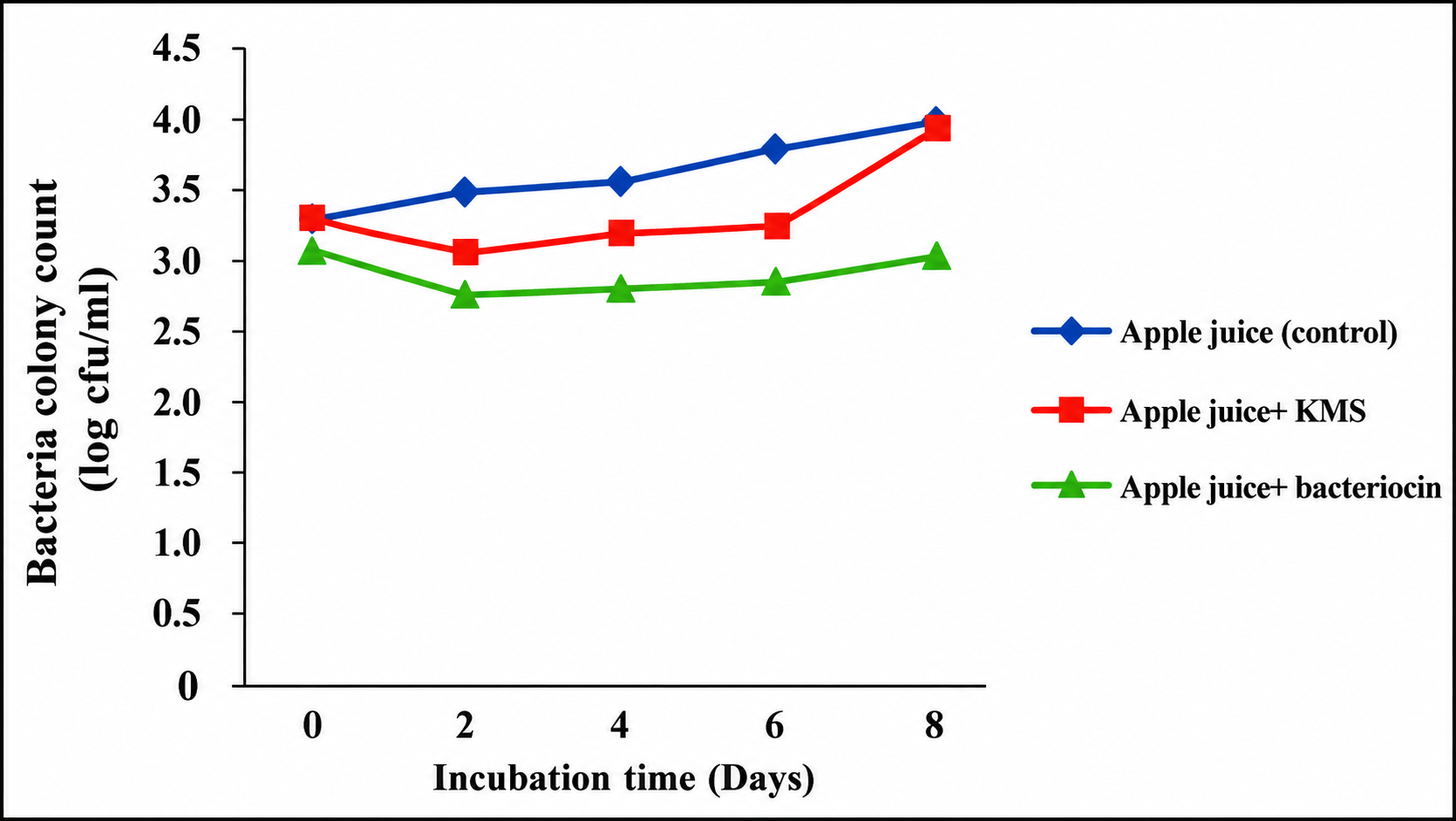
Bacteriocins are antimicrobial metabolites produced by lactic acid bacteria, which are being used as additives to prevent microbial spoilage of food items. Bacteriocins in free form are degraded by the enzymes present in the fruit juices. Encapsulation matrix protects the bacteriocin from food components. The present study was designed to elucidate the effectiveness of calcium alginate entrapped bacteriocin of Lactobacillus acidophilus in preservation of fruit juices. Calcium alginate gel was chosen as immobilization matrix because it is cheap, abundant and bio safe. Bacteriocin of Lactobacillus acidophilus NCDC 343 showed wide spectrum of antimicrobial activity against pathogenic and food spoilage microorganisms. It inhibited the growth of Staphylococcus aureus, Erwinia sp., Bacillus subtilis, Pseudomonas fluorescens, Leuconostoc mesenteroids and Listeria monocytogenes. Immobilized bacteriocin treatment resulted in maximum reduction of bacterial population in apple and pomegranate juice as compared to chemical preservative at 37˚C. Calcium alginate entrapped bacteriocin proved to be better and safe preservative as compared to chemical preservatives in fruit juices.
References
[1] K. R. Aneja, R. Dhiman, N. R. Aggarwal, V. Kumar and M. Kaur (2014). Microbes Associated with Freshly Prepared Juices of Citrus and Carrots. Int. J. Food Sci., Article ID 408085, 7 pages, 2014. doi:10.1155/2014/408085.
[2] J. M. Melgar, R. M. Raybaudi-Massilia and O. Martın-Belloso (2012). Microbiological shelf life and sensory evaluation of fruit juices treated by high intensity electric fields and antimicrobials. Food Bioprod. Process., 90: 205-214.
[3]. L. Gram, L. Ravn, M. Rasch, J. B. Bruhn, A. B. Christensen and M. Givskov (2002). Food spoilage- interactions between food spoilage bacteria. Int. J. Food Microbiol., 78: 79-97.
[4] K. A. Lawlor, J. D. Schuman, P. G. Simpson and P. J. Taormina (2009). Microbiological spoilage of beverages. W. H. Sperber and M. P. Doyle (ed.), Springer, pp. 245-284.
[5] R. M. Massilia, J. Mosqueda-Melgar, R. Soliva-Fortuny and O. Martin-Belloso (2009). Control of pathogenic and spoilage microorganisms in fresh-cut fruits and fruit juices by traditional and alternative natural antimicrobials. Comp. Rev. Food Sci. Food Safety, 8:157-180.
[6] J. Kuldiloke and M. N. Eshtiaghi (2008). Application of non-thermal processing for preservation of orange juice. KMITL Sci. Technol. J., 8: 64-74.
[7] M. Walker and C. A. Phillips (2008). The effect of preservatives on Alicyclobacillus acidoterrestris and Propionibacterium cyclohexanicum in fruit juice. Food Control., 19: 974-981.
[8] A. A. L. Tribst, A. DeS. SantAna and P. R. DeMassaguer (2009). Review: Microbiological quality and safety of fruit juices past, present and future perspectives. Crit. Rev. Microbiol., 35: 310-339.
[9] J. Meyer-Nissen and I. F. Nes (1997). Ribosomally synthesized antimicrobial peptides: their function, structure, biogenesis, and mechanism of action. Arch. Microbiol., 167: 67-77.
[10] P. M. Muriana and T. R. Klaenhammer (1991). Purification and partial characterization of lactacin F, a bacteriocin produced by Lactobacillus acidophilus 11088. Appl. Environ. Microbiol., 57: 144-121.
[11] S. D. Torodov and L. M. T. Dicks (2004). Effect of medium components on bacteriocin production by Lactobacillus pentosus ST151BR, a strain isolated from beer produced by the fermentation of maize, barley and soy flour. World J. Microbiol. Biotechnol., 20: 643-650.
[12] A. Caridi (2002). Selection of Escherichia coli inhibiting strains of Lactobacillus paracasei subsp. paracasei. J. Ind. Microbiol. Biotechnol., 29: 303-308.
[13] V. Miteva, T. Stefanova, I. Budakov, I. Ivanova, V. Mitev, A. Gancheva and M. Ljubenov (1998). Characterization of bacteriocins produced by strains from traditional Bulgarian dairy products. Syst. Appl. Microbiol. 21: 151- 161.
[14] E. Komitopoulo, I. S. Boziaris, E. A. Vavies, J. Delves-Broughton and M. R. Adams (1999). Alicyclobacillus acidoterrestris in fruit juicea and its control by nisin. Int. J. Food Sci. Technol., 34: 81-85.
[15] M .J. G. Burgos, R. P. Pulido, M. D. C. L. Aguayo, A. Galvez, and R. Lucas (2014). The Cyclic Antibacterial Peptide Enterocin AS-48:Isolation, Mode of Action, and Possible Food Applications. Int. J. Mol. Sci., 15: 22706-22727.
[16] J. Pei, T. Yue and Y. Yuan (2014). Control of Alicyclobacillus acidoterrestris in fruit juices by a newly discovered bacteriocin. World J. Microbiol. Biotechnol., 30: 855-863.
[17] V. K. Joshi, S. Sharma and N. S. Rana (2006). Production, purification, stability and efficacy of bacteriocin from isolates of natural Lactic acid fermentation of vegetables. Food Technol. Biotechnol., 44: 435-439.
[18] O. H. Lowry, N. J. Rosebrough, N. L. Farr and R. J. Randall (1951). Protein measurement with the Folin phenol reagent. J. Biol. Chem., 193: 265-273.
[19] H. P. Fleming, J. L. Etchells and R. L. Costilow (1985). Microbial inhibition by an isolate of Pediococcus from cucumber brins. Appl. Microbiol., 30: 1040-1042.
[20] H. S. Hermes and R. Narayani (2002). Polymeric alginate films and alginate beads for the controlled delivery of macromolecules. Trends Biomater. Artif. Organs, 15: 54-56.
[21] A. Bhatia, P. Rana, A. Sharma, R. Singla and M. K. Randhawa (2012). Preparation, characterization and hypocholesterolemic effect of sodium alginate encapsulated lab isolate. J. Microbiol. Biotech. Res., 2: 741-746.
[22] G. M. Vignolo, M. N. de-Kairuz, A. A. P. de-R. Holgado and G. Oliver (1995). Influence of growth conditions on the production of lactocin 705, a bacteriocin produced by Lactobacillus casei CRL 705. J. Appl. Microbiol., 78: 5-10.
[23] L. V. Thomas, M. R. Clarkson and B. J. Delves (2000). Nisin. A. S. Naidu (ed.), CRC Press, Boca-Raton, pp. 463-524.
[24]. K. Yamazaki, M. Murami, Y. Kawai, N. Inoue and T. Matsuda (2000). Use of nisin for inhibition of Alicyclobacillus acidoterrestris in acidic drinks. Food Microbiol., 17: 210-315.
[25]. A. Pratush, A. Gupta, A. Kumar and G. Vyas (2012). Application of purified bacteriocin produced by Lactococcus lactis AP2 as food biopreservatives in acidic foods. Annals Food Sci. Technol., 13: 82-87.
[26] I. M. Aasen , S. Markussen, T. Moretro, T. Katla, L. Axelsson and K. Naterstad (2003). Interactions of the bacteriocins sakacin P and nisin with food constituents. Int. J. Food Microbiol., 87: 35-43.
[27] J. Cleveland, T. J. Montville, I. F. Nes and M. L. Chikindas (2001). Bacteriocins: Safe, natural antimicrobials for food preservation. Int. J. Food Microbiol., 71: 1-20.
Downloads
Published
Issue
Section
License
Copyright (c) 2016 Author (s)

This work is licensed under a Creative Commons Attribution-NonCommercial-NoDerivatives 4.0 International License.
Copyright © The Author(s). This is an open access article distributed under the terms of the Creative Commons Attribution-NonCommercial-NoDerivatives 4.0 International License (CC BY-NC-ND 4.0), which permits unrestricted non-commercial use, distribution, and reproduction in any medium, provided the original author(s) and source are properly credited, and the work is not modified or adapted.