Evaluation of total Phenol, Flavonoid and Anthocyanin Content in Different Varieties of Eggplant
Keywords:
anthocyanin, eggplant, flavonoid, phenolAbstract
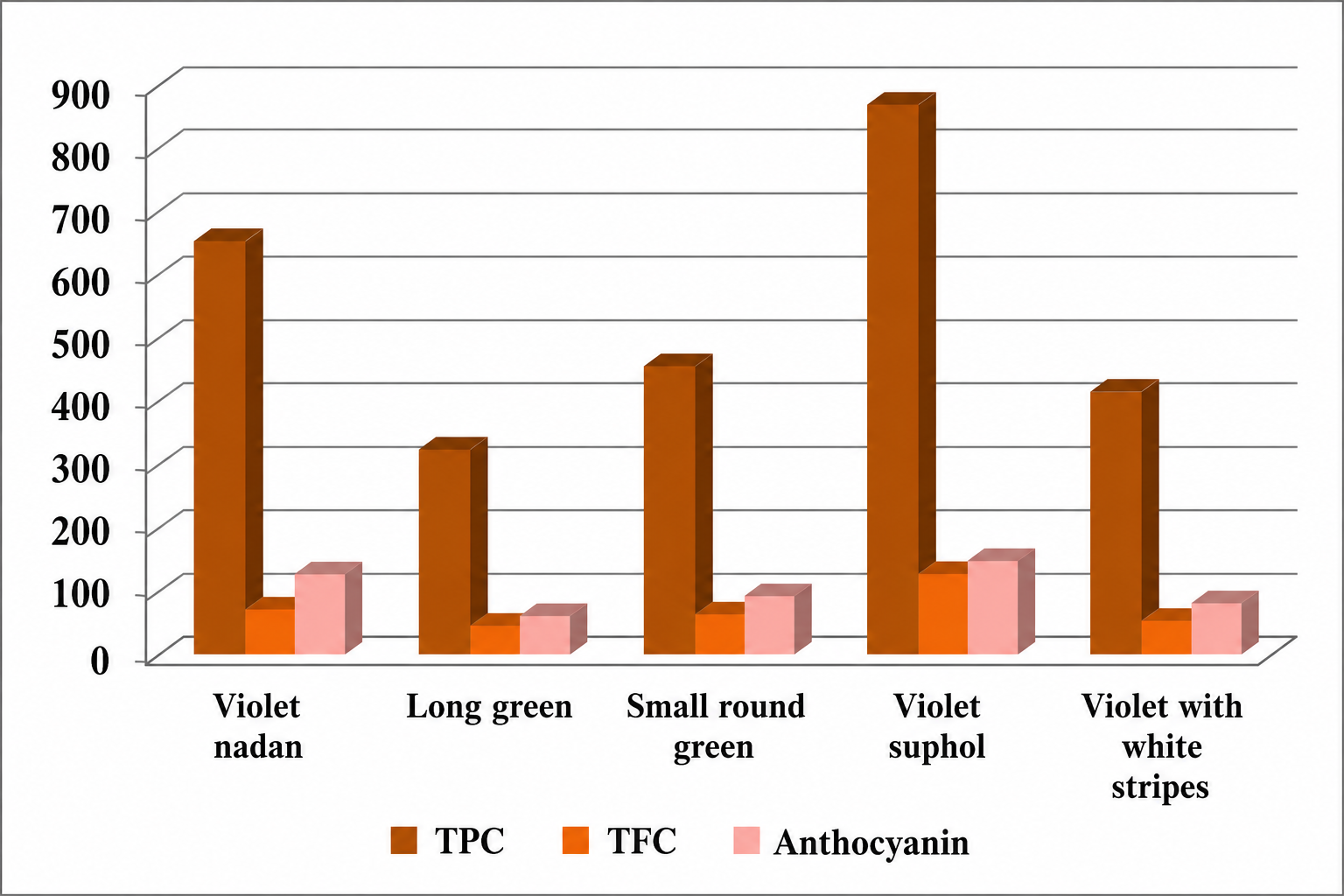
Eggplant or brinjal (Solanum melongena) fruit is known as vegetables of diet food because of high moisture content and low coloristic value. Eggplant is endowed with nutrients as other plants. The eggplant fruit possess medicinal properties because of the presence of phyto-chemicals which attributes to its anti-carcinogenic activity. In this study, five eggplants genotypes (violet nadan, long green, small round green, violet suphol and violet with white stripes) were evaluated for total phenolic activity, total flavonoid activity and anthocyanin activity. The results showed that the total phenolic and flavonoid values of eggplant varieties extract varied from 856.76 to 386.75 gallic acid equivalents mg/100 g extract and total flavonoid content from 102.01 to 22.62 catechin equivalents mg/100 g extract Violet suphol which contained high total phenolic and flavonoid content had better anthocyanin value as compared (129.29 mg/gm) to other varieties. Vegetables provide the body, an added source of antioxidants to fight against free radicals.
References
[1] C. Guohua, E. Sofic, and R. L. Prior (1996). Antioxidant capacity of tea and common vegetables. J. Agric. Food Chem., 44: 3426-3431.
[2] D. Huang, B. Ou and R. L. Prior (2005). The Chemistry behind Antioxidant Capacity Assays. J. Agric. Food Chem., 53: 1841-1856.
[3] Y. Noda, T. Kaneyuki, K. Igarashi, A. Mori and L. Packer (2000). Antioxidant activity of nasunin, an anthocyanin in eggplant peels. Toxicology, 148: 119-123.
[4] T. Kaneyuki, Y. Noda, M. G. Traber, A. Mori and L. Packer (1999). Superoxide anion and hydroxyl radical scavenging activities of vegetable extracts measured using electron spin resonance. Biochem. Mol. Biol. Int., 47: 979-989.
[5] M. Liu, X. Q. Li, C. Weber, C. Y. Lee, J. Brown and R. H. Liu (2002). Antioxidant and antiproliferative activities of raspberry. J. Agric. Food Chem., 50: 2926-2930.
[6] J. Prohens, A. Rodríguez-Burruezo, M. D. Raigón and F. Nuez (2007). Total Phenolic Concentration and Browning Susceptibility in a Collection of Different Varietal Types and Hybrids of Eggplant: Implications for Breeding for Higher Nutritional Quality and Reduced Browning. J. Am. Soc. Hortic. Sci., 132: 638-646.
[7] A. P. Singh, D. Luthria, T. Wilson, N. Vorsa, V. Singh, G. S. Banuelos and S. Pasakdee (2009). Polyphenols content and antioxidant capacity of eggplant pulp. Food Chem., 114: 955- 961.
[8] M. Bimakr, R. A. Rahman, F. S. Taip, A. Ganjloo., L. M. Salleh., J. Selamat., A. Hamid and I. S. M. Zaidul (2011). Comparison of different extraction methods for the extraction of major bioactive flavonoid compounds from spearmint (Menthaspicata L.) leaves. Food Bioprod. Process., 89: 67-72.
[9] J. B. Harborne (1998). Phenolic compounds in phytochemical methods a guide to modern techniques of plant analysis. Third edition. Chapman and Hall, New York, 66-74.
[10] G. Flores, D. L. P. Moreno F., G. P. Blanch, D. Castillo M. L. (2014).Phenylalanine ammonia-lyase, flavanone 3b-hydroxylase and flavonol synthase enzyme activity by a new in vitro assay method in berry fruits Food Chem., 153: 130-133.
Downloads
Published
Issue
Section
License
Copyright (c) 2016 Author (s)

This work is licensed under a Creative Commons Attribution-NonCommercial-NoDerivatives 4.0 International License.
Copyright © The Author(s). This is an open access article distributed under the terms of the Creative Commons Attribution-NonCommercial-NoDerivatives 4.0 International License (CC BY-NC-ND 4.0), which permits unrestricted non-commercial use, distribution, and reproduction in any medium, provided the original author(s) and source are properly credited, and the work is not modified or adapted.