Esters from castor oil: interfering with the salivary gland secretory cycle of Rhipicephalus sanguineus ticks (Acari: Ixodidae)
Keywords:
alternative control, castor oil, esters, salivary glands, ticksAbstract
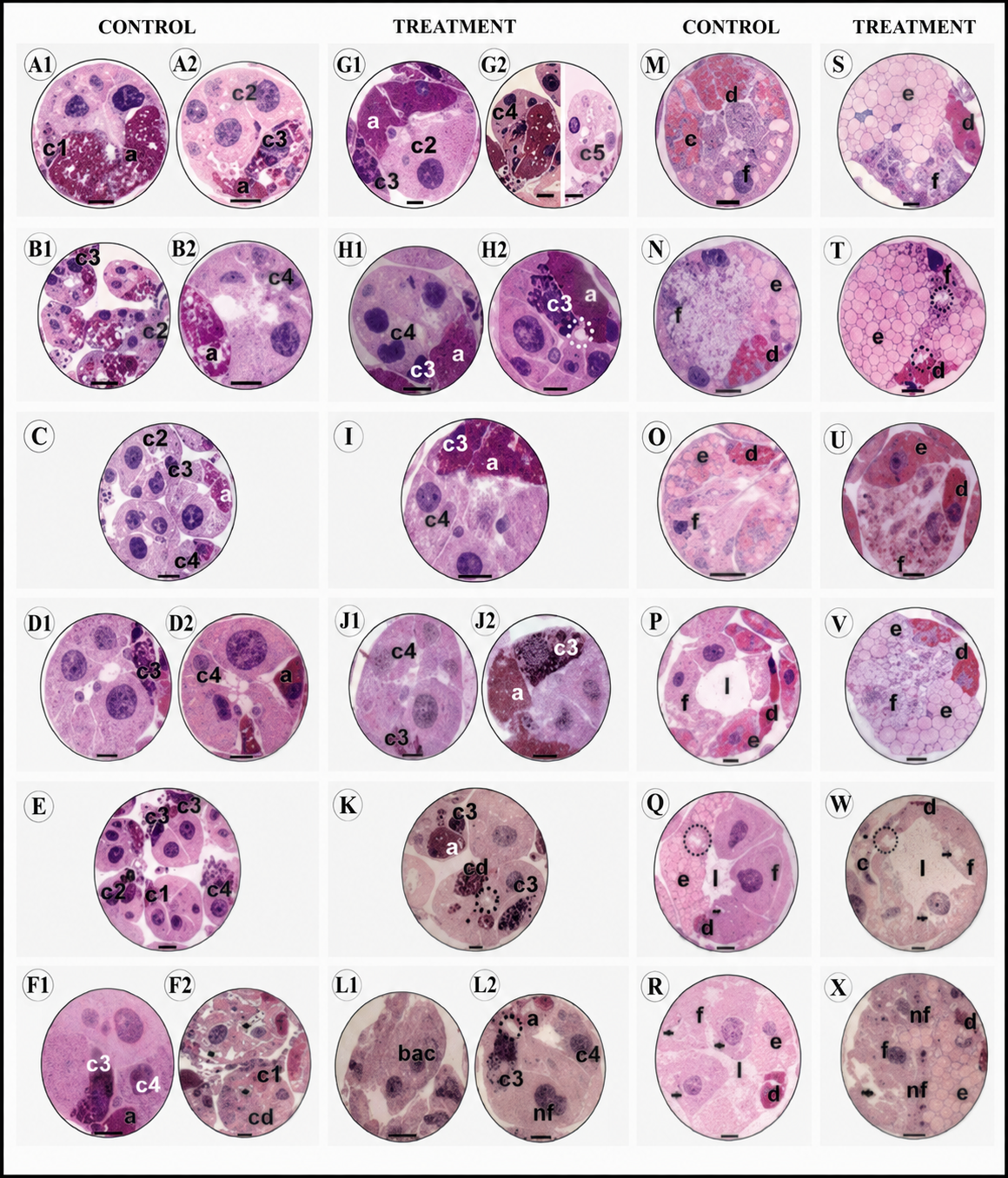
The medical-veterinary importance of ticks has long been recognized and studies on the internal morphology and histology of the organs and systems in these ectoparasites have been considered of great relevance. The tick Riphicephalus sanguineus sensu lato (s.l.) is particularly important, considering its proximity to the human being. The present study investigated that how ricinoleic acid esters from castor oil interfere with the secretory cycle of the salivary glands in R. sanguineus s.l. females fed for a period of 1 to 6 days. To accomplish the objectives, females were fed on both, the rabbits fed with the food enriched in esters and on the rabbits fed with regular rabbit commercial food. The results showed that the salivary glands had changes in its secretory cycle, varying according to the considered acinus, leading to a precocious degeneration of the gland caused by the exposure of the hosts to the esters. Another important data obtained was that the esters did not interfere in the metabolism of the hosts (rabbits) and thus, the results signalize the perspective of a new strategy to effectively control these ectoparasites.
References
[1] F. Dantas-Torres (2010). Biology and ecology of the brown dog tick, Rhipicephalus sanguineus. Parasite. Vector, 3: 26. doi: 10.1186/1756-3305-3-26.
[2] D. E. Sonenshine and R. M. Roe (2014). Biology of ticks. Oxford University Press, New York, USA.
[3] A. L. Ribeiro, J. L. H. Faccini and E. Daemon (1996). Estudo das variações morfológicas de Rhipicephalus sanguineus (Latreille, 1806) (Acari: Ixodidae) no Brasil. Revista da Universidade Federal Rural - Série Ciências da Vida., 18: 25-33.
[4] A. Walker (1994). Arthropods of domestic animals. A guide to preliminary identification. Chapman and Hall, London, UK.
[5] G. F. Paz, R. C. Leite and P. R. Oliveira (2008). Controle de Rhipicephalus sanguineus (Latreille, 1806) (Acari: Ixodidae) no canil da Escola de Veterinária da UFMG, Belo Horizonte, Minas Gerais, Brasil. Rev. Bras. Par. Vet., 17: 41-44.
[6] M. A. Clemente, F. T. Gomes, A. C. B. S. Scotton, M. S. Goldner, E. S. Dos Reis and M. N. De Almeida (2007). Avaliação do Potencial de Plantas Medicinais no Controle de Boophilus microplus (Acari: Ixodidae). Rev. Bras. Biociências., 5: 516-518.
[7] C. J. Olivo, N. Madruga De Carvalho, J. H. S. Da Silva, F. F. Vogel, P. Massario and G. Meinerz et al., (2008). Óleo de citronela no controle do carrapato de bovinos. Ciência Rural., 38: 406-410.
[8] A. Arnosti, P. D. Brienza, K. C. S. Furquim, G. O. Chierice, G. H. Bechara and I. B. Calligaris et al., (2011). Effects of ricinoleic acid esters from castor oil of Ricinus communis on the vitellogenesis of Rhipicephalus sanguineus (Latreille, 1806) (Acari: Ixodidae) ticks. Exp. Parasitol., 127: 575-580.
[9] A. Arnosti, P. D. Brienza, K. C. S. Furquim, G. O. Chierice, S. C. Neto and G. H. Bechara (2011). Effects of Ricinus communis oil esters on salivary glands of Rhipicephalus sanguineus (Latreille, 1806) (Acari: Ixodidae). Exp. Parasitol., 127: 569-574.
[10] B. R. Sampieri, A. Arnosti, K. C. S. Furquim, G. O. Chierice, G. H. Bechara and P. L. P. F. De Carvalho (2012). Effect of ricinoleic acid esters from castor oil (Ricinus communis) on the oocyte yolk components of the tick Rhipicephalus sanguineus (Latreille, 1806) (Acari: Ixodidae). Vet. Par., 191: 315-322.
[11] B. R. Sampieri, A. Arnosti, P. H. Nunes, K. C. S. Furquim, G. O. Chierice and M. I. Camargo- Mathias (2012). Ultrastructural changes in the ovary cells of engorged Rhipicephalus sanguineus female ticks treated with esters of ricinoleic acid from castor oil (Ricinus communis). Microsc. Res. Techniq., 75: 683-690.
[12] B. R. Sampieri, K. C. S. Furquim, P. H. Nunes and M. I. Camargo-Mathias (2013). Rhipicephalus sanguineus (Acari: Ixodidae) female ticks exposed to castor oil (Ricinus communis): an ultrastructural overview. Parasitol. Res., 112: 611-619.
[13] L. C. U. Junqueira and L. M. M. S. Junqueira (1983). Técnicas básicas de citologia e histologia. p. 48-81. Editora Santos, São Paulo, Brazil.
[14] M. A. Messetti, A. M. Santos, D. F. Angelis, G. O. Chierice and S. C. Neto (2010). Estudo dos derivados do óleo de Ricinus communis L. (Mamona) como agente biocida e redutor da viscosidade produzida por Leuconostoc mesenteroides em indústrias sucroalcooleiras. Arq. Inst. Biol., 77: 301-308.
[15] K. C. Binnington (1978). Sequential changes in salivary gland structure during attachment and feeding of the cattle tick Boophilus microplus. Int. J. Parasitol., 8: 97-115.
[16] A. Walker, J. D. Fletcher and H. S. Gill (1985). Structural and histochemical changes in the salivary glands of Rhipicephalus appendiculatus during feeding. Inter. J. Parasitol. 15: 81-100.
[17] S. K. Wikel (1981). The induction of host resistance to tick infestation with a salivary gland antigen. Am. J. Trop. Med. Hyg., 30: 284-288.
[18] K. C. S. Furquim (2007). Estudo das Glândulas Salivares de Fêmeas e de Machos de Carrapato Rhipicephalus sanguineus (LATREILLE,1806) (ACARI, IXODIDAE): Caracterização do Ciclo Secretor com Ênfase no Processo de Degeneração. (thesis), UNESP, Brazil.
[19] D. W. Fawcett, K. C. Binnington, and W. R. Voight (1986). The cell biology of the ixodid tick salivary gland. In Morphology, Physiology and Behavioral Biology of Ticks (ed. Sauer J. R., Hair, J. A.), pp. 22-45. Ellis Horwood Ltd, Herts, UK.
[20] L. B. Coons and W. J. Lamoreaux (1986). Developmental changes in the salivary glands of male and female Dermacentor variabilis (Say) during feeding. In D. Borovsky, A. Spielman (eds.), University of Florida-IFAS, pp. 86-92.
[21] S. E. Denardi, K. C. S. Furquim, G. H. Bechara and M. I. Camargo-Mathias (2011). Salivary glands of Amblyomma cajennense (Acari: Ixodidae): a histological and an ultrastructural overview. Exp. Appl. Acarol., 54: 177-189.
[22] K. C. S. Furquim, G. H. Bechara and M. I. Camargo-Mathias (2008). Death by apoptosis in salivary glands of females of the ticks Rhipicephalus sanguineus (Latreille, 1806) (Acari: Ixodidae). Exp. Parasitol., 119: 152-163.
Downloads
Published
Issue
Section
License
Copyright (c) 2016 Author (s)

This work is licensed under a Creative Commons Attribution-NonCommercial-NoDerivatives 4.0 International License.
Copyright © The Author(s). This is an open access article distributed under the terms of the Creative Commons Attribution-NonCommercial-NoDerivatives 4.0 International License (CC BY-NC-ND 4.0), which permits unrestricted non-commercial use, distribution, and reproduction in any medium, provided the original author(s) and source are properly credited, and the work is not modified or adapted.