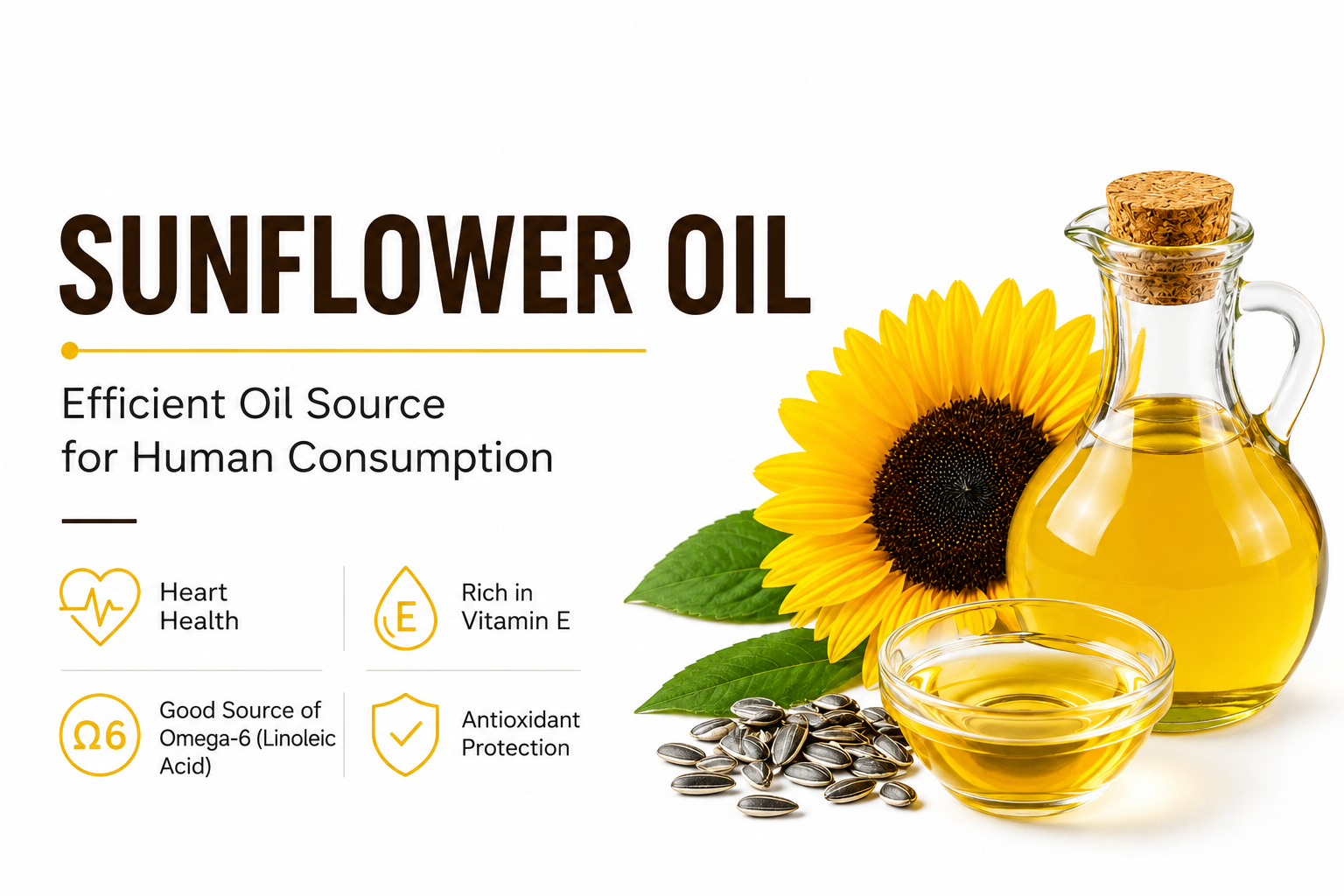
Sunflower Oil: Efficient Oil Source for Human Consumption
Keywords:
Oil crops, Sunflower, Fatty acids, Human dietAbstract
Oil crops are well distinguished for supplying protein and energy in human diet (Mehran et al. 2011). Sunflower (Helianthus annuus) is a significant crop possessing 15-21% protein and 50% oil content (Ayeen 1996). It holds second position in the world in edible oil manufacturing following soyabean oil (Nandha et al. 2014) and grouped among preeminent plant oils for human diet due to its nutritional worth (Skoric et al. 2008). Its seeds provide considerable amount of vitamins, minerals and tocopherols (Skoric 2009) and found to be rich in minerals like magnesium, iron, copper, calcium, zinc, sodium, potassium, phosphorus, selenium and manganese (Nandha et al. 2014). Regular sunflower oil contains 69% linoleic acid, 20% oleic acid and 11% saturated fatty acids, but a number of strategies have been adopted to present advance range of sunflower oils with elevated oleic acid, stearic acid, linoleic acid, palmitic acid and low saturated acid.
References
A. Ayeen (1996). MSc Thesis of Agronomy, Shiraz University (Shiraz, Iran, 1996). (In Farsi).
A. Dutta and S.K. Dutta (2003). Vitamin E and its role in the prevention of atherosclerosis and carcinogenesis: a review. J. Am. Coll. Nutr., 22: 258-268.
D. Mozaffarian, M.B. Katan, A. Ascherio, P.H, M.J. Stampfer, P.H and W.C. Willet (2006). Trans Fatty Acids and Cardiovascular Disease. N. Engl. J. Med., 354: 1601-1613.
D. Skoric (2009). Possible uses of sunflower in proper human nutrition. Med. Pregl. 62: 105-110.
D. Skoric, S. Jocic, Z. Sakac and N. Lecic (2008). Genetic possibilities for altering sunflower oil quality to obtain novel oils. Can. J. Physiol. Pharmacol., 86: 215-221.
E.C. Campbell, A.J. Gerdes, T.R. Tiffany and A.D Midland (1999, 2000, 2001). Midland NuSun Frying Stability, In Proceedings of the 21st, 22nd, 23rd, Sunflower Research Workshop, January. National Sunflower Association, Bismarck, ND.
K. Chowdhury, L.A. Banu, S. Khan and A Latif (2007). Studies on the Fatty Acid Composition of Edible Oil. Bangladesh J. Sci. Ind. Res., 42: 311-316.
Kleingartner et al. (2002). NuSun, the New Face of U.S. Sunflower Oil. Cereal Foods World. March.
R.P. Mensink, P.L. Zock, A.D. Kester and M.B. Katan (2003). Effects of dietary fatty acids and carbohydrates on the ratio of serum total to HDL cholesterol and on serum lipids and apolipoproteins: a meta-analysis of 60 controlled trials. Am. J. Clin. Nutr., 77: 1146-1155.
R. Nandha, H. Singh, K. Garg and S. Rani (2014). A review on “Therapeutic potential of Sunflower seeds”. Int. J. Res. Dev. Pharm. L. Sci., 3: 967-972.
U. Singh, S. Devaraj and I. Jialal (2005). Vitamin E, oxidative stress, and inflammation. Annu. Rev. Nutr., 25: 151-174.
W.H. Morrison, R.J. Hamilton and C Kaln (1995). Sunflower seed oil. In: Developments in Oils and Fats, (RJ Hamilton ed.), pp. 132–51. Blackie Academic and Professional, Glasgow.
WHO/FAO Expert Consultation. Diet, nutrition and the prevention of chronic diseases. Geneva, Switzerland: World Health Organization; (2003). Available at: http://www.who.int/hpr/NPH/docs/who_fao_expert_report.pdf
Downloads
Published
Issue
Section
License
Copyright (c) 2015 Author (s)

This work is licensed under a Creative Commons Attribution-NonCommercial-NoDerivatives 4.0 International License.
Copyright © The Author(s). This is an open access article distributed under the terms of the Creative Commons Attribution-NonCommercial-NoDerivatives 4.0 International License (CC BY-NC-ND 4.0), which permits unrestricted non-commercial use, distribution, and reproduction in any medium, provided the original author(s) and source are properly credited, and the work is not modified or adapted.